Main

March 4, 2012

Second Avenue Subway by 2016 ?


Will the subway keep digging to downtown NY ?

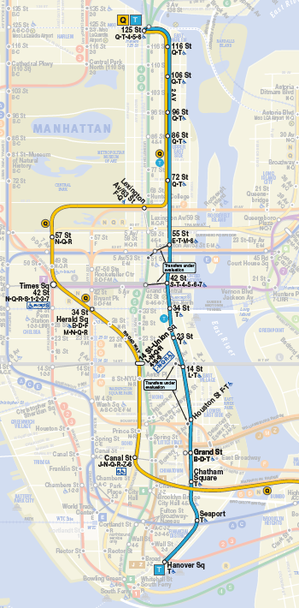
MTA_sas_map_lg.png

Second Avenue Subway project will include a two-track line along Second Avenue from 125th Street to the Financial District in Lower Manhattan. It will also include a connection from Second Avenue through the 63rd Street tunnel to existing tracks for service to West Midtown and Brooklyn.

construction updates.


July 2, 2011

Cars are 38 times bigger than people


Zurich's 's chief traffic planner, Andy Fellmann calculated that a person using a car took up 115 cubic meters (roughly 4,000 cubic feet) of urban space in Zurich while a pedestrian took three. "So it's not really fair to everyone else if you take the car," he said.

June 13, 2011

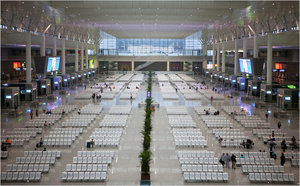
Shanghai Hongqiao


Shanghai Hongqiao train station is brighter, cleaner than Penn.

Railjp_Hongqiao_Shanghai.jpg

April 12, 2011

Why can't American airports have public transport like this?


Kuala Lumpur, Tokyo-Narita and Shanghai are among other spots in Asia with similar railway links. And this is where it gets depressing. Why can't American airports have public transport like this? Even our most expensive efforts are half-assed by comparison. Compare the best of Asia with, for example, my hometown airport, Boston-Logan. My commute to the airport by public transportation takes almost an hour and requires two changes, including a ride on the Silver Line bus, which, in addition to being at the mercy of automobile traffic, requires, at one point, that the driver step out and manually switch power sources to the bus.

Or how about JFK, where for hundreds of millions of dollars they finally got the AirTrain completed -- an inter-terminal rail loop that can't take you beyond the Queens subway. Heck, it can take 45 minutes, up and down a byzantine array of escalators, elevators and passageways, just to get from one terminal to another, let alone all the way to Manhattan. The distance from Shanghai airport to the city is about 20 miles -- roughly the mileage from JFK to midtown. Shanghai's bullet train covers this distance in seven minutes.

Continue reading "Why can't American airports have public transport like this?" »

April 10, 2011

Regional Rail passengers are a different breed of rider


Frequent rail passenger Douglas Diehl of Drexel Hill said he could envision riding free from Trenton on SEPTA's train and then returning on the cheaper NJ Transit River Line. He said he got conflicting answers from SEPTA representatives Friday about that possibility. And Diehl said rail passengers would not be happy with the proposed gates in Center City stations.

"Regional Rail passengers are a different breed of rider," he said. "And now SEPTA is going to treat them like subway riders and make them go through turnstiles?"

SEPTA's chief of new payment technologies, John McGee, said the Regional Rail changes were not firm.

[ Via Atrios ]

November 19, 2010

Flushing 0, Secaucus 1


The Flushing station is a grimy, crowded subway stop that has been around for about 70 years and handles an average of 57,753 trips through its turnstiles every weekday in an exercise that closely resembles a subterranean running of the bulls, but performed on stairways.

Secaucus Junction, which saw about 19,360 trips each weekday this spring, is a young station, less than 10 years old, that can best be characterized as civilized. It has a soaring central atrium that floods the sand-colored terminal with natural light. Its official name is the Frank R. Lautenberg Rail Station at Secaucus Junction, named for the longtime Democratic senator who was the station's patron and whose name is emblazoned in enormous lettering inside and outside.

The station is a main transfer point for several New Jersey Transit lines, with trains from throughout the state feeding passengers into Manhattan.

Still, during the morning rush, there is plenty of room to spread out, trot for a coming train or even sit on one of the wooden benches that surround a giant, shimmering sculpture of a cattail made of steel and glass.

Even the bathrooms are clean.

Real estate interests like the plan.

Continue reading "Flushing 0, Secaucus 1" »

October 30, 2010

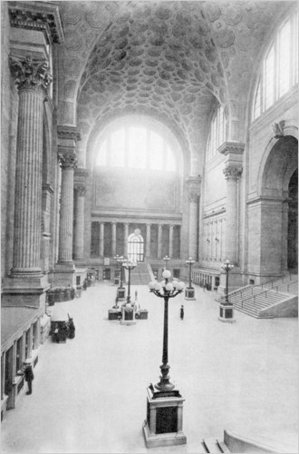
Penn Station, 1910


The main waiting room of Pennsylvania Station, 1910.

PennSt1910.jpg

More: NY, transit.

Continue reading "Penn Station, 1910" »

October 25, 2010

Rail line adds more to home values than it costs


WHAT is the real estate value of a one-seat train ride to Manhattan from a station close to one's home in New Jersey ? Leave it to statisticians to come up with a figure.

"It has to be a lot," said Perri K. Feldman of Keller Williams Realty, who has built a client base in towns along a section of the New Jersey Transit Midtown Direct line running from Morristown to South Orange. "It's the first question so many people ask about a house: 'How close is it to the train? Can I walk to the station?' "

Now, the extra value that comes with proximity to a station with direct service to Manhattan -- no transfer required -- has been quantified: $19,000, on average, for homes within two miles of a station; $29,000 for houses within half a mile.

Home values would increase by those amounts in neighborhoods surrounding 10 New Jersey Transit lines and 2 Metro-North Railroad lines if a third rail tunnel under the Hudson River was ever built, according to a study by the independent Regional Plan Association.

Statisticians worked backwards, analyzing the impact on real estate value when previous rail-improvement projects were done, to project the impact that a new tunnel would have on home values.

The cumulative increase in property value would be $18 billion, according to the study, which was published two months before Gov. Christopher J. Christie of New Jersey decided to suspend work on the tunnel as of Oct. 7. Senator Frank R. Lautenberg, a tunnel supporter, has worked to publicize the findings.

Mr. Christie says the state should not proceed with the $8.7 billion project, because it cannot afford to pay for any cost overruns. He cited a recent study by his transit officials, which predicted that the project could end up $2 billion to $5 billion over budget.

The original cost of the tunnel was to be financed this way: $3 billion from the federal government, $3 billion from the Port Authority of New York and New Jersey, and $2.7 billion from the State of New Jersey (mostly in the form of Turnpike receipts).

In the study of the tunnel's potential effects, researchers estimated that the $18 billion in increased property value would generate $375 million in increased tax revenues per year.

Some local and county politicians -- in addition to Mr. Lautenberg -- have argued that municipalities cannot stand to "lose" those potential tax revenues, which would presumably start flowing in 2017, after the project was completed. Others have called the tax receipt estimates "fictional," and contended that they were too far in the future to matter now, in the midst of a statewide budget crisis.

The calculations on the proposed trans-Hudson tunnel known as ARC (Access to the Region's Core) were based on what happened to real estate after these developments:

¶The 1996 addition of Midtown Direct service to the Morris and Essex Line;

¶The 2002 addition of the service along the Montclair-Boonton Line;

¶The 2003 opening of the Secaucus Junction, allowing transfers there instead of at Hoboken.

After those projects were completed, the value of homes within two miles of train stations increased by an average of $23,000, according to the planning group's study. The Regional Plan Association is a nonprofit that studies policy matters affecting Connecticut, Long Island and New Jersey.

Data from 45,000 area home sales that took place from 1993 through 2008 were analyzed. According to Juliette Michaelson, who performed that section of the research, the analytic process assumes that the price of a house is determined by the value of characteristics like number of bedrooms, quality of the school district and access to train service. By looking at thousands of sales involving houses with differing combinations of those characteristics, it becomes possible to estimate the amount that each individual characteristic adds to the price of the house, Ms. Michaelson explained in the notes accompanying the study.

She tallied the estimated time in minutes that train riders saved on travel, waiting and making transfers after the Midtown Direct and Secaucus Junction improvements. Each minute saved, she determined, adds an average of $1,959 to the value of the house.

For homes within walking distance (half a mile) of a station, each minute was worth $2,902.

If the ARC tunnel was built, the average New Jerseyan's train ride would be shortened by 10 minutes each way, the study indicated.

Riders on the Raritan Valley line, which runs to Raritan Station out of Pennsylvania Station in Newark, would see the biggest drop in round-trip travel time in the state, since the new tunnel would directly serve that area. Trip time would decrease by an average of 32.6 minutes, with variations along the route.

Cranford residents' commute would be 23.6 minutes shorter, for instance; Roselle Park riders would get the biggest drop in travel time in the state, 37.6 minutes.

Using the rate-per-minute formula, the value of a home close to the rail line in Roselle Park could be expected to increase by more than $100,000.

But a third tunnel would also have statewide impact, as it would nearly double the current tunnel capacity, cutting down on trip time across the board and allowing for more frequent trains. (The estimates in the planning group's study are all based on schedules as they stood last spring.)

Continue reading "Rail line adds more to home values than it costs" »
July 29, 2010

Need supertrains or at least trolleys and buses when on the meds

Another reason to ride the trolley (or bus, if need be):


In one such case in Wisconsin, a former physician slammed his S.U.V. into a Honda Accord in April 2008, killing the pregnant driver and her 10-year-old daughter. Prosecutors said the physician, Mark Benson, had high levels of the sleep aid Ambien in his system, as well as Xanax, an anti-anxiety drug, and oxycodone, an opiate painkiller. Mr. Benson was sentenced to 30 years in prison.

Defendants can try to prove that they did not realize their medication would affect their driving, prosecutors said, but that argument may not hold up if the bottle had a warning label.

"Would you go home and start a chain saw and cut down a tree?" said Lt. Col. Thomas C. Hejl, the assistant sheriff in Calvert County, Md. "Why should you get behind the wheel of a vehicle when the same medication has the same side effects?"

Continue reading "Need supertrains or at least trolleys and buses when on the meds" »

May 27, 2010

MTA transit data dump #MTADEV opens for development


#MTADEV: Build your own transit informatics for lower NY and NYC using MTA's data.

January 1, 2010

Port Authority bus terminal 42nd Street


7 P.M. Assuming you passed on the beer towers, check out Port 41, 355 West 41st Street, (212) 947-1188, a bona fide dive bar with a life-size hippopotamus head -- missing one eye and sporting a hard hat -- that adorns one wall. Other perks: the bartenders wear bikinis, sometimes accessorized with fishnet stockings, and the regulars -- working stiffs, construction crews and, one recent afternoon, a guy passed out by the pool table in the back room -- put the salty in "salt of the earth." Beers start at $4, $3 during happy hour, and well drinks are $5. For those women who like to disappear to the bathroom in pairs, the restroom is one stall with two toilets, side by side, separated by nothing.

Posted to eat, transit, NY.

Continue reading "Port Authority bus terminal 42nd Street" »

December 22, 2009

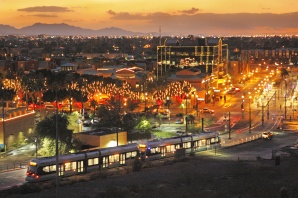
Light rail of Tempe, Arizona

The silver and teal trains that light up the bridge over Town Lake, swish through downtown, sound their bells near campus and travel along Apache Boulevard have become part of Tempe's identity.

Metro light rail has changed the landscape of the city since service began last Dec. 27. As the transit system marks its first year of operations Sunday, Tempe is celebrating the successes.


tempe_lightrail_train_PHP4B32E6D0A4073.jpg


People driving from the West and East Valley to get to the nearest light-rail station made the Phoenix and Mesa end-of-the line stops the most popular of the 28 stations. But Tempe's station near University Drive and Rural Road is on track to be the third most frequented stop. Students and faculty using that station and others hubs near Arizona State University account for a bulk of light-rail riders.

An ASU study released earlier this year also showed Tempe's land value near rail stations had increased at a greater rate compared to Phoenix and Mesa.

Continue reading "Light rail of Tempe, Arizona" »

December 11, 2009

Wayfinding by chirping sparrows in Penn Station

Q. Every time I wait in the Long Island Rail Road section of NYC Pennsylvania Station, I hear chirping, tweeting birds. The sound is louder near overhead speakers, so I'm assuming it's a recording. Is it supposed to make passengers calmer, like Muzak?

A. You are hearing a "talking kiosk," designed to help visually impaired passengers and others navigate the confusion of the station. The kiosk is in the Long Island Rail Road's main concourse, between the entrances to Tracks 14 and 15.

"To help visually impaired customers locate the kiosk, it emits the song of the lark sparrow (Chondestes grammacus), a bird species native to the American West, that is found by audiologists to have a unique set of phonetic properties considered effective for directional way-finding," said Susan McGowan, a spokeswoman for the railroad.

The current model was installed in December 2008, replacing an older one that also chirped. This one features a touch-activated tactile map of the station, visual displays for the partially sighted, and a voice designed for phonetic clarity, Ms. McGowan said in an e-mail message. As a customer touches different parts of the map, the kiosk describes the location and gives directions. It also offers general information about Penn Station and the Long Island Rail Road.

June 27, 2009

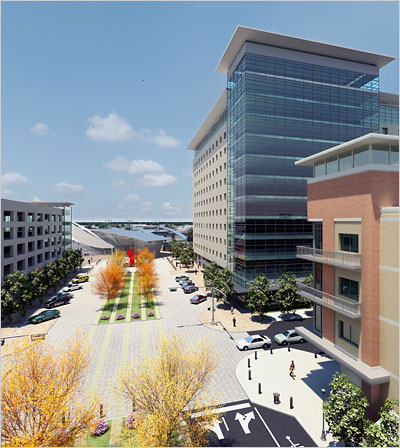
New rail lines, new urbanism, still growing

Urban-style development may be the brightest spot in a generally gloomy market. A recent survey of developers and investors by the Urban Land Institute for its annual Emerging Trends in Real Estate report found that urban redevelopment had the best prospects among all types of housing, while urban mixed-use properties and town centers scored high among niche property types. "These are the places that will be creating and holding value," Ms. Poticha said. She said proximity to public transit could raise property values significantly.

"It's moved from being an interesting idea to a core investment," said Jonathan F. P. Rose, the president of the Jonathan Rose Companies, a New York-based developer and investor.

The most successful projects do more than build housing near transit stations. They take pains to create livable neighborhoods, with parks, paths, retail stores and places for people to gather. "Place-making is key," Ms. Poticha said.

new_carrolltonTX_14sqftC_large.jpg

Continue reading "New rail lines, new urbanism, still growing" »

May 23, 2009

Late night safety bus

If public transport and public health could merge, there would be a safe way to get home at night.

Atrios would approve, if public safety is a public good.


Phoenix, AZ 2009 May 21:

The Valley's light rail will soon extend its hours on the weekends.

Currently, the light rail makes its last run at 11 p.m.

However, starting July 1, the trains will leave from both ends of the line at 2 a.m., which means if your stop is somewhere in the middle, the final train will sometimes come past 2 a.m.

On Wednesday, the METRO Board of Directors approved the new hours.

The change was made after getting feedback from passengers and businesses along the light rail route.

Melissa Harrigan, a bartender at Zuma Grill in Tempe, said she thinks the change will be good for business because people will be able to stay longer.

She also said that she feels it will keep the roads safer because a bigger group of people won't be drinking and driving.

According to a METRO news release, the estimated fiscal and maintenance impact for extended weekend service is $254,500 annually to the METRO operating budget.

After six months, the Board will review ridership statistics and costs associated with the service extension to see if the change is cost effective.


Published in transit, urbanism, UK, SFO, ny.

May 22, 2009

Town for car-free life: Vauban

While there have been efforts in the past two decades to make cities denser, and better for walking, planners are now taking the concept to the suburbs and focusing specifically on environmental benefits like reducing emissions. Vauban, home to 5,500 residents within a rectangular square mile, may be the most advanced experiment in low-car suburban life. But its basic precepts are being adopted around the world in attempts to make suburbs more compact and more accessible to public transportation, with less space for parking. In this new approach, stores are placed a walk away, on a main street, rather than in malls along some distant highway.

"All of our development since World War II has been centered on the car, and that will have to change," said David Goldberg, an official of Transportation for America, a fast-growing coalition of hundreds of groups in the United States -- including environmental groups, mayors' offices and the American Association of Retired People -- who are promoting new communities that are less dependent on cars. Mr. Goldberg added: "How much you drive is as important as whether you have a hybrid."

Levittown and Scarsdale, New York suburbs with spread-out homes and private garages, were the dream towns of the 1950s and still exert a strong appeal. But some new suburbs may well look more Vauban-like, not only in developed countries but also in the developing world, where emissions from an increasing number of private cars owned by the burgeoning middle class are choking cities.

In the United States, the Environmental Protection Agency is promoting "car reduced" communities, and legislators are starting to act, if cautiously. Many experts expect public transport serving suburbs to play a much larger role in a new six-year federal transportation bill to be approved this year, Mr. Goldberg said. In previous bills, 80 percent of appropriations have by law gone to highways and only 20 percent to other transport.

In California, the Hayward Area Planning Association is developing a Vauban-like community called Quarry Village on the outskirts of Oakland, accessible without a car to the Bay Area Rapid Transit system and to the California State University's campus in Hayward.

Continue reading "Town for car-free life: Vauban" »

January 22, 2009

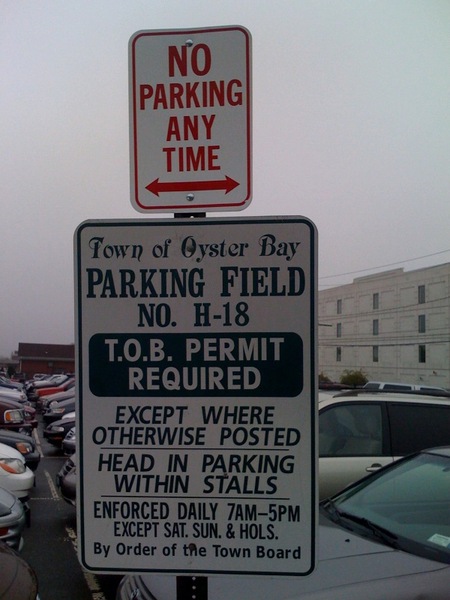
Parking no parking

Can you park here now ?

parking_no_parking_Hickville_NY.jpg

Posted in NY transit language.

January 12, 2009

The public good of local trains

Public goods are a great outlet for soveriegn spending. But are new projects really shovel-ready ?

Commuter trains are topping the charts at citizensbriefingbook.change.gov.

NIMBYs are organizing.

Supporters of trains are lining up.


January 8, 2009

America's middle class is motorized mobilized

Is ever increasing car ownership a healthly goal. Or is mobility a healthier goal ?

I worry that the avalanche of troubles already ongoing will overwhelm Mr. Obama and his people. It's also well worth worrying whether they will pursue policies similar in kind to the ones pursued by Bush, namely throwing money at everything and anything, and it sure looks like they are planning to do just that. I am especially concerned about an "infrastructure stimulus" project aimed at highway improvement at the expense of public transit. This would be the epitome of a campaign to sustain the unsustainable middle class. We need to begin planning right away for a transition away from automobiles, not in order to be good socialists but because Happy Motoring is at the core of our unsustainability trap.

Continue reading "America's middle class is motorized mobilized" »

May 30, 2008

Subway Maps, overlay, by on ny turf

onnyturf overlays subway maps with street maps for New York City.
Useful ! And updated.

May 31, 2007

Subway riding

How to ride the subway, take one.

Mark your territory

Remember, what makes you feel more secure(and comfortable) is
having strangers away from you.So go ahead, try this - when you
get on your next crowded subway/bus/train, try to occupy the most
space as possible; keep others AWAY - keep your arms a bit wider
from you, keep your backpack on the back instead of at your feet,
make larger arms gestures whenever possible, etc.You don't need
to have "clear space" around you to make yourself more
comfortable. Whether you are seated or standing, you can keep the
crowd away from you by marking your territory with clothes,
accessories, luggage, etc. For instance, if you keep your jacket
or luggage in your hand or on your seat, barely trespassing the
space of your neighbors, you are actually making THEM feel
uncomfortable - though they probably won't be able to see why ;
hopefully they will step back a bit, preys of your evil
space-domination plan. [/quote]

Continue reading "Subway riding" »

March 26, 2007

Busses for the poor

I considered taking the Long Island Rail Road,
but I can’t afford it, and I don’t have a car.

-- Sheryl McKenzie, who lives in Manhattan and commutes
to a nonprofit company in Hempstead.

January 31, 2007

Beyond Robson

Beyond Robson looks around Vancouver.
Example: Honking on the Canada Line near 12th and Cambie.

November 3, 2006

Music ban strikes a chord

Campaign for quiet passengers and quiet electronics
(cel phone ring tones, iPod, walman headphones).

Music ban strikes a chord.
-- Headline that could have been used.

Continue reading "Music ban strikes a chord" »

August 26, 2006

BART Rage

BART Rage, group of BART
riders in the SF Bay area.

August 20, 2006

Train riders work

Train riders were more educated and better paid.
More than 60 percent of rail commuters had college
degrees compared with about 40 percent of drivers
and subway riders.

The average income of rail commuters in the region
was about $105,000, more than double the income
of the typical subway and bus riders.

-- Mass Transit Grows as Commuters’ Trip of Choice.

August 18, 2006

subway map mashup for NYC

google-subway map mashup by onnyturf.
See previously: Dynamap layered map.

August 16, 2006

NY water Taxi

nywatertaxi connects lower Manhattan across the East River
* Queens Hunters' Point to Midtown
* Brooklyn Williamsburg, Fulton Ferry, Red Hook to Battery Park
and
across the Hudson to NJ.
* World Finacial Center to Jersey City, NJ.

August 3, 2006

LIRR in LIC

Long Island City has two Long Island Railroad stations.

Manhattan --- LIC --- Hunter's Point --- Jamaica ---

Hunters' Point Station: AirFoto
on 49 Ave between 21st Street and Skillman Ave,
Long Island City, NY 11101

Long Island City station: AirFoto
on Borden Ave, between 2nd Street and 5th Street.
Long Island City, NY 11101

StaphHangers weigh in.

June 12, 2006

Light Rail North-South routing for Saint Louis City

North South reports and analysis of light rail North-South
routes begin in 2006 -- the 40th anniversary of the last
streetcar to operate in regular service in St. Louis, via the
excellent STL Urban Review.

April 21, 2006

Connecticut commuters' Mark Ginocchio

Connecticut commuters' reporter Mark Ginocchio at the Stamford Advocate.

January 26, 2006

transit parking crunch: NY Long Island

OYSTER BAY


STATIONCOMMUTERSPARKING SPACES
Albertson181103
East Williston472346
Glen Cove100149
Glen Head194177
Glen Street120125
Greenvale85195
Locust Valley98310
Oyster Bay46307
Roslyn221244
Sea Cliff150185

WEST HEMPSTEAD

STATIONCOMMUTERSPARKING SPACES
Hempstead Gdns16175
Lakeview32065
Malverne518248
West Hempstead198423
Westwood29568

RONKONKOMA

STATIONCOMMUTERSPARKING SPACES
Bethpage6015977
Brentwood1177884
Central Islip1553902
Deer Park20521486
Farmingdale1035689
Greenport3103
Mattituck273
Medford2030
Riverhead1224
Ronkonkoma60156059
Southold122
Wyandanch13371039
Yaphank742

FAR ROCKAWAY

STATIONCOMMUTERSPARKING SPACES
Cedarhurst531879
Far Rockaway46165
Gibson47380
Hewlett598816
Inwood268216
Laurelton519278
Lawrence259249
Locust Manor42532
Rosedale1038386
Valley Stream21391382
Woodmere597550

HEMPSTEAD

STATIONCOMMUTERSPARKING SPACES
Bellerose48136
Country Life307447
Floral Park1294658
Garden City526503
Hempstead774803
Nassau Blvd613207
Queens Village51287
Stewart Manor756156

LONG BEACH

STATIONCOMMUTERSPARKING SPACES
Centre Avenue498183
East Rockaway460232
Island Park1219568
Long Beach1633756
Lynbrook13961106
Oceanside1260761

MONTAUK

STATIONCOMMUTERSPARKING SPACES
Amagansett035
Bay Shore634489
Bellport935
Bridgehampton8139
East Hampton4454
Great River9499
Hampton Bays9149
Islip325435
Mastic-Shirley254223
Montauk360
Oakdale137252
Patchogue428552
Sayville446580
Southampton9101
Speonk59335
Westhampton5114

PORT JEFFERSON

STATIONCOMMUTERSPARKING SPACES
New Hyde Park7081249
Merillon Avenue158617
Mineola9472834
Carle Place6788
Westbury7541324
Hicksville36986359
Syosset13182546
Cold Spring Harbor9691231
Huntington38024602
Greenlawn402349
Northport1130886
Kings Park730647
Smithtown791502
St. James282160
Stony Brook475246
Port Jefferson783312

PORT WASHINGTON

STATIONCOMMUTERSPARKING SPACES
Auburndale1027255
Bayside3106520
Broadway905285
Douglaston1042381
Flushing304970
Great Neck3309357
Little Neck1424592
Manhasset1998569
Murray Hill402100
Plandome472256
Port Washington2517927

BABYLON

STATIONCOMMUTERSPARKING SPACES
Amityville765735
Babylon34671989
Baldwin27951646
Bellmore29171808
Copiague967747
Freeport16471450
Lindenhurst13581034
Massapequa27092003
Massapequa Park1477755
Merrick28761732
Rockville Ctr23531791
Seaford16641217
Wantagh27291546

Continue reading "transit parking crunch: NY Long Island" »

January 4, 2006

metro north commuters

CT Council (serving riders on Metro-North's New Haven Division
& Shore Line East Railroads @TrainWeb), Metro North Commuter
at blogspot, and Metro North Commuters forum on RailRoad.net.

December 26, 2005

transport and transit: transportblog

Update 2006 November 24: transportblog is back to full strength posting.

Sadly, transportblog was on hiatus in 2005
Coverage of transport and transit, wide ranging.

December 25, 2005

Tax for subway to the sea

Los Angeles Councilman Bill Rosendahl is making waves
with his proposal to raise Los Angeles County’s sales tax
in order to fund a subway to the County’s beach.

Of course, if you look at the ballot measures from the
last two times L.A. approved a sales tax to fund general
transit projects, you would see that we already have a
world-class transit system with subways from Sylmar
to Seal Beach, paralleling the 405, and down the length
of Wilshire Boulevard.

Of course 2/3 of the projects promised in 1980 and 1990
have never been built, yet we continue to pay the taxes!

Continue reading "Tax for subway to the sea" »

September 14, 2005

Altamont Press' RailRoad News

Altamont Press' RailRoad News and foamers' discussion.
History and trainspotting, mainline freight and commuter trains.

August 31, 2005

Party Car on CalTrain

Party Car on CalTrain.

Every Friday, on northbound Train 275 (arrives in SF @ 6:39pm)
in the Bike Car at the front of the train (the SF end).

People bring beer, snacks, music, and a certain savoir-faire....

A nice way to end the last summer month, commuting.

July 11, 2005

GIS realtime: BusMonster Seattle

GIS realtime for commuting, BusMonster (motd) maps routes through Seattle.

With help by Intelligent Transportation Systems Research Program at UW.

Continue reading "GIS realtime: BusMonster Seattle" »

May 24, 2005

Union City intermodal station

Union City, CA intermodal station will connect BART, Dumbarton Rail,
Capitol Corridor, and ACE Rail.