Citibike angels program is pure arbitrage
Bike Angels forCitiBike NYC bike share.
Bike Angels forCitiBike NYC bike share.
Help stop procrastination psychology.
We know from psychological research by Andrew Elliot and others that progress on our goals feeds our well-being.
Peter Gollwitzer and his colleagues for years have shown us that implementation intentions make a huge difference to even deal with things like distractions.
Robert Pozen, who's written a book on extreme productivity, has the OHIO rule: only handle it once.
Continue reading "To act now, visualize your future self " »
Social pressure:
The experiment assigned all US Facebook users who were over 18 and accessed the website on the 2 November 2010 -- the day of the elections -- to one of three groups.
Social science: Poked to vote
Computational social science: Making the links Facebook 'likes' the scientific method
About 611,000 users (1%) received an 'informational message' at the top of their news feeds, which encouraged them to vote, provided a link to information on local polling places and included a clickable 'I voted' button and a counter of Facebook users who had clicked it. About 60 million users (98%) received a 'social message', which included the same elements but also showed the profile pictures of up to six randomly selected Facebook friends who had clicked the 'I voted' button. The remaining 1% of users were assigned to a control group that received no message.
The researchers then compared the groups' online behaviours, and matched 6.3 million users with publicly available voting records to see which group was actually most likely to vote in real life.
The results showed that those who got the informational message voted at the same rate as those who saw no message at all. But those who saw the social message were 2% more likely to click the 'I voted' button and 0.3% more likely to seek information about a polling place than those who received the informational message, and 0.4% more likely to head to the polls than either other group.
The social message, the researchers estimate, directly increased turnout by about 60,000 votes. But a further 280,000 people were indirectly nudged to the polls by seeing messages in their news feeds, for example, telling them that their friends had clicked the 'I voted' button. "The online social network helps to quadruple the effect of the message," says Fowler.
Culturedigitally: facebook trending its made of people but we should have already known that.
According to a statement from Tom Stocky, who is in charge of the trending topics list, Facebook has policies "for the review team to ensure consistency and neutrality" of the items that appear in the trending list.
But Facebook declined to discuss whether any editorial guidelines governed its algorithms, including the system that determines what people see in News Feed. Those algorithms could have profound implications for society. For instance, one persistent worry about algorithmic-selected news is that it might reinforce people's previously held points of view. If News Feed shows news that we're each likely to Like, it could trap us into echo chambers and contribute to rising political polarization. In a study last year, Facebook's scientists asserted the echo chamber effect was muted.
But when Facebook changes its algorithm -- which it does routinely -- does it have guidelines to make sure the changes aren't furthering an echo chamber? Or that the changes aren't inadvertently favoring one candidate or ideology over another? In other words, are Facebook's engineering decisions subject to ethical review? Nobody knows.
The other reason to be wary of Facebook's bias has to do with sheer size. Ms. Caplan notes that when studying bias in traditional media, scholars try to make comparisons across different news outlets. To determine if The Times is ignoring a certain story unfairly, look at competitors like The Washington Post and The Wall Street Journal. If those outlets are covering a story and The Times isn't, there could be something amiss about The Times's news judgment.
Such comparative studies are nearly impossible for Facebook. Facebook is personalized, in that what you see on your News Feed is different from what I see on mine, so the only entity in a position to look for systemic bias across all of Facebook is Facebook itself. Even if you could determine the spread of stories across all of Facebook's readers, what would you compare it to?
"Facebook has achieved saturation," Ms. Caplan said. No other social network is as large, popular, or used in the same way, so there's really no good rival for comparing Facebook's algorithmic output in order to look for bias.
What we're left with is a very powerful black box. In a 2010 study, Facebook's data scientists proved that simply by showing some users that their friends had voted, Facebook could encourage people to go to the polls. That study was randomized -- Facebook wasn't selectively showing messages to supporters of a particular candidate.
"There's a strain of thought that says an employee represents a company, and thus dress is not about personal expression, but company expression," Professor Scafidi said. "But there's a counterargument that believes because we identify so much with our careers, we should be able to be ourselves at work."
And that has led to all sorts of complications. One person's "appropriate" can easily be another's "disgraceful," and words like "professional," when used to describe dress requirements, can seem so vague as to be almost meaningless. Kanye West wearing ripped jeans and a jeweled Balmain jacket at the Met Gala: cool or rude? Julia Roberts at the premiere of "Money Monster" at Cannes this year in bare feet: red carpet pioneer or a step too far?
"Today it is not good enough to simply churn out product. An authentic and honest brand narrative is fundamental today, otherwise you will simply be edited out. It was time for a course correction in the fashion industry as the desire to go faster and faster simply to outdo the other became the driving force rather than putting the dialogue with the customer at the center."
Armando Branchini, vice chairman of Fondazione Altagamma, the Italian luxury brand organization, said that such a narrative could clearly be seen in Mr. Michele's creative vision, "the collections themselves, the environment in which he presents them, his advertising campaigns and store windows and his approach to digital and social media content."
"There is a consistent narrative that runs throughout, which connects strongly with the customer," he added.
As proof of Mr. Bizzarri's comment, sales at the Kering-owned Gucci have risen markedly since Mr. Michele's appointment early last year.
In exploring new fronts, Christian Louboutin has teamed up with his longtime friend Valérie Schlumberger, whose charity project La Maison Rose assists women and children in Senegal.
Continue reading "Christian Louboutin, branding more important than product" »
One-upmanship of absorbed pain may be the strongest force behind the rise of the microcomplaint. "Whatever happened to Gary Cooper?" Tony Soprano asked, in his first therapy session, on the pilot episode of "The Sopranos," back in 1999. "The strong, silent type. That was an American. He wasn't in touch with his feelings. He just did what he had to do. See, what they didn't know was once they got Gary Cooper in touch with his feelings that they wouldn't be able to shut him up! And then it's dysfunction this, and dysfunction that. ..."
While Tony was talking explicitly about the culture of therapy and confession, he identified a general transformation in the way we regard stoic reserve versus expression of vulnerability.
He surely would have agreed with the conclusions drawn in a 2014 paper in the journal Comparative Sociology called "Microaggression and Moral Cultures." The authors Bradley Campbell and Jason Manning argue that the increased attention recently given to microaggressions (commonplace exchanges that denigrate marginalized groups; see the recent controversy at Yale over Halloween costumes) on college campuses is a result of "the emergence of a victimhood culture that is distinct from the honor cultures and dignity cultures of the past."
White people yelp reviews are a thing.
Evan Fitzmaurice, an Austin-based lawyer and longtime friend who until recently was the Texas Film Commissioner, has attended many a SXSW. He tells me one night over dinner that while he's wired to the hilt ("I've gotta connect to the Matrix"), he sees the downside of perpetual connectedness. "You're truncating natural thought.
Things don't gestate anymore. It's instantaneous, without the benefit of reflection. And everything's said at volume 10. Nothing's graduated anymore. It's a clamor." Though not religious himself, he says what I witness at SXSW would be recognized by any religious person. "They're trying to supplant deliverance and redemption through religion with civil religion and technological redemption--the promise of a sublime life on a higher plane."
How Quora and StackExchange thrive where Mahalo failed.
ehow or aks.yahoo.
There are plenty of statistics that tell us that inequality is continually rising. At the same time, according to the Urban Institute, the nonprofit sector has been steadily growing. Between 2001 and 2011, the number of nonprofits increased 25 percent. Their growth rate now exceeds that of both the business and government sectors. It's a massive business, with approximately $316 billion given away in 2012 in the United States alone and more than 9.4 million employed.
Philanthropy has become the "it" vehicle to level the playing field and has generated a growing number of gatherings, workshops and affinity groups.
As more lives and communities are destroyed by the system that creates vast amounts of wealth for the few, the more heroic it sounds to "give back." It's what I would call "conscience laundering" -- feeling better about accumulating more than any one person could possibly need to live on by sprinkling a little around as an act of charity.
Infographic artist at work:
For the first time, a massive data set of 10,000 porn stars has been extracted from the world's largest database of adult films and performers. I've spent the last six months analyzing it to discover the truth about what the average performer looks like, what they do on film, and how their role has evolved over the last forty years.
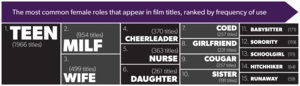
-- Jon Millward's
studies: Deep inside a study of 10000 porn stars.
New features abound, of course, but they're the sort that university teachers and other white-collar workers know all too well: ways of doing more with less, by making workers (or customers) handle the routine chores that used to be done for them. Nowadays you can tag a given "product" for Amazon so that it knows what you think of a book; if you want, you can even study a tag cloud that lists and ranks the most popular customer tags, so that you'll do a better job of tagging for the company. You can enter a customer discussion or post a review.
And, of course, whenever you buy a book, you help Amazon not only gauge the book's popularity, but also identify the other books that you have bought as well. It's an efficient, thoroughly commercial counterpart to the old information system. The simple, elegant Web page that once showered discriminating customers with information now invites the consumer to provide information of every sort for Amazon to digest and profit from.
The cab commission of the District of Columbia is less thrilled: it is in the midst of a legal tussle with Uber. Ron M. Linton, chairman of the commission, said Uber had begun operating in the city without its approval.
He said that under the commission's rules, there are limousines, which set a price with passengers in advance, and there are cabs, which have meters that charge by time or distance. He said Uber was breaking the rules by trying to be both. Uber calculates fares by time and distance, and then bills the customers' credit card.
The commission's inspectors have been citing Uber's car-service partners for infractions, Mr. Linton said. The commission is proposing to change the district's taxi laws to strengthen regulation of sedans like the ones that Uber's partners use. Mr. Linton said this would allow it to protect consumers from issues like extra fees that they don't understand.
"There's room for limos, for taxis and this new concept for sedans," he said. "We're trying to make it work for everybody, but we need cooperation. We can't deal with an organization that sticks its thumb up our nose."
Mr. Kalanick of Uber said its operations in Washington were completely legal, and that the commission was citing rules that don't exist. He said the commission wanted to regulate sedans more tightly so that it could control their fares, which would prevent Uber from eventually undercutting cabs.
"They want to keep our prices from going down, which is a very unusual price-fixing scheme," Mr. Kalanick said. "Essentially they're trying to protect taxis from competition, from having any viable alternative."
New York doesn't seem to have a problem with Uber. Allan Fromberg, a spokesman for the city's taxi and limousine commission, said that as long as services like Uber conformed to the city's rules, "we are highly supportive of ways to use technology to enhance service to the riding public."
Rogue 'phone service' demands verification only on exit, not on entry.
The case of Streaming Flix, Cindy Landeen, Local Exchange Carrier (LEC) billing, and a "billing aggregator" called Billing Services Group (BSG).
MyIproducts, 800 Vmailbox, and Digital Vmail--all services that used LEC billing to offer voicemail service that almost no "subscriber" actually used. (Between July 2009 and March 2010, tens of thousands of people were billed but only 209 ever used their mailbox). The total amount billed for these services in less than a year: $30 million.
"Consumers are continually making choices among products, the consequences of which they are but dimly aware. Not only do consumers lack full information about the prices of goods, but their information is probably even poorer about the quality variation of products simply because the latter information is more difficult to obtain."
-- "Information and Consumer Behavior", Philip Nelson, 1970.
See also, Kihlstorm & Riordan, "Advertising as a Signal" from the Journal of Political Economy (1984).
In today's world of data driven custom targeted advertising,
the better online advertising is, the less valuable it is.
Little podcasting chieftains forming networks of shows under such banners as Nerdist, Earwolf and Ace Broadcasting, which belongs to the former radio host turned podcaster Adam Carolla. It's no coincidence that this is all happening in Los Angeles, where comics move to work in TV and movies and stay to become ironic, insular and defeated about it.
Continue reading "Late stage comedy writers in Los Angeles" »
What Else Is Going On?
At the Bowery Hotel's lounge, Marissa Evans and Esther Kang were concerned about FOMO, the fear of missing out.
Ms. Evans, 27, runs a social networking site called Go Try It On, which gives users feedback on what they are wearing. On her phone, she navigates among three e-mail accounts, two Twitter feeds, Foursquare, Instagram and several group text-message accounts. All of these can cultivate FOMO.
"Especially when I leave the city," she said. "In the past, maybe I'd have had one text message inviting me out. But now I know from Facebook and Twitter and GroupMe that 10 of my friends were all together, and I can see pictures of what they did."
At the moment, however, she was more concerned about a friend who had been left out -- and who, thanks to their mobile phones, knew it. When Ms. Evans arrived at the bar, she "checked in" on the social networking site Foursquare; Ms. Kang, 29, checked in on Facebook. Within moments, Ms. Kang received a Facebook message from a third friend, Joydeep Dey, who had not been invited.
"Miss you two!!" his message read.
Ms. Kang was not warmed by his concern.
"I know he's being passive-aggressive," she said. So she responded in kind.
"Are you working?" she texted.
Mr. Dey, 30, contacted the next morning, said he had felt left out -- not because he had not been invited, but because he had been stuck at work. "Marissa, Esther and I are usually this trio," he said. "When I saw them both check in, I had to let them know I knew."
Among young adults surveyed by the advertising agency JWT New York, 65 percent said they felt left out when they saw that some of their friends were doing something without them. That feeling leaves many social media users perpetually antsy that, somewhere accessible by their phones, someone is having more fun than they are, said Ann Mack, the agency's director of trend-spotting.
"It's a very efficient way to make plans for later, but when you are out, people are still texting other people, trying to drum up more friends, not living in the moment," Ms. Mack said. "It's like, I'm here but what else is going on? Is there something better, cooler, that I'm not in the know about?"
Seated next to Ms. Evans, Jordan Cooper, 29, kept one eye on his cellphone but did not answer any of the incoming text messages, e-mail messages or phone calls. Mr. Cooper, who is starting a data-collection and search site called Hyperpublic, said he did not feel FOMO, in part because he did not feel left out of an event just because he was not there physically.
"I don't think of what's here and what's not here as separate," he said. "Like I'll be out with my mom and if I look at my phone, she says I'm being anti-social. I say, 'I'm being social, just not social with you.' "
Beats have redefined the lowly headphone, as well as how much people are willing to pay for a pair of them. A typical pair of Beats sell for about $300 -- nearly 10 times the price of ear buds that come with iPods. And, despite these lean economic times, they are selling surprisingly fast.
Whether Beats are worth the money is open to debate. Reviews are mixed, but many people love them. The headphones are sleekly Apple-esque, which is no surprise, since they were created by a former designer at Apple. Beats also offer a celebrity vibe and a lot of boom-a-chick-a-boom bass.
So much bass, in fact, that some audio experts say that Beats distort the sound of the music.
"In terms of sound performance, they are among the worst you can buy," says Tyll Hertsens, editor in chief of InnerFidelity.com, a site for audiophiles. "They are absolutely, extraordinarily bad."
Time was, manufacturers marketed high-priced audio equipment by emphasizing technical merits like frequency response, optimum impedance, ambient noise attenuation and so on. The audience was mostly a small cadre of audiophiles tuned to the finer points of sound quality.
But, three years ago, Beats by Dr. Dre set out to change all that by appealing to more primal desires: good looks, celebrity and bone-rattling bass. Annual sales are approaching $500 million, and Beats have transformed headphones into a fashion accessory.
Continue reading "Beats: Dr Dre's fashion accessory for dofus" »
If migrants spent heavily, lenders encouraged them. Traditionally, credit card use was low (in part because of Islamic strictures against charging interest), but banks spotted a new market and moved aggressively.
With foreign banks like HSBC and Citigroup fighting locals for market share, the number of cards leapt to four million in 2008, a fivefold increase in five years, according to the Lafferty Group, a London research firm. But the country lacks a reliable credit bureau, so lenders could not tell how many cards or how much debt the borrowers carried.
"Banks were falling over themselves to lend, and they didn't have proper credit checks," said Andrew Neeson, a Lafferty analyst.
Courted with gifts and teaser rates, few borrowers understood the costs. The average interest rate in the Emirates last year, at 36 percent, was more than twice the global average, and banks routinely add another 10 percent for disability and death insurance. With penalties, some workers borrowed at rates of 50 percent or more.
Anyone can be tempted by easy credit, but migrants raised in poverty can find the glittering malls here especially intoxicating.
"The first time I used my card, I felt amazed," Ms. Naces said. "It's a feeling of excitement, power -- greatness even."
Rex Arcenio, a Filipino optometrist, accepted a gold card because it came with a Montblanc pen and a limousine ride to the airport for his annual leave.
"It was like a status symbol," he said.
He ran up $50,000 in debt -- for his children's education, his brother's cancer treatment and a house in Manila -- and was briefly jailed.
Technically, debtors go to jail for bouncing the blank "security checks" they must sign when accepting a card. If borrowers fail to pay, banks can deposit the checks for the sum owed, and bouncing a check is a crime.
Whether foreign or Emirati, borrowers must repay the debt after leaving jail, though banks often accept reduced terms.
though the for-profit system serves only a little more than a tenth of those in postsecondary education, it accounts for nearly half of student loan defaults. The losses are generally of little concern to the companies themselves, because most of the tuition is paid by federal loans backed by the taxpayer. The defaulting students often end up with their lives in financial ruin.
Bankruptcy makes it possible to escape credit card and gambling debt but nearly impossible to escape student loan debt. As a result, students who default on school loans may never be able to have that weight lifted and can end up with creditors garnishing their wages.
The Obama administration has tried to address these problems with new rules to make programs with especially high levels of student debt and very low repayment rates ineligible for federal student aid. But these rules are insufficient.
Continue reading "For-profit colleges that leave students with crushing debt." »
Like tank commanders giving shout outs through the fog of the battlefield
Consider a fascinating study of the text messaging behavior of Tokyo teenagers that was conducted as part of a much larger investigation of "digital youth" by Mimi Ito, the late Peter Lyman and their colleagues. The kids text back and forth all day. What are they writing? What is so pressing that it can't wait till they see each other?
Anthropologists looking at the matter were surprised to discover that the kids rarely send informative or detailed messages. As a general rule, they are not telling each other anything. Rather, they are just letting each other know that they are "there," that they are online, in reach. Texting for the kids is a way of "pinging" each other. They bounce pings back and forth and so signal their presence for each other.
"Triathlons are much better for the body than long-distance running. With triathlons, when you are injured running, you can still swim and bike."
-- Dr. Michael J. Neely, the medical director at NY Sports Medicine and Physical Therapy, based in Manhattan.
... And leads to branded consumerism:
all the accessories and lifestyle brands that now cater to him and other triathletes. They can now buy TriSwim's shampoo to remove chlorine, and sports drinks like Hammer Nutrition Heed, which is sold on Web sites like One Tri. There are aerodynamic helmets and sunglasses made for triathlons, as well as wet suits and tri-specific running sneakers made by K-Swiss, Asics, Zoots and Newton.At Placid Planet, a bicycle and triathlon shop in Lake Placid, N.Y., the new must-have accessories are Zipp wheels and compression tights. "Zipp wheels are an aerodynamic carbon wheel that increase speed by reducing drag on the wheel," said Kenny Boettger, the owner. Compression tights and socks, he said, help athletes recirculate oxygen and blood. "This is the big thing right now and it works," he said.
There are also magazines like Lava, which began publishing in August and offers testosterone-fueled articles and profiles that appeal to men who dream about being Ironmen. With page after page of Lycra, equipment reviews and training tips, the magazine is geared for "hardcore triathletes who want to get right inside the fiery molten center of triathlon," according to its mission statement.
Lava's macho-man mantra is simple. "Forty is the new 20," said John Duke, who publishes the monthly magazine in San Diego. "And in triathletes, 40 isn't old. The median age of the sport is 41."
Good thing, too, since triathlons don't come cheap. "Forty-somethings are also the ones who can afford the sport," said Scott Berlinger, the head coach of Full Throttle, a 120-man triathlon team that is based out of the Chelsea Piers in Manhattan. "I tell my athletes everything costs $100 -- shoes, helmets, glasses -- and the big purchase is your bike."
A bicycle -- the tri-world equivalent of the red sports car -- can cost anywhere from several hundred dollars to more than $10,000. After the bike and the chiropractor bills, the biggest item is individual coaching, which can easily run $100 an hour.
"Triathletes are a discerning group of alpha consumers, with $175,000 average salaries," said Erik Vervloet, vice president for sports marketing at K-Swiss, which jumped into the tri-market three years ago. "The average Ironman spends $22,000 a year on the sport."
The high price is an issue, particularly for spouses. "I still argue with the wife about the costs," said Mr. Goodman, the triathlete from Stamford. His gear includes a $5,000 Cervelo bicycle, a $3,000 Pinarello bicycle, Xterra Vector Pro2 wet suits, Izumi Tri Fly 111 bike shoes and a Lazer Tardiz helmet.
But his wife, Amy, eventually came around. "At first it was a bit hard for me to swallow," said Ms. Goodman, 32, who is attending graduate school in the field of public health, "but when I saw that the bike wasn't going to hang on the wall, I thought, in terms of self-indulgences, this is one of the best things he could be doing."
Continue reading "Triathletes extend life from 20s to 40s, and consume" »
Frederick Peters, the owner of Warburg Realty Partners, had run his business well in the 30 years he had owned Warburg Realty. Now through no fault of his own he found himself in a financial crisis that threatened the future of his firm. This was the definition of a clutch situation. Over the next few months, he responded well because his actions were guided by the five traits of people who are great under pressure:
He also avoided the three traps that cause most people to choke:
Alec Haverstick II, a co-founder of Boxwood Strategic Advisers, provided a tool that could take the passion out of financial decision-making. His rule was that when you have less than 12 months of cash left to cover your debt payments, you need to start selling assets. His prescription applied to anyone because the advice was not based on having a lot of money so much as being smart with the money you have left.
The relationship between Mr. Rapino and artists is complicated. On the one hand, he must be deferential and accommodating, because without a regular caravan of acts, he has nothing but empty seats and red ink. At the same time, some artists are exasperating, though Mr. Rapino is far too diplomatic to say so.
Instead, he'll simply note that artists -- at least the famous ones -- are in a position these days to define their own destiny. And without question, that destiny includes higher ticket prices. The average price of a ticket to one of the top 100 tours soared to $62.57 last year from $25.81 in 1996, according to Pollstar, far outpacing inflation. The interesting question is why.
Mr. Rapino's theory is that musicians are just benefiting from the same trends that have enriched other superstars, like athletes and actors.
"The ticket was underpriced 40 years ago," he says.
Rival promoters see another culprit in high ticket prices: Live Nation. The company, they say, represents a consolidation of regional promoters that didn't just coincide with rising ticket prices but also helped cause them. Ticket prices, in this telling, have gone up because the largest promoter has been paying whatever-it-takes sums to get bands in the door -- both to drive out competitors and to bring in desperately needed revenue to cover fixed overhead costs and to fill up seats. The company's biggest outlays include "360 deals" with Jay-Z, Madonna, U2 and others, giving the company a stake in tours, recording and merchandise profits in exchange for nine-figure paydays. Jay-Z's deal was reportedly worth more than $150 million.
"Look at what has happened to ticket prices, and the price of everything else at a concert, over the last 10 years, right when consolidation was happening," says John Scher, who books shows in Madison Square Garden, at Radio City Music Hall and elsewhere in New York. "I talk to college kids all the time and they tell me that going to a show at an arena or an amphitheater is just beyond what they can afford. And it's because Live Nation has been paying the acts these outrageous sums, which is just alienating the fan base."
Mr. Rapino denies overpaying for bands, and says that the price of tickets often triples when they're sold by scalpers, which suggests that they were actually underpriced.
Then again, when Mr. Rapino was describing the parlous condition of the concert business in front of Congress last year, he noted that 40 percent of concert tickets go unsold, a statistic that he offered as a symptom of an industry in distress but that might just be evidence that Live Nation and its rivals don't know how to price and sell their products. Today, as high as ticket prices are, Live Nation earns none of its profit from ticket revenue. The artists get nearly all of that. Live Nation's earnings come from stuff sold on site, like beer, parking and advertising.
Continue reading "Pricing concert tickets understates inflation: Ticketmaster, LiveNation" »
This produces a lot of dynamism. As Stephen J. Rose points out in his book "Rebound: Why America Will Emerge Stronger From the Financial Crisis," the number of Americans earning between $35,000 and $70,000 declined by 12 percent between 1980 and 2008. But that's largely because the number earning over $105,000 increased by 14 percent. Over the past 10 years, 60 percent of American adults made more than $100,000 in at least one or two of those years, and 40 percent had incomes that high for at least three.
David Brooks defines a slice of the middle class.
A theory of Aaron Fine, a partner and consumer banking specialist with the consulting firm Oliver Wyman. He argues that more affluent customers have suddenly become a lot more valuable to the banks.
Why? Well, a big chunk of the fee income from the more stretched classes of bank customers stands to go away because many of those people will opt out of paying fees to overspend.
"I expect you'll see another wave of innovation coming from the banks," he said. "And perhaps the first segment they'll address is the higher balance accounts."
Continue reading "Ideal customer according to Oliver Wyman" »
Consumers now buy more PCs than businesses do, and their wants and desires for better-looking devices have invaded the cubicle. The current breed of consumer has shown an ability to turn something like the Apple iPhone into an overnight sensation, then demand that companies embrace it. Google, meanwhile, uses its influential Web search and YouTube properties to introduce people to its e-mail, document and Web browser software, and Facebook now provides inspiration to business software makers.
For Google, winning over consumers is crucial to its strategy of infiltrating corporations and deflating Microsoft's core businesses. "We are the next generation," says Dave Girouard, the president of Google's business products division. "The big difference in technology here is the pace of innovation."
One of many ecstatic iPhone news stories, on the convenience of having recipies stored and immediately searchible. Some use cases such as seeing a sale on lamb when out shopping, and being able to search for alternative recipes, and amend the shopping list.
Not sure how to mount you pumpkin on a kabob ? Snap a picture and share it for instant feedback. The vision of Audrey, realised.
Alert: The muchly annoying robo calls are under investigation.
This is the second warning that the factory warranty on your vehicle has expired.
ATTORNEYS GENERAL in several states are investigating what they suspect are telephone sales scams promoting extended car warranties, often by calling cellphones or numbers that are listed on do-not-call registries.
The Connecticut attorney general, Richard Blumenthal, said his office had received "a huge number of complaints -- hundreds of complaints." Connecticut is part of a large, multistate investigation into such calls, he said.
Another of those states is Iowa. "They are trying to trick you into believing that the communication is coming from the auto manufacturer and that your warranty is about to expire and you need to do something to extend that warranty," said William L. Brauch, a special assistant attorney general and director of the consumer protection division in Iowa.
But automakers are not behind the policies, Mr. Brauch said, and after purchasing such a policy it may be difficult if not impossible to get reimbursed for a repair.
"A number of these companies tend to routinely deny paying, they come up with various interpretations, shall we say, of the agreements, which they say justify them not covering whatever the ...
Fill story after the jump
See also: Amazon Prime $79 Refund class action suit.
Continue reading "Telephone sales scams promoting extended car warranties" »