September 7, 2017
August 26, 2017
Teenage summer is not a summer job
1. With tougher high-school requirements and greater pressure to go to college, summer classes are the new summer job. The percent of 16-to-19-year-olds enrolled in summer school has tripled in the last 20 years, according to the Bureau of Labor Statistics. The rise may be directly related to the fact that parents and high schools are encouraging students to take on more classwork, according to Ben Steverman, a Bloomberg reporter who covers teen employment. He finds that the percentage of high-school grads completing at least four years of English, three years of science, math, and social science, and two years of foreign language has sextupled since the early 1980s.
2. The second reason why teens work less today is that employers are more reluctant to hire them. First, the rise of low-skill immigration in the last few decades has created more competition for exactly the sort of jobs that teenagers used to do, like grocery-store cashiers, restaurant servers, and retail salespeople. Second, older Americans stay in the workforce longer than ever, and many of them wind down their careers in office secretary and retail jobs, which used to be the province of 16-year-olds in the summer.
3. Third, the number of federally funded summer jobs, where students work temporarily with their local government, has declined. At the same time, the minimum wage has grown, which may have discouraged bosses from taking on young inexperienced workers who are only "worth" hiring at a salary that's become illegal.
4. Fourth, training. Companies have caught on to the fact that if they want to hire teenagers, they don't have to pay them at all: There has been an extraordinary rise in unpaid internships over the last decade.
August 19, 2017
Modern digital marketing workplace: a daycare for hyperactive young adults
a daycare for hyperactive young adults. I was told to wait on a nearby bench, a bench with no back I might add. As I surveyed my surroundings, I noted, there was not one inch of private space. There were Ping-Pong tables, candy stations, a variety of snacks, organic coffees and green smoothies in mason jars. Young staffers whipped by, paddle in hand, ready for a quick game before their next meeting. Was it just me or were they actually wearing roller blades? I couldn't help but wonder when the workplace transitioned into a playground.
-- Vickie Fagan
August 13, 2017
Freeters, Solopreneurs: the new untouchables ?
"SOLOPRENEURS" NEED NOT APPLY
Ruettimann believes an economic downturn is overdue, which will flood the job market with legions of contract workers, freelancers, and so-called "solopreneurs" applying for corporate jobs with full-time benefits. Whether or not that proves true, Ruettimann says that in the recruitment world, "nobody really believes in the gig economy."
The prevailing attitude, she says, is that "if you're self-employed, it's because you can't get full-time work." So job seekers looking for traditional roles after years supporting themselves--particularly older ones--she says, "are facing serious ageism and bias in the workforce." Ruettimann's advice is twofold: "If you've been in this gig economy, get your references in order and make sure you're working for really awesome clients who can vouch for you, then think about turning those clients from customers into employers--like now."
Continue reading "Freeters, Solopreneurs: the new untouchables ?" »
August 2, 2017
Bo Stefan Eriksson, Carl Freer, and Gizmondo (not Gizmodo)
So while there was the illusion of fair exchange, there really was no exchange at all: Eriksson and Freer got diehard loyalty and free labor in exchange for Gizmondo stock, while their underlings were allowed to drive outrageous automobiles that they nonetheless didn't own. Models, supercars, diamond watches, paper stocks, parties: these were the currencies in Gizmondo nation, and everyone thought of themselves as fucking rich.
Continue reading "Bo Stefan Eriksson, Carl Freer, and Gizmondo (not Gizmodo)" »
June 24, 2017
How did the culture at your last company empower or disempower you?
Four questions, ht Inc.
- How did the culture at your last company empower or disempower you ?
- What were the characteristics of the best boss you've ever had ?
- Describe how you handled a conflict with one of your co-workers ?
- What kind of feedback do you expect to receive in this role and how often do you expect to receive it?
June 7, 2017
Personal Kanban works on two principles: Visualize your work, and limit your total number of "works in progress."
Personal Kanban works on two principles: Visualize your work, and limit your total number of "works in progress."
Starting but not finishing too many projects puts a person at risk of the so-called Zeigarnik effect, named for Bluma Zeigarnik, a Russian psychiatrist who, in the 1920s, discovered that people are better at remembering unfinished tasks than completed ones. Unfinished items that we've left hanging are like cognitive itches. (Zeigarnik first made this observation watching servers remember detailed meal orders at a restaurant only as long as the order was in process.)
August 13, 2016
Thinking and execution
Separate thinking and execution to think better and execute faster.
-- Sol Tanguay
June 14, 2016
The vision of Facebook
Facebook is full of true believers who really, really, really are not doing it for the money, and really, really will not stop until every man, woman, and child on earth is staring into a blue-bannered window with a Facebook logo. Which, if you think about it, is much scarier than simple greed. The greedy man can always be bought at some price, and his behavior is predictable. But the true zealot? He can't be had at any price, and there's no telling what his mad visions will have him and his followers do.
That's what we're talking about with Mark Elliot Zuckerberg and the company he created.
May 30, 2016
Business attire
"There's a strain of thought that says an employee represents a company, and thus dress is not about personal expression, but company expression," Professor Scafidi said. "But there's a counterargument that believes because we identify so much with our careers, we should be able to be ourselves at work."
And that has led to all sorts of complications. One person's "appropriate" can easily be another's "disgraceful," and words like "professional," when used to describe dress requirements, can seem so vague as to be almost meaningless. Kanye West wearing ripped jeans and a jeweled Balmain jacket at the Met Gala: cool or rude? Julia Roberts at the premiere of "Money Monster" at Cannes this year in bare feet: red carpet pioneer or a step too far?
April 24, 2016
On Time
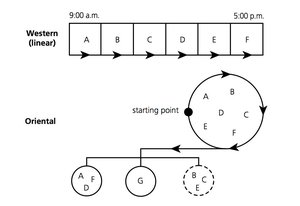
Few Northern Europeans or North Americans can reconcile themselves to the multi-active use of time. Germans and Swiss, unless they reach an understanding of the underlying psychology, will be driven to distraction. Germans see compartmentalization of programs, schedules, procedures and production as the surest route to efficiency. The Swiss, even more time and regulation dominated, have made precision a national symbol. This applies to their watch industry, their optical instruments, their pharmaceutical products, their banking. Planes, buses and trains leave on the dot. Accordingly, everything can be exactly calculated and predicted.
In countries inhabited by linear-active people, time is clock- and calendar- related, segmented in an abstract manner for our convenience, measurement, and disposal. In multi-active cultures like the Arab and Latin spheres, time is event- or personality-related, a subjective commodity which can be manipulated, molded, stretched, or dispensed with, irrespective of what the clock says.
January 18, 2016
Aging well and gracefully ?
Aging well and gracefully in retirement may be the goal, but getting there is often a challenge. After all, it can be traumatic to leave the working world -- particularly if your self-concept is wrapped up in your job. You might feel a loss of importance and a loss of vitality; you may grieve the loss of friendships. "A lot of people get their identity from work and they get their social interaction from work, so the idea of stopping means they're going to lose both," says Peter Cappelli, professor of management at Wharton and the director of the school's Center for Human Resources. "[You need to] respect that it's going to be a huge loss.
November 16, 2015
Next Economy Conference, by Maciej (Idlewords)
Storified Maciej on the Next Economy Conference.
May 25, 2015
PLOS' Sci Comm's Hello World
May 12, 2015
J. Random
In a time when "to other" has become a condemnatory verb, randos are the other. If the mores in a given ZIP code preclude snarling at people for their race, sex, creed or sexual orientation, those uncertain of their own grip on the social center can always dump on randos. It is a nice, clean slur, free of identifying social characteristics.
It refers to the extras, the spear-carriers in the background, the people who apparently have only themselves to blame for their exclusion, those you'll forget all about when you move away. Their being tagged with that handle may indeed derive, at bottom, from their race, sex, creed, sexual orientation, body shape, economic misfortune or anything else, but users always have convenient deniability at their service.
After all, there are so many people around nowadays, perhaps more than all the collected dead of ages past -- who can keep track? We rest secure in the knowledge that while those people over there represent arbitrary collisions of data, we ourselves are a result of long and careful planning.
Luc Sante is the author of "Low Life" and "Kill All Your Darlings." His new book, "The Other Paris,"
May 8, 2015
Andreessen Horowitz is a talent agency
Andreessen Horowitz is a talent agency as much as a tech investor. Marc Andreessen, the web pioneer who was a founder of Netscape and other companies before trying his hand at venture capital, has made this point explicitly a in 2010 interview of Michael Ovitz, the onetime Hollywood superagent who started Creative Artists Agency.
October 22, 2014
Women's computers were heavy
Computer science wasn't always dominated by men. "In the beginning, the word 'computers' meant 'women,' " says Ruth Oldenziel, a professor at Eindhoven University of Technology in the Netherlands who studies history, gender and technology. Six women programmed one of the most famous computers in history -- the 30-ton Eniac -- for the United States Army during World War II.
But as with many professions, Dr. Oldenziel said, once programming gained prestige, women were pushed out. Over the decades, the share of women in computing has continued to decline. In 2012, just 18 percent of computer-science college graduates were women, down from 37 percent in 1985, according to the National Center for Women & Information Technology.
This lack of women has become of greater concern in the industry for a number of reasons. For one, the products that the tech industry creates are shaping the future for everyone. "Women are increasingly consumers; they're not going to like products that don't work for them," said Londa Schiebinger, a Stanford professor who runs the Gendered Innovations project, which encourages engineers and scientists to consider gender when developing new products.
August 26, 2014
Banking, cool
The Renaissance Kids typically have their pick of investment banks, and what makes them so attractive to Wall Street -- aside from their credentials, which look good on a pitch book -- is that they're interesting. They're not carbon-copy Alex P. Keatons. They read books, can wax eloquent on nonfinancial matters, and are good at male small-talk (which female Renaissance Kids also excel at). Executives look them over and imagine them schmoozing clients, passing the airport test, and eventually taking over for them at the top of the firm.
Goldman Sachs is especially desirous of Renaissance Kids, because it's always fancied itself the thinking man's investment bank. ("I think you also have to be a complete person. You have to be interesting," Lloyd Blankfein told the bank's interns last year.) But because Goldman wants them, everyone else does, too.
The problem, for Goldman and the rest of Wall Street, is that banks aren't pulling nearly the number of Renaissance Kids they once did. These firms are having no problems drawing applicants out of college, but what I've heard from senior Wall Street hiring managers is that they're not the right kind of applicants. They're second-stringers, as far as the banks are concerned. The students these firms want to attract -- badly -- are increasingly going to Google or Facebook instead of Goldman and J.P. Morgan. (Or, almost worse, going to Goldman and J.P. Morgan, working for a year or two, and then quitting to go to Google or Facebook.)
August 10, 2014
Every job ever
The grunt work of programming--probably like the boilerplate in a brief: you have to understand the situation and know the customs, but you're not really solving a puzzle. The thinking gets sprinkled in when there's something in the situation that's novel or unusual.
June 17, 2014
Tony Schwartz on More reflection less action
The two of them had been on the road together for four consecutive weeks. I asked how that felt. "It's brutal," he said. "But it's typical. My boss essentially has no openings on his schedule for the next three months."
Think about that for a moment:
This executive had no times at work when he could just breathe deep and relax for a half hour, nor could he step back after a key meeting and quietly metabolize what had just happened or look forward and muse about strategy. He could not simply wander through his office, talking to people about what they're doing, in order to energize and enrich them, and himself.
Continue reading "Tony Schwartz on More reflection less action" »
May 24, 2014
Model Off with excel monkeys
If there was a competition entitled "Correct the analyst's spreadsheet", that could be sort of cool, right?
April 23, 2014
Boring Gloria Mark is unstressful
mindless at-work activities such as surfing the Web or deleting the inbox--may sound a bit mind-numbing. But new research has found that people are actually happiest on the job doing unchallenging assignments.
The study, led by Gloria Mark at the University of California, Irvine along with colleagues at Microsoft Research, examined how employees' mood and attention change when performing various activities at work, such as responding to email or checking FacebookFB +2.92%.
"With rote work, you get a feeling of accomplishment, but you haven't exerted a lot of mental activity," says Dr. Mark. "It gives you a feeling of fulfillment, but there's not frustration or stress."
The researchers' findings provide a picture of how boredom and focus change throughout the day--and what digital tasks make workers happiest.
Focus, they found, peaks in the mid-afternoon from 2 to 3 p.m. and also rises in late morning, around 11 a.m., after workers have time to gear up. (After 3, however, workplace focus drops precipitously.) Meanwhile, people are most bored early in the afternoon, soon after lunch--and not surprisingly, on Mondays.
"It takes time to ramp up and get into a focused and productive state," says Dr. Mark. "You don't hit the ground running."
The research will be presented at a panel on workplace distraction at the SXSW Interactive conference on Saturday, and is forthcoming for publication in April at the Proceedings of the Computer-Human Interaction Conference 2014.
February 12, 2014
Order coffee in 3000 words or less
It felt like being hungry, I suppose, in a place where being hungry is shameful, and where one has no money and everyone else is full. It felt, at least sometimes, difficult and embarrassing and important to conceal. Being foreign didn't help. I kept botching the ballgame of language: fumbling my catches, bungling my throws. Most days, I went for coffee in the same place, a glass-fronted café full of tiny tables, populated almost exclusively by people gazing into the glowing clamshells of their laptops. Each time, the same thing happened. I ordered the nearest thing to filter on the menu: a medium urn brew, which was written in large chalk letters on the board. Each time, without fail, the barista looked blankly up and asked me to repeat myself. I might have found it funny in England, or irritating, or I might not have noticed it all, but that spring it worked under my skin, depositing little grains of anxiety and shame.
February 1, 2014
New rules for education and status identification
Like many professions today, software development is developing new rules for education and status identification. At one point, a degree from MIT or Stanford was the key ticket to a major Silicon Valley company, and from there, a start-up or a management role.
The new culture around hackathons and open source projects is going to upend this forced march. Students increasingly are engaging with startups earlier in their careers, and they are building products rather than writing code samples. With a continued focus on education, there is an opportunity here to solve the engineer crunch, and perhaps even expand the range of people who are involved in engineering the next great startups.
January 18, 2014
Code among theives
The Stratton brokers could have just placed orders in these customers' accounts without their permission, but they rarely did. Unauthorized orders were more likely to trigger complaints to regulators, and the move would have violated some unofficial boiler-room code of honor. These guys took pride in their ability to talk suckers into parting with their life savings.
-- Ronald Rubin
November 4, 2013
Give it away, Give it away, Give it away, Give it away now
So I'm writing this not only in the hope that everyone will cross me off the list of writers to hit up for free content but, more important, to make a plea to my younger colleagues. As an older, more accomplished, equally unsuccessful artist, I beseech you, don't give it away. As a matter of principle. Do it for your colleagues, your fellow artists, because if we all consistently say no they might, eventually, take the hint. It shouldn't be professionally or socially acceptable -- it isn't right -- for people to tell us, over and over, that our vocation is worthless.
Here, for public use, is my very own template for a response to people who offer to let me write something for them for nothing:
Thanks very much for your compliments on my [writing/illustration/whatever thing you do]. I'm flattered by your invitation to [do whatever it is they want you to do for nothing]. But [thing you do] is work, it takes time, it's how I make my living, and in this economy I can't afford to do it for free. I'm sorry to decline, but thanks again, sincerely, for your kind words about my work.
Feel free to amend as necessary. This I'm willing to give away.
Tim Kreider is the author.
Next: Gary Vaynerchuk's Jab jab jab jab, right hook.
October 29, 2013
Algorithmic predictions and portfolio management
We think the robot future is going to be more disruptive than many think, but we also suspect that actual data-crunching plays only a small part in the career of a successful analyst.
There is some time spent crafting a compelling narrative around some basic assumptions, and then an awful lot more spent repeating that story ad nauseam on the phone, in reports, and in person.
Not to mention the part about getting to know people at the companies they cover. Top of UK brokers' list of problems at the moment are regulatory plans to make them charge their clients directly (as opposed to their clients' customers) for introducing them to the management of companies.
But, even if it is just about the value of good ideas - if you have some really good algorithms for, say, indexing websites or trawling Twitter, why would you advertise and sell them?
The world's most successful hedge fund strategy is both the most secretive and the one that you could never invest in: Renaissance Technology's Medallion fund. The fund ignores the mainstream finance literature, preferring to scoop up experienced cryptographers and mathematicians required to sign intimidating non-compete clauses, and it is willing to trade signals in the noise that work even if it doesn't understand why.
October 26, 2013
Scientific American Why Your Brain Needs More Down time Research on naps, meditation, nature walks and the habits of exceptional artists and athletes reveals how mental breaks increase productivity, replenish attention, solidify memories, creativity
Why Your Brain Needs More Downtime.
A 2010 LexisNexis survey of 1,700 white collar workers in the U.S., China, South Africa, the U.K. and Australia revealed that on average employees spend more than half their workdays receiving and managing information rather than using it to do their jobs; half of the surveyed workers also confessed that they were reaching a breaking point after which they would not be able to accommodate the deluge of data.
Research on naps, meditation, nature walks and the habits of exceptional artists and athletes reveals how mental breaks increase productivity, replenish attention, solidify memories and encourage creativity
scientificamerican.com/article.cfm?id=mental-downtime&WT.mc_id=SA_MindFacebook.
August 5, 2013
Fine line between being a creative, honest workaholic and turning into a scatterbrained procrastinator with a big mouth
Workaholic I work hard; I always have. That helps on the job. Unfortunately, since ADD/ADHD makes some things -- such as being prompt, focused, and respectful -- that are simple for others, challenging for me, this work ethic doesn't apply to all tasks. I can tackle assignments that require these skills, but doing so costs me far more time and energy than average person.
My vain attempts to try and pass off or over this kind of unrewarding and mundane work have led me to waste many days arguing with my bosses. My point? They were asking me to do something inane. Theirs? The work needed to be done regardless. Naturally, I always lost. And at what cost?
I wouldn't dare to generalize my personal experience -- work circumstances and ADD/ADHD behaviors are simply too diverse -- but I will offer the following observation: There's a fine line between being a creative, honest workaholic and turning into a scatterbrained procrastinator with a big mouth. Even when I couldn't tell the difference, my soon-to-be-former employers always could. You need to make sure you're on the right side.
June 22, 2013
Good golly
Molly still feels like a more respectable substance than others.
"I think people are much more aware of where coke comes from and what it does in those countries," said Sarah Nicole Prickett, 27, a writer for Vice and The New Inquiry, a culture and commentary site, who called cocaine a "blood drug." "Molly, if it's pure, it feels good and fun." (Much of it comes from Canada and the Netherlands, Mr. Payne said.)
Ms. Prickett, who moved to New York from Toronto last year, added that she could see why the drug might be taking hold in her new habitat.
"My impression of New York was that everyone just did drugs for work, that everyone was on speed," she said. "Molly makes you feel unplanned, and that's not a common feeling in New York, where everyone knows where they're going all the time and they're going very, very fast."
Rick Doblin, the founder of the Multidisciplinary Association for Psychedelic Studies, which has helped finance MDMA studies since the drug first entered the club scene, put Molly in the context of past drug trends: in the 1960s, he suggested, people searched for deeper spirituality and found LSD; in the '70s, as hippie culture became mainstream, marijuana entered the suburban household; in the '80s, cocaine complemented the extravagance and selfishness of the greed decade; and by the early '90s, youths dropped out of reality, dancing all night on Ecstasy or slumping in the corner on heroin. MDMA, which in addition to acting as a stimulant also promotes feelings of bonding and human connection, just might be what people are looking for right now.
"As we move more and more electronic, people are extremely hungry for the opposite: human interaction on a deeper level where you're not rushing around," Mr. Doblin said. "The rise of Molly is in tune with how people are feeling emotionally."
May 5, 2013
Gatsby III
Leon Wieseltier, the literary editor of The New Republic, understands that we're drawn back to "Gatsby" because we keep seeing modern buccaneers of banking and hedge funds, swathed in carelessness and opulence. "But what most people don't understand is that the adjective 'Great' in the title was meant laconically," he said. "There's nothing genuinely great about Gatsby. He's a poignant phony. Owing to the money-addled society we live in, people have lost the irony of Fitzgerald's title. So the movies become complicit in the excessively materialistic culture that the novel set out to criticize."
He noted that Gatsby movies are usually just moving versions of Town and Country or The Times's T magazine, and that filmmakers "get seduced by the seductions that the book itself is warning about."
A really great movie of the novel, he argues, would "show a dissenting streak of austerity." He thinks it's time for a black Gatsby, noting that Jay-Z might be an inspirational starting point -- "a young man of talents with an unsavory past consumed by status anxiety and ascending unstoppably through tireless self-promotion and increasingly conspicuous wealth."
The problem with the "Gatsby" movies, he said, "is that they look like they were made by Gatsby. The trick is to make a Gatsby movie that couldn't have been made by Gatsby -- an unglossy portrait of gloss."
March 10, 2013
Life After Work -- Erin Callan
AT an office party in 2005, one of my colleagues asked my then husband what I did on weekends. She knew me as someone with great intensity and energy. "Does she kayak, go rock climbing and then run a half marathon?" she joked. No, he answered simply, "she sleeps." And that was true. When I wasn't catching up on work, I spent my weekends recharging my batteries for the coming week. Work always came first, before my family, friends and marriage -- which ended just a few years later.
In recent weeks I have been following with interest the escalating debate about work-life balance and the varying positions of Facebook's Sheryl Sandberg, Marissa Mayer of Yahoo and the academic Anne-Marie Slaughter, among others. Since I resigned my position as chief financial officer of Lehman Brothers in 2008, amid mounting chaos and a cloud of public humiliation only months before the company went bankrupt, I have had ample time to reflect on the decisions I made in balancing (or failing to balance) my job with the rest of my life. The fact that I call it "the rest of my life" gives you an indication where work stood in the pecking order.
-- Erin Callan, former chief financial officer of Lehman Brothers
October 1, 2012
On downgrading banks
The potential downgrades would cost those institutions billions of dollars in higher interest payments, steeper collateral costs and missed revenue opportunities.
What's making executives at Morgan Stanley and the scores of rivals waiting for Moody's decisions even more frustrated is they are fighting against an army of credit-rating analysts who are nowhere near as well-known and are paid a fraction of what bankers get. Even finding someone to blame can prove elusive, as Moody's ratings actions are decided by a voting committee of about a dozen analysts whose identities are never disclosed.
Moody's actions are faceless by design. The aim is to shroud at-times contentious decisions in an aura of mechanic precision, and to protect its analysts from the personalized attacks they may otherwise endure from finance ministers, bank executives and other debt issuers unhappy with their decisions.
September 6, 2012
Microsoft (1975 - 2000) $MSFT
The story of Microsoft's lost decade could serve as a business-school case study on the pitfalls of success. For what began as a lean competition machine led by young visionaries of unparalleled talent has mutated into something bloated and bureaucracy-laden, with an internal culture that unintentionally rewards managers who strangle innovative ideas that might threaten the established order of things.
"I was stunned when Bill announced that he was stepping aside to become 'chief software architect' in January 2000, with Steve Ballmer succeeding him as C.E.O.," recalled Paul Allen. "While Steve had long served as Bill's top lieutenant, you got the sense through the nineties that he wasn't necessarily being groomed for Microsoft's top spot. I'd say that Bill viewed him as a very smart executive with less affinity for technology than for the business side--that Steve just wasn't a 'product guy.' "A businessman with a background in deal-making, finance, and product marketing had replaced a software-and-technological genius.
By the dawn of the millennium, the hallways at Microsoft were no longer home to barefoot programmers in Hawaiian shirts working through nights and weekends toward a common goal of excellence; instead, life behind the thick corporate walls had become staid and brutish. Fiefdoms had taken root, and a mastery of internal politics emerged as key to career success.
In those years Microsoft had stepped up its efforts to cripple competitors, but--because of a series of astonishingly foolish management decisions--the competitors being crippled were often co-workers at Microsoft, instead of other companies. Staffers were rewarded not just for doing well but for making sure that their colleagues failed. As a result, the company was consumed by an endless series of internal knife fights. Potential market-busting businesses--such as e-book and smartphone technology--were killed, derailed, or delayed amid bickering and power plays.
That is the portrait of Microsoft depicted in interviews with dozens of current and former executives, as well as in thousands of pages of internal documents and legal records.
"They used to point their finger at IBM and laugh," said Bill Hill, a former Microsoft manager. "Now they've become the thing they despised."
July 15, 2012
Goldman builds what Goldman needs
TIMUR GALEN, the global head of corporate services and real estate at Goldman, spearheaded the group that imagined Goldman Alley. In 2006, Goldman bought the 15-story building behind the headquarters location, which contained a midpriced Embassy Suites hotel, a movie theater and dining choices that might fit well in a suburban strip mall. It had a markedly different vision for what would be reborn there.
As Mr. Galen expressed it, Goldman wanted to shift to "what we thought of as the best of New York." It didn't rely on chance. "Mostly we went out and invited who we wanted," he said.
That included Danny Meyer, the prolific New York restaurateur who heads Union Square Hospitality Group, and he opened three restaurants, with his latest outpost of the Shake Shack already a popular attraction on the corner of Murray Street.
Goldman people like wine. Enter the Poulakakos family, whose Wall Street restaurants Goldman knew well. The family opened its first wine store, Vintry Fine Wines, and Harry's Italian restaurant.
Alan Phillips had three existing restaurants in the acquired building. Goldman was willing to keep one, his Pick a Bagel, and gave him space for two new ones, Wei West, an Asian restaurant, and Beans and Greens, a salad place.
Gourmet groceries? Battery Place Market was on the other side of the World Financial Center, and Goldman workers who lived in Battery Park liked it. It was offered an alley spot for a second outlet.
Flowers? Bloom, a luxury uptown florist, was invited down. For eyeglasses, Goldman went to Artsee, with its handmade frames in styles like buffalo horn and surgical steel, and asked it to also find an eye doctor.
The pastry chef François Payard was regularly serving sweets to Goldman executives at other Goldman locations, and so the company gave him the nod to open a bakery.
Goldman's far-flung employees travel a lot to New York, and many used to stay at the Battery Park Ritz-Carlton until Goldman bought the Embassy Suites and directed them there. They would refer to it as Hotel Goldman. They didn't adore the place, even with the free all-you-can-eat breakfast buffet.
Also, an Embassy Suites wasn't really in keeping with the Goldman image or what it felt would excite tourists. It converted the hotel to a Conrad, a higher-end Hilton brand. Goldman owns the hotel, while Hilton runs it. There's a rooftop Loopy Doopy Bar and a giant ballroom that Goldman uses for events like analyst training classes.
July 12, 2012
reddit finance what are quant lifestyles like
reddit finance: What are quant lifestyles like ?
Posted in The Life and Quantfinance.
Buy side FI desk Mon-Thursday 12 hour days (8-8) Spend the day building trading/pricing models, test them, reporting functions done at night. A sample day Come in the office at 8am, eat breakfast at my desk and have coffee while catching up on news/market movements/big events fire up all the pricing and trading models, start checking the holdings, making sure we're positioned correctly. Start working on whatever piece of work I have to do, performance attribution on tons of issues to identify better "risk to reward" bets and other spreads that may be profitable. You'll spend your day creating models to do this. Confer with team about days movements (9am - 9:30 am), back to working on the models 12:30, have lunch maybe a quick workout too 13:30 check market, check daily p/l 13:40 back to working on models of the day ~16:00 confer with colleagues on potential trades/plays ~17:00 check days p/l, sign off on reports trade journals etc ~18:00 Conduct macro research/stress test/risk test, continue testing/refining models ~20:00 go home. Putting out random fires at anytime during the day: dealing with sell side sales guys (many of them are idiots), Chasing down unmatched trades, preparing presentations/client reports, Talking to clients Fridays 8-6 Would leave early on friday as I would fly somewhere new every weekend. 2.Quant trading for own book 6:00 am, wake up, hit the gym 7:00 check p/l 9:00 start working on research projects/ while keeping an eye on systems 15:00 stop research and go out and have fun :D Hours are very variable and you do the work whenever you want.... I'm considering going back to a "proper" job, but i'll make less money :(, however the structure of a workplace environment can be good, and I'd probably do something outside of trading so I can run my machines on the side.
Continue reading "reddit finance what are quant lifestyles like" »
November 21, 2011
FOMO: fear of missing out
What Else Is Going On?
At the Bowery Hotel's lounge, Marissa Evans and Esther Kang were concerned about FOMO, the fear of missing out.
Ms. Evans, 27, runs a social networking site called Go Try It On, which gives users feedback on what they are wearing. On her phone, she navigates among three e-mail accounts, two Twitter feeds, Foursquare, Instagram and several group text-message accounts. All of these can cultivate FOMO.
"Especially when I leave the city," she said. "In the past, maybe I'd have had one text message inviting me out. But now I know from Facebook and Twitter and GroupMe that 10 of my friends were all together, and I can see pictures of what they did."
At the moment, however, she was more concerned about a friend who had been left out -- and who, thanks to their mobile phones, knew it. When Ms. Evans arrived at the bar, she "checked in" on the social networking site Foursquare; Ms. Kang, 29, checked in on Facebook. Within moments, Ms. Kang received a Facebook message from a third friend, Joydeep Dey, who had not been invited.
"Miss you two!!" his message read.
Ms. Kang was not warmed by his concern.
"I know he's being passive-aggressive," she said. So she responded in kind.
"Are you working?" she texted.
Mr. Dey, 30, contacted the next morning, said he had felt left out -- not because he had not been invited, but because he had been stuck at work. "Marissa, Esther and I are usually this trio," he said. "When I saw them both check in, I had to let them know I knew."
Among young adults surveyed by the advertising agency JWT New York, 65 percent said they felt left out when they saw that some of their friends were doing something without them. That feeling leaves many social media users perpetually antsy that, somewhere accessible by their phones, someone is having more fun than they are, said Ann Mack, the agency's director of trend-spotting.
"It's a very efficient way to make plans for later, but when you are out, people are still texting other people, trying to drum up more friends, not living in the moment," Ms. Mack said. "It's like, I'm here but what else is going on? Is there something better, cooler, that I'm not in the know about?"
Seated next to Ms. Evans, Jordan Cooper, 29, kept one eye on his cellphone but did not answer any of the incoming text messages, e-mail messages or phone calls. Mr. Cooper, who is starting a data-collection and search site called Hyperpublic, said he did not feel FOMO, in part because he did not feel left out of an event just because he was not there physically.
"I don't think of what's here and what's not here as separate," he said. "Like I'll be out with my mom and if I look at my phone, she says I'm being anti-social. I say, 'I'm being social, just not social with you.' "
August 13, 2011
Age of Greed ? Jeff Madrick
If the greed of Boesky or Weill is unsurprising, the lack of greed evinced by some of Madrick's characters is striking. Paul Volcker, the Fed chairman whom Madrick eccentrically berates for his determined fight against inflation, was known to be frugal; John Reed, Citigroup's boss during the 1990s, was by Madrick's own account "thoughtful and unflashy." Reagan himself was more enthusiastic about self-reliance and hard work than about material advancement, remarking that "free enterprise is not a hunting license." Early in his career, Walter Wriston, Reed's predecessor at Citi and perhaps the character whom Madrick conjures most successfully, was offered a salary of $1 million to move to Monaco and work for Aristotle Onassis. He chose to remain in a middle-income housing project in Stuyvesant Village.
Age of Greed: The Triumph of Finance and the Decline of America, 1970 to the Present
Sebastian Mallaby -- the Paul A. Volcker senior fellow at the Council on Foreign Relations, is the author of "More Money Than God: Hedge Funds and the Making of a New Elite."
BOOKS
Why We Deregulated the Banks
By SEBASTIAN MALLABY
Published: July 29, 2011
Jeff Madrick traces the regulatory and cultural changes that led to America's current financial trouble.
July 29, 2011
Mike Mayo's Exile on Wall Street
"Look, if you can't compete in the major leagues for over a decade, it's time to go back to the minors," said the always outspoken Mike Mayo, an analyst with CLSA. His chronicle of ruffling bank management feathers, "Exile on Wall Street" (Wiley), will be published in the fall.
JPMorgan Chase is as well managed as any gargantuan bank can be. But if you look at its businesses, it's hard to see any area where it is clearly the best, something even its own executives concede. Not in credit cards, where the premier name is American Express. Not in money management, where you might offer up T. Rowe Price. Investment banking -- Goldman Sachs (the last quarter notwithstanding). Back-office transactions, State Street.
Yet even JPMorgan is merely trading at book value. Put another way, the market regards the value that JPMorgan provides as a financial services conglomerate as zilch. How well do all of JPMorgan's divisions work together? In presentations to investors, JPMorgan executives show how much revenue they gain from existing clients. But these measures are hardly unbiased. Executives have an incentive to defend their empires. Who is to say that a certain division of JPMorgan wouldn't have won that business anyway? And nobody measures how much a bank loses through conflicts of interest.
Making a nuanced argument, John Hempton, a blogger, investor and former regulator in Australia, says that it's better for shareholders -- and societies -- to have large banks with lots of market power. That makes them more profitable and leads them to take less risk, making them safer and more enticing for investors.
June 12, 2011
business card is already close to extinct in places like tech conventions
Gina Trapani, founder of the influential blog Lifehacker, said the business card is already close to extinct in places like tech conventions. "I see people exchange Twitter handles, I see people scan each other's badges," and send one another quick e-mails from their phones, she said. "But I definitely don't see people handing out cards anymore."
An app for the business networking site LinkedIn.com makes it easier to share contacts in person using Bluetooth. Newer sites like Hashable.com, Contxts.com and About.me allow users to create and share virtual business cards.
Continue reading "business card is already close to extinct in places like tech conventions" »
May 17, 2011
Clients are off limits ?
For obvious reasons, doctors are not allowed to sleep with their patients. In Ontario, where the rules are strictest, even a consensual affair will trigger an automatic five-year suspension. The guidelines for lawyers are not quite so specific, but considering that every attorney is duty bound to avoid "conflicts of interest," it's hard to imagine a sex-with-client scenario that isn't out of bounds. Even soldiers have rules to obey when it comes to romance. They are free to fraternize with fellow troops--as long as they're not deployed together. (Apparently, sex in battle is bad for discipline.)
But what about investment advisers? Should brokers be allowed to pursue more than a client's portfolio?
RBC mitigating view: "such encounters were infrequent and occasional, and were not part of a long-term relationship."
Posted to The Life, via McLeans.
Back in 2009, Above the Law asked, Should Lawyers Be Banned From Having Sex With Their Clients?
April 7, 2011
What questions do you typically ask ?
Q. So what questions do you typically ask?
A. One of the questions I always ask them is, why don't you want this job? What are the things that scare you about this job? You learn a lot about a person that way. And if they say, "Well, what scares me about this job is it's too chaotic," they're not going to thrive here. Or if they say to me, "You know, I like to be in charge," then you're thinking, this person's not going to thrive in his group.
You're really looking for that person who understands the mission. Not that they agree with everything that you say, but they understand the mission. I want to hear someone who says: "I can contribute. I want to be part of this team. I feel like I can add some value and these are the reasons why." That's important. You want people who can put in and not take out.
Q. Have you been given feedback about your leadership and management style that led to you to make some adjustments?
A. People want to hear from me. I thought I was being very communicative. But they want more, so I send out updates constantly. They are usually pretty passionate and it's about what's going on in the business.
March 16, 2011
Ability to mask disappointment
Studies of emotional cognition in preschoolers have shown that the ability to mask disappointment is highly correlated with perceived social skill level. "Display rules," that is, accepted social guidelines dictating the expression of emotions, can be seen in use by children as young as three years old--children who don't yet fully understand the difference between authentic and fabricated emotions. Writers, who understand nothing if not the difference between authentic and fabricated emotions, are often shockingly bad at hiding their own disappointments. For example: begin talking about trying the writing life, about applying to MFA programs, and the first thing anyone who has gone through a writing program will tell you is, "Don't expect to get anything out of it." You'll be told that workshop is harsh (or else stupid), that creative writing teaching jobs are a figment of Jane Smiley's imagination, that James Franco is the only person in the country allowed to publish short stories anymore. You'll be assured, essentially, that putting pen to paper is bad business.
On Expectations (And A Writer's Lack Of Same)
by S.J. Culver on March 17th, 2011
March 15, 2011
Startups better suited to San Francisco Bay than New York City
And that's precisely what's wrong with New York: it's filled with hyper-stressed, aggressive, social climbers who are actually kind of effete and helpless at the end of the day, and probably need to outsource their software development, because they're not, like, technical and all that. Except there's one problem....there aren't that many hackers in New York, and the few there are (I know because I used to be one of them) won't leave their $300,000 jobs on Wall Street to work on your hopelessly risky idea.
-- Antonio
Counterpoint: UK expat Paul Carr. bring the meh
November 12, 2010
Daydreaming
People spend 'half their waking hours daydreaming'
Daydreaming 'does not make you happy'
Continue reading the main story
Related stories
The joy of daydreaming
People spend nearly half of their waking hours not thinking about what they are actually doing, according to a US study conducted via the iPhone.
More than 2,200 volunteers downloaded an app which then surveyed them about their thoughts and mood at random times of day and night.
The Science study suggested minds wander, even from demanding tasks, at least 30% of the time.
October 27, 2010
On line youth are really 'there' in Japan
Like tank commanders giving shout outs through the fog of the battlefield
Consider a fascinating study of the text messaging behavior of Tokyo teenagers that was conducted as part of a much larger investigation of "digital youth" by Mimi Ito, the late Peter Lyman and their colleagues. The kids text back and forth all day. What are they writing? What is so pressing that it can't wait till they see each other?
Anthropologists looking at the matter were surprised to discover that the kids rarely send informative or detailed messages. As a general rule, they are not telling each other anything. Rather, they are just letting each other know that they are "there," that they are online, in reach. Texting for the kids is a way of "pinging" each other. They bounce pings back and forth and so signal their presence for each other.
October 24, 2010
Triathletes extend life from 20s to 40s, and consume
"Triathlons are much better for the body than long-distance running. With triathlons, when you are injured running, you can still swim and bike."
-- Dr. Michael J. Neely, the medical director at NY Sports Medicine and Physical Therapy, based in Manhattan.
... And leads to branded consumerism:
all the accessories and lifestyle brands that now cater to him and other triathletes. They can now buy TriSwim's shampoo to remove chlorine, and sports drinks like Hammer Nutrition Heed, which is sold on Web sites like One Tri. There are aerodynamic helmets and sunglasses made for triathlons, as well as wet suits and tri-specific running sneakers made by K-Swiss, Asics, Zoots and Newton.At Placid Planet, a bicycle and triathlon shop in Lake Placid, N.Y., the new must-have accessories are Zipp wheels and compression tights. "Zipp wheels are an aerodynamic carbon wheel that increase speed by reducing drag on the wheel," said Kenny Boettger, the owner. Compression tights and socks, he said, help athletes recirculate oxygen and blood. "This is the big thing right now and it works," he said.
There are also magazines like Lava, which began publishing in August and offers testosterone-fueled articles and profiles that appeal to men who dream about being Ironmen. With page after page of Lycra, equipment reviews and training tips, the magazine is geared for "hardcore triathletes who want to get right inside the fiery molten center of triathlon," according to its mission statement.
Lava's macho-man mantra is simple. "Forty is the new 20," said John Duke, who publishes the monthly magazine in San Diego. "And in triathletes, 40 isn't old. The median age of the sport is 41."
Good thing, too, since triathlons don't come cheap. "Forty-somethings are also the ones who can afford the sport," said Scott Berlinger, the head coach of Full Throttle, a 120-man triathlon team that is based out of the Chelsea Piers in Manhattan. "I tell my athletes everything costs $100 -- shoes, helmets, glasses -- and the big purchase is your bike."
A bicycle -- the tri-world equivalent of the red sports car -- can cost anywhere from several hundred dollars to more than $10,000. After the bike and the chiropractor bills, the biggest item is individual coaching, which can easily run $100 an hour.
"Triathletes are a discerning group of alpha consumers, with $175,000 average salaries," said Erik Vervloet, vice president for sports marketing at K-Swiss, which jumped into the tri-market three years ago. "The average Ironman spends $22,000 a year on the sport."
The high price is an issue, particularly for spouses. "I still argue with the wife about the costs," said Mr. Goodman, the triathlete from Stamford. His gear includes a $5,000 Cervelo bicycle, a $3,000 Pinarello bicycle, Xterra Vector Pro2 wet suits, Izumi Tri Fly 111 bike shoes and a Lazer Tardiz helmet.
But his wife, Amy, eventually came around. "At first it was a bit hard for me to swallow," said Ms. Goodman, 32, who is attending graduate school in the field of public health, "but when I saw that the bike wasn't going to hang on the wall, I thought, in terms of self-indulgences, this is one of the best things he could be doing."
Continue reading "Triathletes extend life from 20s to 40s, and consume" »
August 3, 2010
NY values
At Passport NYC, the ethos is also aspirational, but if the young people there are racing toward adulthood, it is the Bravo television version, a New York existence in which everyone is passionately creative. On most days, the campers -- a mix from all over the country, as well as Mexico, Canada and the Upper East Side -- are out the door of the Y by 8:30 a.m., on their way to their first class or session with someone plugged in. "They're really commuting," said Molly Hott, the director of Passport NYC. "Parents today want to know their children are directed."
By 11:30 a.m. on a recent Thursday, teenagers were wiping down kitchen counters in the basement kitchen of an Upper West Side synagogue, having already whipped up baba ghanouj and couscous with stewed vegetables for a Moroccan Shabbat dinner (the camp is financed, in part, by the Foundation for Jewish Camp, and has a community service component).
Some parents pay good money so that their children can come as close to possible to living out the fantasy that they are demigods battling mythological monsters; at Passport NYC, parents are paying ($3,900 for three weeks) so their children can test out the fantasy of a glamorous New York career.
"Meeting Johnny Iuzzini" -- Jean Georges's pastry chef -- "was a life-changing experience," said Jesse Nagelberg, 16, of East Brunswick, N.J., who was in the kitchen that morning. "To see him use molecular gastronomy, to take a strawberry compote and put it into calcium nitrate so that it totally changed the consistency -- it opened my mind to an entire world of pastry." Jesse already runs his own catering business; now he thinks he might shift his focus in the direction of pastry.
When the economy is good, it is easy to raise an eyebrow at parents who urge their children to consider careers before they have even filled out college applications. When the economy is slow, the push suddenly seems more practical, even when the children chase less-than-practical careers.
Worst-case scenario, we will have a generation of aspirational, empowered young people coming up against a still-sluggish job market, one that cannot accommodate all that confidence and expectation. Best case, they will use that energy and confidence to recharge whatever they find.
August 1, 2010
More Money Than God, Sebastian Mallaby
Since the princes are nicer and more impressive, it is easy to be seduced into the belief that they also are more trustworthy. This is false. During the last few years, for example, the princes at Citigroup, Bear Stearns, Goldman Sachs and Lehman Brothers behaved with incredible stupidity while the hedge fund loners often behaved with impressive restraint.
As Sebastian Mallaby shows in his superb book, "More Money Than God", the smooth operators at the big banks were playing with other people's money, so they borrowed up to 30 times their investors' capital. The hedge fund guys usually had their own money in their fund, so they typically borrowed only one or two times their capital.
The social butterflies at the banks got swept up in the popular enthusiasms. The contrarians at the hedge funds made money betting against them. The well-connected bankers knew they'd get bailed out if anything went wrong. The solitary hedge fund guys knew they were on their own and regarded their trades with paranoid anxiety.
July 28, 2010
NYU: $52,000 a year plus $12 per drink
The high cost of living is an obstacle for N.Y.U. students as well, who tend to spend their evenings in Manhattan rather than Brooklyn. The price of eating and drinking ($12 is a fairly typical price for a cocktail) can be a deterrent to socializing.
At the end of her freshman year, after a pained period of calculating her savings, Taylor Horak decided that she could no longer afford to go to school in New York, despite having grown increasingly fond of the university. In March, when she received her financial aid package for sophomore year, it covered much less of the approximate $52,000 for tuition, books, and room and board than she had expected. After computing that she would be more than $100,000 in debt by graduation, she withdrew from N.Y.U.
This fall she is going to a state school in Virginia where tuition will be less than $10,000. But she worries that she's been tainted by her year in the city.
"I'm stuck in this strange in-between space," she said. "You come up here and you're the Southerner, and you go back home and you're suddenly the snotty, cultured girl from New York."
June 15, 2010
Man's life
Just capering cuties in grainy black-and-white making the clichéd "you've caught me in my nightie!" face. The stories are bombastic but empty, always exposing something or other - sin, vice, sinful vice. Typical tales: "The Harlots of Des Moines!" or "Girls For Sale in Sex-Drenched Dusseldorf!" And there's always a Nazi story. In every issue, Nazis. Why? Because a large part of the target American demographic had spent its youth whipping Nazi butt, I suppose. And another part of the demographic really got off on Nazis, one fears.

In the back, the ads - "Bedtime story" books, novelty records shipped in plain wrappers, lots of truss ads (more so in the fifties than the 60s - by the JFK era, men were no longer rupturing their innards at the same rate) and innumerable tiny ads aimed at self-improvement. Because if there's one theme that runs throughout these mags, it's the need for the readership to improve itself. The readership knew it. If the readership didn't need self improvement, they wouldn't be reading these things.
-- James Lileks
April 23, 2010
Sen. Gillibrand is competitive
By far the most talked-about diet regimen in New York political circles is that of New York's junior senator, Kirsten E. Gillibrand, who has dropped pounds even faster in recent months than she has would-be election opponents. A spokesman, however, said that Ms. Gillibrand had embarked on her diet -- lean protein with large portions of fruits and vegetables, as prescribed by a nutritionist -- not for the campaign, but to return to her normal weight after having her second child, Henry, who was born in May 2008.
Indeed, an informal survey of lawmakers and candidates turned up fewer women on campaign-season diets, a theory for which was offered by Diane J. Savino, a Democratic state senator from Staten Island.
"Most women are going on a diet whether or not they have a campaign," she said. "Since I hit puberty, there hasn't been a week in my life that I haven't been on a diet. It's kind of like an ever-present condition for me."
March 17, 2010
Modern Love: earnest young banker builds home
Extended real estate personal ?
Except for the sometimes heartbreaking images of a vanished past, the apartment looks like many an i-banker's bachelor pad. The drum kit for an Xbox Rock Band is stationed next to a 47-inch television set, which is surrounded by a bouquet of remotes. "I know," Mr. Yomtobian said. "It's really terrible there are so many."
The kitchen is bare bones; Mr. Yomtobian hopes that one day this will not be the case. "I'd like to find someone to help me renovate," he said. "And it would be an added plus if we cooked dinner together, too."
The theme of being able to share this space with another person is one he returns to again and again; banker's hours -- typically 12-hour days -- don't leave much time for socializing.
There is, however, a dog in residence, a rescue animal that Mr. Yomtobian named Lehman, a gift from friends to cheer him up after the bankruptcy. Mr. Yomtobian thought that Lehman had some cairn terrier in him until a person he met at the nearby Madison Square Park dog run suggested that he was part Glen of Imaal terrier.
Continue reading "Modern Love: earnest young banker builds home" »
September 22, 2009
We own them; we can sell them to you for this price.
"What the heck is the name of that place? Oh yeah, Tradition," said John Ollquist, who refers to his younger brother by his nickname, Moose. "It's a different kind of firm, you understand, from Lehman Brothers. People don't call Tradition. Moose has to go out and say, 'If you like these prices, I can get them.' At Lehman, he could say, 'We own them; we can sell them to you for this price.' I don't know if it's better or worse, but it's probably harder."
Continue reading "We own them; we can sell them to you for this price." »
August 4, 2009
Who's who of banking, 2009
The traumatic upheaval that has roiled Wall Street during the past two years has produced - surprisingly quickly - a widely acknowledged new pecking order in the world of high finance: Goldman Sachs, in trading, and JPMorgan Chase, in banking, have become the undisputed industry leaders, with a hand in nearly every deal or trade. Clients can try to avoid these two, but only at their own peril.
The likes of Morgan Stanley, Barclays and Bank of America/Merrill Lynch - wounded but not fatally - continue to seek a firm footing on which to operate, while the so-called "zombie banks", such as Citigroup and Wells Fargo, remain on life support. Boutiques, such as Lazard, Greenhill, Rothschild, Evercore and Jefferies, that primarily provide advice to clients - and little capital - have been hiring broadly and have seen a resurgence of activity in their restructuring businesses, where a wave of recapitalisation and "amend and extend" deals have allowed many overleveraged companies to avoid bankruptcy filings. For the boutiques, the question remains whether, any time soon, there will be enough non-restructuring advisory business - formerly known as M&A - to justify all the new hiring.
But none of this is particularly surprising in the wake of the worst crisis to hit banking since the Great Depression produced the Glass-Steagall Act and the separation of investment banking from commercial banking.
What does seem to be spooking Wall Street these days, though, is the traction that some private equity firms, such as KKR and Apollo Advisors, and hedge funds, such as Citadel Investment Group, appear to be "backward integrating" into investment banking by building up their businesses that compete with Wall Street in the lucrative underwriting of debt and equity securities.
April 19, 2009
Big Law 1, vs in-house counsel 0 ?
Are in house counsels the miniballers of law ?
Many in-house attorneys that I have met lead nice little simple lives. They shop at discount outlets for clothes and drive Volvos or low end luxury cars. I wouldn't call that the life of a big dog. The simple truth is most in-house attorneys could not handle the demands of working at a peer firm. The ones that worked at peer firms, burned out easily and escaped to the havens of in-house counseldom. A low six figure salary and some stock options. Very pitiful indeed. You better pray that you don't fall victim to the economic tsunami as I see very limited future employment opportunities for you. As a tip, you better dip yourself in sour mustard so that the big rodents won't eat you first.
April 12, 2009
New hot banks ?
People leaving struggling big established firms and joining newer smaller firms, including foreign banks, or start-up companies.
Standard Schumpeterian renewal, or a consequence of the bailouts, tighter regulation and crackdown on compensation ?
In:
Aladdin Capital
Broadpoint
Pinetum Capital
BTIG
LaBranche Financial Services
Moelis & Company
Perella Weinberg
Evercore
Deutsche Bank
Credit Suisse
Out:
UBS
Goldman Sachs
Morgan Stanley
Citigroup
Bank of America and Merrill Lynch
Bear Stearns or a Lehman
JPMorgan Chase
March 23, 2009
Worker housing includes $40,000 annual mortgage assistance
Property records show that the Edward R. Morrison, a law professor and economist at Columbia University, had some help financing the purchase. They obtained a $1 million first mortgage from Countrywide Bank, now a subsidiary of Bank of America, and a second mortgage directly from Columbia University for $1,039,000.
Elizabeth Schmalz, a spokeswoman for the law school, said the Columbia mortgage was provided by the law school as "one-time compensation assistance" to help Mr. Morrison complete the sale. The first mortgage was provided by Countrywide through another university program that provides mortgages at "favorable rates" to some faculty members. That program also provides a one-time $40,000 payment and an additional $40,000 a year in housing assistance.
"The greatest challenge to recruiting and retaining faculty in New York is housing," Ms. Schmalz said.
Mr. Morrison is a practitioner of empirical legal studies, analyzing the impact of the law on people and institutions. In 2007, another Columbia law professor specializing in empirical techniques, Catherine M. Sharkey, was recruited by the law school of New York University, whose foundation provided $4.2 million toward the purchase of an apartment for her use on Central Park West and West 106th.
Continue reading "Worker housing includes $40,000 annual mortgage assistance" »
January 20, 2009
More or less free time ?
Does the recession leave more or less free time ? The evidence is mixed.
Raoul Felder, the Manhattan divorce lawyer, said that cases involving financiers always stack up as the economy starts to slip, because layoffs and shrinking bonuses place stress on relationships -- and, he said, because "there aren't funds or time for mistresses any more."Once it was seen as a blessing in certain circles to have a wealthy, powerful partner who would leave you alone with the credit card while he was busy brokering deals. Now, many Wall Street wives, girlfriends and, increasingly, exes, are living the curse of cutbacks in nanny hours and reservations at Masa or Megu. And that credit card? Canceled.
November 20, 2008
Charles Tyrwhitt, cursed shirts ?
Fact: Charles Tyrwhitt New York City store #1 is located at Madison Avenue & 46th Street, on the ground floor of the ex-Bear Stearns corporate headquarters
Fact: Charles Tyrwhitt New York City store #2 is located at 7th Avenue & 50th Street, on the ground floor of the ex-Lehman Brothers corporate headquarters
Fact: Bear Stearns is toast
Fact: Lehman Brothers is even toastier
Conclusion: The shirts are cursed.
Shirt reviews; financial analysis by LongOrShortCapital.
June 22, 2007
Wall Street Oasis (was IBanking Oasis)
Update 2009 July: Now known as Wall Street Oasis.
ibankingoasis hobnobs with the junior monkeys of investment banking.
Example: their life in NY.
June 1, 2007
Epicurean Dealmaker
epicureandealmaker on fat tails.
Derivatives: Transfering risk or reducing risk ?