Main

March 14, 2010

Now is a good time to buy a house


many real estate agents said it was time to buy as prices began to drop -- and continued to say it over the past several years as prices fell by an average of 33 percent in America's 20 largest cities.

Mr. Lereah would acknowledge that he had gotten it wrong. But from the perspective of many real estate agents, it is always a good time to buy.

"What they are really saying is that it is a good time to be involved in a transaction that generates a commission," says Barry Ritholtz, C.E.O. and director of equity research at FusionIQ, a quantitative research firm. He's also author of "The Big Picture," an irreverent blog on markets.

If agents are always motivated to make a deal, buyers are often asking an impossible question: "Will the price of this house go up?"

Although the National Association of Realtors said for many years that home prices historically don't fall, actually they do, and sometimes quite sharply. The housing market is complicated, and the future unknowable. Still, for clues to the overall direction of prices, Mr. Ritholtz advises buyers to look at three metrics: the ratio of median income to median home prices, which suggests whether people can afford a house; the cost of ownership versus renting; and the value of the national housing stock as a percentage of gross domestic product.

All those measures were aberrationally inflated during the housing bubble. And they still aren't back to historical norms. We can get back to the norm in either of two ways, Mr. Ritholtz says: home prices can either drop an additional 50 percent or go sideways for seven years or so, while G.D.P. and income presumably grow.

To complicate matters, even if home prices rise or fall nationally, they may not follow that pattern in Las Vegas or South Florida or Maine, to say nothing of the neighborhood where you want to buy.

There may be a better way, however, for potential buyers to approach the problem. "Predicting interest rates is a whole lot easier than predicting home prices," says Glenn Kelman, chief executive of Redfin, a multistate discount online real estate brokerage company based in Seattle. "Before you buy the house, you buy the money," he says.

It's a little like walking into a dealership to buy a car, and finding the saleswoman immediately jotting down what your monthly payments will be and starting the negotiations there. That's absolutely the wrong way to buy a car. But for a prospective homeowner, it's a good place to start the analysis to determine how much house you can buy.

Instead of betting on home prices, you make a bet on whether money will become cheaper or more expensive, allowing you to buy more or less house.

March 12, 2010

Banks reject Condo, Co-op properties

But even the best-qualified buyer can be denied a loan if the building he or she wishes to buy into is deemed a risk.

Melissa Cohn, the president of Manhattan Mortgage, said, "The biggest issue that we have is that a large number of buildings in the city don't meet Fannie Mae guidelines."

Over the last two years, Fannie Mae and Freddie Mac have tightened the regulations that govern the loans they buy from lenders.

Fannie now requires that some condominiums carry more insurance, for example, and a new I.R.S. requirement keeps the agency from acquiring mortgages made in buildings where more than 20 percent of the square footage is commercial -- space that is used for, say, a hotel or a doctor's office.

But many of the guidelines that New York City apartment buildings don't meet have been in place for years. Fannie and Freddie guidelines have long held, for example, that no single person or entity can own more than 10 percent of the units in an established condo or co-op building. During the boom, that didn't matter much. Investors were hungry to buy bundled residential mortgages, and banks could bypass Fannie and Freddie and sell the loans elsewhere. Now, Fannie and Freddie are by far the biggest game in town, so on conforming loans, their rules are gospel.

Andrea Mottola ran into the problem of a building cold-shouldered by banks last year, when she was trying to sell her daughter's two-bedroom apartment in a condo on West 58th Street.

Continue reading "Banks reject Condo, Co-op properties" »

March 7, 2010

Sonyma will help if income under $146,420, home less than $637,640.


In sharp contrast to all the mortgages out there with stiff underwriting guidelines, New York's Low Interest Rate mortgages have no minimum credit score. Borrowers can also qualify for a Sonyma mortgage if their total monthly debt payments reach 45 percent of their monthly income -- and sometimes more. That's about 5 percent higher than the amount allowed by conventional lenders, and higher than the threshold recommended by many financial counselors.

Still, Mr. Leocata maintains that borrowers default on these loans less frequently than those with conventional mortgages. Borrowers must pay monthly mortgage insurance premiums. For a 3 percent down payment, the monthly premium is 0.8 percent of the loan amount; for 5 percent, it's 0.67 percent; and for 10 percent, 0.42 percent.

Borrowers must also fall within the household income limits -- $107,520 in Manhattan, $142,520 in Long Island and $146,420 in Westchester -- and the purchase price cannot exceed $637,640.

Continue reading "Sonyma will help if income under $146,420, home less than $637,640." »

February 3, 2010

Letting your house go to foreclosure because you are out of money and purposefully defaulting on a mortgage to save money: murky


The difference between letting your house go to foreclosure because you are out of money and purposefully defaulting on a mortgage to save money can be murky. But a growing body of research indicates that significant numbers of borrowers are declining to live under what some waggishly call "house arrest."

Using credit bureau data, consultants at Oliver Wyman calculated how many borrowers went straight from being current on their mortgage to default, rather than making spotty payments. They also weeded out owners having trouble paying other bills. Their estimate was that about 17 percent of owners defaulting in 2008, or 588,000 people, chose that option as a strategic calculation.

Continue reading "Letting your house go to foreclosure because you are out of money and purposefully defaulting on a mortgage to save money: murky" »

December 28, 2009

Predatory loans: uncollectable fo B of A / Countrywide ?

"This is a first step in a decision by a federal judge that says even after the servicers' safe harbor was enacted and even after all the wrangling in Congress, we are still going to allow people to enforce their contract rights when it is appropriate," said Owen L. Cyrulnik, counsel at Grais & Ellsworth in New York, which is representing investors in the suit against Countrywide.

The lawsuit was filed in December after Bank of America struck a predatory lending settlement with attorneys general in 11 states. In that deal, the bank agreed to modify thousands of mortgages written by Countrywide, providing $8.4 billion in loan aid to an estimated 400,000 Countrywide borrowers.

Under the terms of the settlement, Countrywide said it would cut principal balances on some loans and reduce interest rates on others. Rates could decline to 2.5 percent
depending upon a borrower's ability to pay, and remain at that level for five years.

Continue reading "Predatory loans: uncollectable fo B of A / Countrywide ?" »

December 12, 2009

American Consumers Owe, Borrow Less

Figures released this week by the Federal Reserve showed that Americans owed $10.8 trillion on home mortgages at the end of the third quarter, down 2.2 percent from a year earlier and the lowest level since mid-2007.

Similarly, the Fed said that outstanding credit card bills in October totaled $888 billion, down 8.5 percent from a year earlier. That number was the lowest since March 2007.

Those trends do not, however, necessarily indicate that Americans have paid down their debts and are starting to lead the more frugal lives that some financial planners have been recommending for years. There has undoubtedly been some of that, but the declines also indicate that banks have been forced to write off a lot of bad debts and have grown more stingy in granting credit.

As can be seen from the accompanying charts, banks' credit card write-offs have soared, to an annual rate of 10.2 percent in the third quarter of this year.

And the Mortgage Bankers Association reported that at the end of the third quarter, 4.5 percent of all mortgages were in foreclosure -- one in 22 mortgages. It said another 6.1 percent -- one in 16 -- were at least two months overdue. Those figures are for all mortgages, not just subprime ones.

Continue reading "American Consumers Owe, Borrow Less" »

October 12, 2009

Foreclosure until 2014 ?

Wells Fargo researchers said investors can instead look for a return to longer-run measures. Existing home sales excluding foreclosures are likely to cap at around 3m units annually. foreclosure sales are likely to contribute 1m transactions to total sales, with a peak in foreclosure rates likely to occur in mid- to late-2010 between 1.8m and 2m units.

"Overall, our forecast implies a total of 7.2 million foreclosure units by 2014," researchers wrote. "Although the foreclosure inventory will likely dampen home price appreciation, we believe most of the home price damage due to foreclosure inventory is done and that home prices will likely remain stable over the period."

Continue reading "Foreclosure until 2014 ?" »

October 4, 2009

Low-income housing in New Orleans stokes long-simmering tensions

James Perry, executive director of the housing center and a candidate for mayor of New Orleans, said class animosity might be at the root of much of this anger, though discrimination against the poor is not a violation of the Fair Housing Act. It is illegal to discriminate against minorities, however, and given that a disproportionate number of those who need affordable housing in the area are black, he said, these arguments almost inevitably involve race.

Continue reading "Low-income housing in New Orleans stokes long-simmering tensions" »

August 28, 2009

Negative home equity predicts defaults

Negative equity is the best predictor for loan defaults, said Sam Khater, a senior economist for First American. Still, "a majority of people who are underwater probably will not default," he said, "because if you have your job and don't encounter economic shock, you'll most likely keep paying your mortgage on your home."

Real estate values in the greater New York area may suffer less from underwater mortgages than in other parts of the nation, said Mr. Khater, of First American, because homeowners are less likely to fall into foreclosure.

That is because this area was less popular among people who bought homes as investments rather than for their own use. In Arizona, Nevada, California and Florida, where speculative buying was much more common, homeowners who owe much more than their homes are worth generally have less incentive to keep paying the mortgage.

Continue reading "Negative home equity predicts defaults" »

August 5, 2009

Making home affordable.gov refinance eligibility

Once you have determined if you are eligible for a Home Affordable Refinance or Modification, the next step is to contact your mortgage servicer to discuss your situation. A wide array of servicers have agreed to participate in the Home Affordable Modification program and have already engaged borrowers and expanded capacity to begin the modification process for eligible homeowners. In addition, all servicers for loans owned by Fannie Mae and Freddie Mac are required to participate.

makinghomeaffordable via CNBC and Clusterstock.

July 9, 2009

Urging mortgage refinance -- Obama ?

Mortgage refinance is available.

goog_ads_obama_refi2.png


Is mortgage refinance it really urged by Barack Obama ? Sorry we cannot better filter or screen the Google Adwords.

Update: Loan modification is a big topic now, but is President Obama really blogging about it ?

Obama_loan_mod.png

We think these sites are running some google adwords arbitrage strategy.

In a later press Q&A, Eric Schmidt talked significantly tougher when it came to assessing advertiser quality, with specific reference to ads taking users to misleading landing pages full of ad links--commonly known as click arbitrage. In that session, he sounded annoyed at the prospect of users landing on such "arbitrary agglomerations of ad links," and asserted that "we don't believe it is healthy.

-- Danny Sulivan

July 7, 2009

Between $250,000 and $500,000 is middle income, mortgage-wise

David Adamo, the chief executive of Luxury Mortgage in Stamford, Conn. likened the current mortgage market to a barbell, with pockets of availability for borrowers at both ends of the income spectrum but less for those in between. Those with annual incomes up to about $250,000 have access to mortgages insured by the Federal Housing Administration, while the very affluent can obtain loans from private banking institutions.

For middle class borrowers with household incomes between $250,000 and $500,000, however, mortgages are not as easy to get, Mr. Adamo said. "These people are living in places where starter homes might be $1 million," he said, "and it's really affecting them."

Fannie Mae and Freddie Mac will accept only loans below $729,500 in the highest-cost markets like New York City and northern New Jersey. For mortgages larger than that, mortgage brokers and bankers must find other investors who want to take the loans. (Mortgage brokers process the applications on a lender's behalf, while mortgage bankers will finance the loan and sell it shortly thereafter.)

Continue reading "Between $250,000 and $500,000 is middle income, mortgage-wise" »

June 30, 2009

Danger of home equity, home appreciation

"The conventional view is that housing appreciation is good because it reduces (default) risk. Not according to my theory, which is housing appreciation is bad. It encourages junior-lien borrowing. When appreciation stops, somebody is going to be left in a bad position."

-- Michael LaCour-Little, finance professor at Cal State Fullerton.

June 24, 2009

Money in search of home owners ?

So tells Alyssa Katz' Our Lot: How Real Estate Came to Own Us in an engaging economic history.

How and when did home mortgages become Wall Street's playthings?
Who invented subprime loans - and how did they remain legal?
Who won the presidency promising to help as many Americans as possible buy a home?
What did Fannie Mae really do?
How did renters become second-class citizens?
Could your house be a target for mortgage fraud?
Why do new homes generate more greenhouse gases than all the nation's cars, trucks and buses combined?
Through stories about ordinary Americans who did their part to make the United States a nation of homeowners, Our Lot reveals how real estate turned into a fatal national obsession.

May 25, 2009

Third Wave of US Foreclosures

Waves:

1. Subprime
2. Rate resent
3. Unemployment

Under a program announced in February by the Obama administration, the government is to spend $75 billion on incentives for mortgage servicing companies that reduce payments for troubled homeowners. The Treasury Department says the program will spare as many as four million homeowners from foreclosure.

But three months after the program was announced, a Treasury spokeswoman, Jenni Engebretsen, estimated the number of loans that have been modified at "more than 10,000 but fewer than 55,000."

In the first two months of the year alone, another 313,000 mortgages landed in foreclosure or became delinquent at least 90 days, according to First American CoreLogic.

"I don't think there's any chance of government measures making more than a small dent," said Alan Ruskin, chief international strategist at RBS Greenwich Capital.

Last year, foreclosures expanded sharply as the economy shed an average of 256,000 jobs each month. Since then, the job market has deteriorated further, with an average of 665,000 jobs vanishing each month.

Each foreclosure costs lenders $50,000, according to data cited in a 2006 study by the Federal Reserve Bank of Chicago, so an additional two million foreclosures could mean $100 billion in lender losses.

Continue reading "Third Wave of US Foreclosures" »

May 11, 2009

MEW: mortgage equity withdrawl

From 2004 to 2006, Americans took almost $700 billion per annum of net equity out of their homes through borrowing and spent as much as 50% of it on consumables. The most highly regarded study on mortgage equity withdrawals (MEW) is "Estimates of Home Mortgage Originations, Repayments, and Debt On One-to-Four-Family Residences," by Prof. James Kennedy and none other than Alan Greenspan (Federal Reserve Board FEDS working paper No. 2005-41); Kennedy has been updating his numbers.

Also: The Rise of A New Asset Class


Without MEW, we would have had 2 years, 2001 and 2002, with negative GDP growth. We're not going to go get those levels of mortgage equity withdrawals today - not in this environment. We're still seeing some cash-out borrowing, but it's getting more and more difficult; as home values drop, there are going to be fewer and fewer people pulling less and less money out of the "home ATMs." As Paul McCulley says, your home ATM is starting to spit out negative twenty-dollar bills

May 9, 2009

The Giant Pool of Money / TAL Mortgageland

This American Life revisits the mortgage world: TAL.

Continue reading "The Giant Pool of Money / TAL Mortgageland" »

April 26, 2009

Loan modifications are complicated for invetsors

The danger, some investors and securitization lawyers say, is that these provisions might allow some financial companies that engaged in improper lending -- and also happen to be loan servicers -- to escape legal punishment.

For example, if the servicer of an abusive loan was also the initial lender, the bill would take that company off the hook for any future predatory lending suits. The safe harbor, therefore, could encourage servicers to modify their most poisonous loans, even if they are not yet near default, just to reduce their legal exposures.

And allowing servicers to void buyback requirements on loans they modify would eliminate any liability for breaches in representations and warranties on the loans they made to investors who subsequently bought into the pools.

"Main Street investors need to know that banks who received their tax money through government bailouts are going to profit again from the safe-harbor loan modification provisions at the expense of their mutual funds, 401(k)'s and pension investments," said Thomas C. Priore, chief executive of ICP Capital, an investment firm that specializes in credit markets.

Another perverse incentive that the bill would create involves the problem of conflicting interests among investors who own the first mortgage on a property and holders of the second liens. First liens of any kind take priority and are supposed to be paid off before secondary obligations are. But many of the companies servicing loans today own second liens on the same properties whose first mortgages are held by investors in securitizations.

By removing any liability associated with modifying the first mortgage, the banks that own the second liens can expose invest

Continue reading "Loan modifications are complicated for invetsors" »

April 14, 2009

Mortgage fraud rings

Federal prosecutors indicted 24 people in a massive mortgage fraud scheme that they said was led in part by a gang member from San Diego and netted participants $11 million in profits.

In an indictment unsealed yesterday, prosecutors laid out a wide-ranging racketeering conspiracy that ran from 2005 to 2008 and targeted homes across the county. Among the identified leaders was Darnell 'Stringer' Bell, a documented member of the Lincoln Park street gang.

Bell, 38, used his status in the gang to recruit other members for the scheme and "maintain discipline," according to the indictment.

March 23, 2009

Worker housing includes $40,000 annual mortgage assistance

Property records show that the Edward R. Morrison, a law professor and economist at Columbia University, had some help financing the purchase. They obtained a $1 million first mortgage from Countrywide Bank, now a subsidiary of Bank of America, and a second mortgage directly from Columbia University for $1,039,000.

Elizabeth Schmalz, a spokeswoman for the law school, said the Columbia mortgage was provided by the law school as "one-time compensation assistance" to help Mr. Morrison complete the sale. The first mortgage was provided by Countrywide through another university program that provides mortgages at "favorable rates" to some faculty members. That program also provides a one-time $40,000 payment and an additional $40,000 a year in housing assistance.

"The greatest challenge to recruiting and retaining faculty in New York is housing," Ms. Schmalz said.

Mr. Morrison is a practitioner of empirical legal studies, analyzing the impact of the law on people and institutions. In 2007, another Columbia law professor specializing in empirical techniques, Catherine M. Sharkey, was recruited by the law school of New York University, whose foundation provided $4.2 million toward the purchase of an apartment for her use on Central Park West and West 106th.

Continue reading "Worker housing includes $40,000 annual mortgage assistance" »

March 21, 2009

Debt to Income for Mortgages, Historically 28 % after tax ?

One weeks' wages on housing, three weeks' wages spent elsewhere
was the tradition before income tax.

Several financial advisers recommend reverting to an old standard known as the 28/36 rule. Using that rule, households should spend no more than 28 percent of their gross income on housing costs -- including mortgage payments, property taxes and insurance -- and less than 36 percent on all debt. The total includes obligations like car payments, student loans, credit cards and medical debt.

There is some debate about whether you should base your calculations on gross income or take-home pay. While some advisers said using gross income was reasonable enough, Mr. Birkofer said he told his clients to apply it to net pay.

"I want people to have more than a house, I want them to have a life, too," Mr. Birkofer said. "The application of the 28/36 rule can be an eye opener and a 'go slow' or 'reform now' sign." The original maxim of a week's pay for a month's rent was also based on take-home pay, given that it predates the federal income tax system, which formally started in 1913, said Danilo Pelletiere, research director at the National Low Income Housing Coalition.

Many people are spending much more than that. According to the Census Bureau's American Community Survey in 2007, the latest available, 38 percent of homeowners with mortgages spend more than 30 percent of their monthly gross income on all housing costs.

And a swath of homeowners was even more thinly stretched. In 2007, nearly 9.17 million homeowners, or about 12 percent of all owners, spent more than half of their gross income on housing costs, according to tabulations of Census data by the Joint Center for Housing Studies of Harvard University.

Continue reading "Debt to Income for Mortgages, Historically 28 % after tax ?" »

February 22, 2009

Mortgage Rescue: diagnosing delinquency

On Obama's housing plan was on CNN last night (AC 360 2/20/2008; transcript accessed via Lexis/Nexis):

"TOM FOREMAN: Many who oppose the bill, however, seem to understand it fine. They just think it's wrong.

(on camera) Opponents argue this plan simply has no clear way to determine if a troubled homeowner added to his mortgage problems by spending too much money on other things, for example, sending his kids to private school or buying expensive cars or taking lavish vacations."

Continue reading "Mortgage Rescue: diagnosing delinquency" »

February 18, 2009

Bank burndown analysis

So here's a strong first step: the Treasury Department needs to hire out-of-work bankers to conduct what investors call a "burndown analysis" of banks' financial positions. This is what private investors do as they go foraging for gems hidden amid the wreckage in the banking system.

A burndown analysis, because it is a worst-case exercise, typically requires very pessimistic estimates for loan performance early on and higher-than-average loss estimates for loans in later years. A bank's prospects also derive primarily from its deposits, not its loan book, in such an assessment. To reiterate: Any examination of a troubled financial institution needs to determine what its assets are truly worth, how much can it earn and how much capital it needs to operate at a profit.


Continue reading "Bank burndown analysis" »

February 16, 2009

Mortgage Insurers dodged 100% LTV bullet

Traditional home mortgage finance structure options:

A. 20 % down, 80 % LTV mortgage, no Insurance
or
B. 10 % down, 90 % LTV mortgage, with Insurance

Circa 2005:

C. 0 % down, 80 % LTV mortgage, 20 % LTV HELOC (total LTV = 100 %), no Insurance

The mortgage insurers thereby missed taking risks on some of the most leveraged homeowners.

The mortgage insurers were cut out of the worst deals (lucky for them!), because Wall Street happily securitized 100% financing with 2nds and no MI (mortgage insurance) . But the losses are still piling up.

Continue reading "Mortgage Insurers dodged 100% LTV bullet" »

January 3, 2009

Market discipline has come to subprime

Primary Market - Loan Originations

Fannie Mae and Freddie Mac do not originate mortgages. More than 80% of subprime loans still outstanding were originated in 2004 through 2007. The top ten subprime loan originators in 2006 were: HSBC Finance, New Century Financial, Countrywide Financial, Citimortgage, WMC Mortgage, Fremont Investment and Loan, Ameriquest, Option One, Wells Fargo Home Mortgage and First Franklin Financial. Seven of the ten (the nonbank lenders, who were not regulated by the Community Reinvestment Act) no longer exist, or were merged into banks. The lists for 2005 and 2004 were similar, but also included Washington Mutual. The top ten lenders accounted for about 60% of ALL subprime loans in 2006.

Secondary Market - Wholesale Loan Buyers

In 2004, 2005 and 2006, securitized mortgages were 73%, 79% and 81% of all subprime mortgages. So for practical purposes the wholesale market was the securitization market. For the same three years, the total volume of subprime loans securitized was $521 billion, $797 billion and $814 billion respectively.

Almost none of those securities were issued by Fannie and Freddie. They were not in the business of purchasing and securitizing subprime mortgages, although they purchased some subprime mortgages to hold in portfolio, and issued about $6 billion in subprime securities in 2004 to 2006 (one-third of one percent of the market.) The top fifteen issuers of subprime mortgage-backed securities, accounting for about 75% of the market, in 2006 were: Countrywide, New Century, Option One, Fremont, Washington Mutual, First Franklin, Residential Funding (GMAC affiliate), Lehman Brothers, WMC, Ameriquest, Morgan Stanley, Bear Sterns, Wells Fargo Securities, Credit Suisse and Goldman Sachs.

Continue reading "Market discipline has come to subprime" »

January 2, 2009

Opposing the interventionism of the Ownership Society: Who ?

There's several lines of thought here.

First, clearly, there were regulatory failures. The fact of the matter is that teaser mortgages were the result of the overriding of usury laws and preemption of state lender laws in favor of lax federal regulations that favored "the free market". And we don't have regulations of Credit Default Swaps and Hedge Funds because some powerful lobbies made "free market" arguments that libertarians accept. All these things contributed a lot more to the crisis than whether Fannie and Freddie guaranteed some loans they should have (remember, most of the bad mortgages were securitized by the private sector) or whether the government was overzealous in promoting minority homeownership.

Second, while Ilya is right about the governmental promotion of homeownership not being a libertarian idea, it is also not really one that libertarians spent a lot of effort trying to fight. Indeed, libertarians were promoting the "Ownership Society" along with conservatives, because libertarians tend to believe that property ownership has several beneficial effects on society. This doesn't mean that libertarians were necessarily supportive of efforts to lean on lenders, but it does mean that libertarians weren't exactly policing this issue (because it meant going after political allies as well as taking on an ideological contention about ownership that they had some sympathy with or mixed feelings towards).

Third, I think it's too broad to blame anything like this on libertarianism. Libertarians don't have a lot of political power; conservatives do and liberals did and will. But what Ilya seems to be really after is to counter any efforts to blame this crisis on laissez faire policies or free market policies. And that position seems untenable. Of course you can point to actions of the government that weren't good ideas which may have contributed to this. But the reality is that one of the problems with the free market is that if people can take their money out in the very short term, they don't have much of an incentive to price in longer term risk. And these mortgages lasted for 15 or 30 years. Thus, as long as someone else was going to be able to internalize the risk of a default, it made sense to make bad loans. This was true even without any pressure from the government or any "ownership society" programs.

The free market did this, because there are not any market mechanisms in the mortgage backed securities market to ensure the mitigation of long-term risk.

-- Dilan Esper responds to Ilya Somin

Continue reading "Opposing the interventionism of the Ownership Society: Who ?" »

December 29, 2008

NYC Co-ops Apartments: sticky on credit and price, flexible on renting

With financial markets in crisis and unemployment rising by the hour, many co-op boards are looking very skeptically at buyers who have large stock portfolios or who earn much of their income in year-end bonuses that may not materialize.

To counter that and to satisfy the concerns of co-op boards, these buyers are finding that they must either increase their down payment to 50 percent of the sale price or more, or put six months' to two years' worth of maintenance into an escrow account.

Some boards have also made it clear that they prefer buyers with fixed-rate mortgages over those with adjustable-rate mortgages; buyers with interest-only mortgages need not apply. These are not the sorts of requirements that appear in the bylaws or the house rules, but in this market, word gets out quickly after a board rejection.

"If you get a board turndown, you can ask how to improve the application," said Richard Grossman, the executive director of downtown sales for Halstead Property. "I've seen some approvals lately where the board tried to work with the buyer, either by asking for money in escrow for maintenance or for additional down payment to increase the equity in the apartment."
Robert J. Rosa, an executive vice president at Century 21 NYC, said that's exactly what happened in a recent deal. He represented a father buying an alcove studio for his daughter on East 21st Street. The father, an investment banker, planned to take out an interest-only mortgage even though he had about $10 million in liquid assets and could easily have paid cash for the studio.

Continue reading "NYC Co-ops Apartments: sticky on credit and price, flexible on renting" »

December 1, 2008

Tanta (Doris Dungey), RIP

Tanta of Calculated Risk, dead at 47.
A scathing yet joyous nerd.

Best of: On automated underwriting systems (AUS), underwriting cheat sheets, dogs.

First, there's the old "let's retrain a bunch of subprime loan officers to be prime GSE loan officers." You civilians might think this should be fairly easy, but the fact is that training a lot of these people to be prime loan officers basically means training them to be loan officers. If they had any basic depth of understanding of the business they're in, they could move to prime origination by just reading that other rate sheet. The reality is that they've been doing no-doc no-down no-sweat stuff for so long--some of them have never done anything but--that they're sitting around with the PlayStation waiting for someone to tell them how a 30-year fixed rate loan with a down payment and verified income actually works. Which is to say, their bosses are sitting around in the busier conference rooms trying to figure out if it's possibly worth the time and money to turn these people into mortgage experts instead of corner-cutting order-takers.

Continue reading "Tanta (Doris Dungey), RIP" »

October 21, 2008

Mortgage meltdown diagnoses

In 2006, the question was the canary in the coal mine question, 'Will the subprime mortgage industry meltdown, and would the meltdown spill over to other financial sectors ? '

In 2007, the question became, 'What started the meltdown ?'. Chris Whalen has an excellent summary of what we know in autumn 2007.

Continue reading "Mortgage meltdown diagnoses" »

September 28, 2008

OCC's second Mortgage Metrics Report

The OCC's second Mortgage Metrics Report shows that not only are mortgage repayment plans and especially modifications increasing, they are increasing at a faster rate than new foreclosure starts. One metric in the report is the number of new loss mitigation actions as a percentage of all seriously delinquent loans.

OCC's second Mortgage Metrics Report

September 9, 2008

Josh Rosner, Graham Fisher: leverage amplifies losses

As Josh Rosner, an expert on mortgage securities at Graham Fisher in New York noted in a research piece last week, the leverage used to put such securities pools together can amplify losses. For example, a 4 percent loss in a mortgage-backed security held by collateralized debt obligations can turn into almost a 40 percent loss to the holder of the C.D.O. itself.

Continue reading "Josh Rosner, Graham Fisher: leverage amplifies losses" »

August 13, 2008

Mortgages in America, a people's History

A breif history of subprime mortgage.

But any industry this big was soon irresistible to speculators. In several waves of deregulation, the industry set out to fix something that wasn't broken and managed to slip outside the bounds of government banking supervision. In each of these cycles, free-marketers promised greater efficiency and more plentiful credit, if government regulators would just get out of the way. In each episode, however, the result has instead been increased speculation followed by huge losses and costs to the public.

Robert Kuttner

August 4, 2008

Housing Wire

Housingwire is a lively news source for the mortgage and residential real estate industries.

July 8, 2008

Mortgage Lender Implode-O-Meter tallies failed lenders

The Implode-O-Meter is the brainchild of Aaron Krowne, a former researcher
at Emory University in Atlanta. A computer scientist and mathematician,
Mr. Krowne, 28, started the site in 2007, believing that the troubles in the
housing market, and by extension the mortgage industry, would worsen.

He was right -- and the Implode-O-Meter took off. Traffic on the site soared,
reaching as many as 100,000 regular visitors, and advertising dollars rolled in.
Mr. Krowne quit his day job and hired 10 people for his company, Implode-Explode Heavy Industries.

"The crisis has come in waves," Mr. Krowne said. "It just keeps coming."

Business: Loan Pains Turned Site Into a Hit
By LOUISE STORY
Published: July 8, 2008
The Mortgage Lender Implode-O-Meter, a Web site, is gleefully tallying the
number of lenders that run into trouble.

July 6, 2008

FDIC bank data of loans secured by real estate

The RC-C section in a FDIC CALL report shows loans secured by
real estate. Manually add up the various detail lines in RC-C,
subheading 1, to get the totals.


Total Assets - $2.118B
(RC-C.1) Loans secured by real estate $1.360B ( 64.2% )

Where does one get the RC-C.1 data?

Each bank submits CALL data to the FDIC on a quarterly basis.
The data usually becomes available 15-30 days after the quarter
ends.

Search for banks and download/view as PDF data at the FDIC
Institution Directory
.

[Via CR/Comments]

May 21, 2008

ARMs in Wachovia's closet

ARM (negative amortization option pay adjustable rate mortgages)
sales training at World Savings:

"So if I'm paying that minimum payment, I'm not actually
putting a dent in my principal though right? My principal and
interest they're just going to keep climbing up right?" the
borrower asks in the video tape. "It's optional," the broker
in the video replied.

Oakland, California's Golden West Financial Corp., the No. 2 U.S.
savings and loan specialized in ARMs, which comprise about
99 percent of its mortgage lending.

World Savings and Golden West are both now part of Wachovia.


October 22, 2007

Converting ARMs to fixed rate mortgages: required ?

"Save the borrower" legislative proposals abound. And,

Sheila Bair, chairman of the FDIC, who proposed yesterday
that mortgage servicers freeze all adjustable rate mortgages
facing resets at their current rates.


Naked Capitalism thinks such
forbearance is doomed.

September 22, 2007

Subprime fixed rate mortgage performance

Subprime fixed rate mortgages are performing OK.

Continue reading "Subprime fixed rate mortgage performance" »

September 21, 2007

piggyback ratings reconsidered

The firms say that since first asked to rate securities based on subprime
loans more than a decade ago, they've done the best they could with the
data they've had. "The housing market has proven to be weaker than a
lot of expectations," says Warren Kornfeld, co-head of residential
mortgage-backed securities at Moody's. This summer, the firms
downgraded hundreds of mortgage bonds built on subprime mortgages.
They say those bonds represent only a small part of the subprime-mortgage
market.

Continue reading "piggyback ratings reconsidered" »

August 13, 2007

Federal Reserve 'purchases' mortgages backed securities ?

Q. Over the last couple of days the Times and other publications
have reported that the Federal Reserve has injected $68 billion
into the equities markets and that foreign central banks, such
as the ECB, have pumped even larger amounts of capital into
their markets.

Could you tell me precisely how this is done? Are the central
banks simply printing money to purchase the CDO’s other debt
instruments
that nobody else wants to touch? If so, isn’t this
just a way of socializing the costs of bad investment through
inflation? Finally, didn’t this whole mess begin with too much
liquidity and reckless lending practices?


The Fed injects money into banks by lending dollars on the
security of high quality assets held by banks. Under the
rules central banks now follow, this is almost an automatic
action.

The Fed sets a target on the federal funds rate — the rate
on loans between banks. If the market rate rises above that
rate, it is a sign that demand for funds is greater than anticipated,
and the Fed meets the demand. Similarly, it withdraws loans if
the rate falls below that level. There was an interesting twist
on one day, in that the Fed asked that the security for loans be
mortgage securities, but those are of the type issued by Fannie
Mae and Freddie Mac, not the ones that are now questionable.
Because the Fed is not lending against bad securities, it is not
bailing out anyone. But that move enables banks to lend to
customers who own securities that cannot be sold right now.

Floyd Norris

August 2, 2007

Mortgage Rate Rest Peak, 2007-2008

The peak month for the resetting of mortgages will come this October,
according to Credit Suisse, when more than $50 billion in mortgages
will switch to a new rate for the first time. The level will remain above
$30 billion a month through September 2008. In all, the interest rates
on about $1 trillion worth of mortgages, or 12 percent of the nation’s
total, will reset for the first time this year or next.

A couple of years ago, by comparison, only a marginal amount of
mortgage debt — a few billion dollars a month — was resetting each
month.

Continue reading "Mortgage Rate Rest Peak, 2007-2008" »

July 21, 2007

ABX Mortgage Index

A way to measure the effects of problems in the sub-prime mortgage
sector is to look at Credit Default Swaps (CDS). Remember that these
CDS contracts effectively work as a kind of insurance policy for banks
or other holders of bad mortgages. If the mortgage goes bad, then
the seller of the CDS must pay the bank for the lost mortgage payments
(alternatively ... if the mortgage stays good then the seller makes a lot
of money).

The index that measures the CDS market for home equity is called
the ABX.HE index. The sub-variation of this index that refers to risky
sub-prime loans is called the ABX.HE BBB index.
Markit's ABX catalog.

Continue reading "ABX Mortgage Index" »

July 15, 2007

Bond Market Association, Securities Industry and Financial Markets

SIFMA, the Securities Industry and Financial Markets Association
represents the industry (eponymously)..

Born of the merger between The Securities Industry Association and
The Bond Market Association, SIFMA is a 'single powerful voice'.

Example publication: Mortgage Prepayment Projection Tables,
PSA Median, CPR average, etc.

More in Quant Finance, mortgage.

July 12, 2007

Morgage Doom by Roubini

Nouriel Roubini preaches doom for the mortgage world.
Quantified doom is rather small though.

July 8, 2007

Mortgages for nerds

Tanta's ubernerd tour of the mortgage business.

Mortgage Servicing
Negative Amortization
FICOs and AUS
Private Mortgage Insurance
Foreclosure and REO
MBS
Delinquency and Default
Reverse Mortgages

June 30, 2007

Subprime Mortgages Meet Stricter Federal Rules

“Stated income and reduced documentation loans to subprime
borrowers should be accepted only if there are mitigating
factors that clearly minimize the need for direct verification
of repayment capacity,”

“However,” the regulators added, “a higher interest rate is
not considered an acceptable mitigating factor.”

Federal Financial Regulatory Agencies Issue Final Statement on Subprime Mortgage Lending. [PDF]

Posted in mortgage.

Continue reading "Subprime Mortgages Meet Stricter Federal Rules" »

June 15, 2007

Bankers Online

bankersonline resource for banking regulation and practices.
Example: HMDA tour (eg Borrower Isn't
Homeowner, HMDA Reportable ? )

Continue reading "Bankers Online" »

June 11, 2007

Cash back at closing -- Mortgage fraud ?

First he built a dictionary of 150 keywords in real estate
ads — “creative financing,” for instance — that might
signal a seller’s willingness to play loose. He then looked
for instances in which a house had languished on the
market and yet wound up selling at or even above the
final asking price. In such cases, he found that buyers
typically paid a very small down payment; the smaller
the down payment, in fact, the higher the price they
paid for the house. What could this mean?

Either the most highly leveraged buyers were terrible
bargainers — or, as Ben-David concluded, such anomalies
indicated the artificial inflation that marked a cash-back deal.

Having isolated the suspicious transactions in the data,
Ben-David could now examine the noteworthy traits they
shared. He found that a small group of real estate agents
were repeatedly involved, in particular when the seller was
himself an agent or when there was no second agent in the
deal. Ben-David also found that the suspect transactions
were more likely to occur when the lending bank, rather
than keeping the mortgage, bundled it up with thousands
of others and sold them off as mortgage-backed securities.

This suggests that the issuing banks treat suspect mortgages
with roughly the same care as you might treat a rental car,
knowing that you aren’t responsible for its long-term outcome
once it is out of your possession.

-- Freakonomic pf the week.

June 5, 2007

House flipper fraud: Flip This House, Sam Leccima in Atlanta

'Flip This House' Star Accused of Fraud

On an episode of A&E's popular reality series "Flip This House," Atlanta
businessman Sam Leccima sits in front of a run-down house and calls
buying and selling real estate his passion.

Now authorities and legal filings claim that Leccima's true passion was
a series of scams that included faking the home renovations shown on
the cable TV show and claiming to have sold houses he never owned.

"This is, indeed, a con artist," said Sonya McGee, an Atlanta pharmaceutical
representative who says Leccima took $4,000 from her in an investment
scheme.

Continue reading "House flipper fraud: Flip This House, Sam Leccima in Atlanta" »

June 4, 2007

ARM Handbook

Adjustable Rate Mortgage Handbook by the Federal Reserve.

May 28, 2007

What is Sub Prime Today ?

MacroBlog opines on the state of sub-prime lending today.
More at Federal Reserve's April Survey of Senior Loan Officers [pdf].

Continue reading "What is Sub Prime Today ?" »

May 16, 2007

When to refinance: a financial engineer's optimal mortgage refinance

Kalotay's perspective on personal finance planning.

See previously Kalotay on mortgage option theory, formal modelling of
optimized mortgage refinancing, and option theoretic prepayment models.

May 15, 2007

Wallstfolly on subprime meltdown

The meltdown in sub-prime mortgages explicated by Wall Street Folly.

May 4, 2007

Home Equity Conversion Mortgage (HECM)

The bulk of reverse mortgages funded today are
so-called Home Equity Conversion Mortgages,
known as HECMs, which are insured by the
federal government and cap the amount
homeowners can borrow.

To cater to people with higher-value homes,
lenders increasingly are creating their own
products that don't have loan limits.
Meanwhile, the increased competition
among lenders also is driving down the
overall costs for consumers.

Continue reading "Home Equity Conversion Mortgage (HECM)" »

April 20, 2007

FHA mortgage limit should be $600,000

The government has fairly low limits on how big a mortgage
it will insure, so borrowers in New York City, for instance,
can receive a loan of about $363,000, far less than the
area’s median home price of about $470,000.

In Fairfield County, Conn., the maximum F.H.A. loan for a single-family
home is about $363,000, but the median price in the county’s largest
municipalities is $473,000.

Congress is considering raising the maximum loan to about $600,000, which
“would obviously help a lot of borrowers, especially in the Northeast.”

-- Brian J. Chappelle, founder of Potomac Partners in Washington,
consultants to the mortgage industry.

Continue reading "FHA mortgage limit should be $600,000" »

April 17, 2007

Predatory borrowers

Am I the only one who wonders how a person who borrows
money he can't repay, buys a house he can't afford, and then
stiffs his creditors, is allowed to play the victim?

-- Michael Lewis

April 16, 2007

Mortgage delinquency vs job growth/unemployment

As problem mortgages increase, lenders have tightened their
standards, adding further to pressures on the housing market.
As long as job growth remains strong, the housing downturn
will not derail the economy
, but the impact on consumer
spending is likely to be "more pronounced".

-- Mark Zandi, chief economist of Moody's Economy.com


Continue reading "Mortgage delinquency vs job growth/unemployment" »

April 10, 2007

Owning a home is for debtors, not just the rich

owning-a-house.gif

By Toothpaste for Dinner.

Owning a home is for debtors, not just the rich.

March 24, 2007

Safe from Sub-prime in the suburbs ?

Even affluent suburbs have their share of such borrowers.

Steven Habetz, chief executive of Threshold Mortgage, a
broker based on Westport, Conn., says subprime loans
account for about 5 percent of his business. That could
drop, though, as lenders leave the market.

March 19, 2007

Mortgage rate reset: Cagan and First American

First American CoreLogic projected the impact of ratereset as it relates
to mortage payment increases and foreclosure.

"Mortgage Payment Reset: The Issue and the Impact," is available at www.firstamres.com/MPR2007.

March 6, 2007

Few loans cause many losses

About 20% of the loans in the subprime market "cause more than half the losses.

-- Goldman Sachs Group Inc. fixed-income strategist Michael Marschoun.

We hope this is an ex ante statement. Ex post, we would think that fewer
than 8% of all mortgages cause 100 % of losses.

Continue reading "Few loans cause many losses" »

February 8, 2007

Risk-based Capital Requirements for Mortgage Assets

Risk-based Capital Requirements for Mortgage Assets, by the Federal Reserve. [ PDF ]

January 2, 2007

FDIC Summer Outlook 2006

Historical developments in mortgage loan volume and underwriting trends.
The significance of recent market and institutional innovations in light of
historical trends, reviews mortgage loan performance trends, discusses
the role of regulation, and considers the near-term outlook for the
mortgage lending cycle.

FDIC Summer Outlook 2006 PDF.

Continue reading "FDIC Summer Outlook 2006" »

December 16, 2006

Shared Appreciation Mortgages: Lessons from the UK

The recent rise in shared appreciation mortgage (SAM) availability motivates
careful consideration of underlying borrower incentives. The lender's share
of appreciation in SAMs (share) is essentially a dynamic prepayment penalty
imposed on the borrower. However, the borrower faces a moral hazard
due to his ability to affect the penalty by reducing maintenance.

We adapt a competing risks mortgage-pricing model to calculate SAM
theoretical equilibrium rates. Our borrower possesses rational expectations
of both the house price market and interest rates. Our simulation results may
help explain the lack of secondary market interest for the UK SAMs containing
extreme contract terms.

Keywords:
Shared appreciation, mortgage pricing, options, prepayment penalty, default

JEL Classifications: G21

Sanders, Anthony B. and Slawson Jr., V. Carlos,
"Shared Appreciation Mortgages: Lessons from the UK" (July 2005).
Available at SSRN.

Continue reading "Shared Appreciation Mortgages: Lessons from the UK" »

December 15, 2006

Moody's Commercial Mortgage Metrics (Moody's CMM)

Moody's Commercial Mortgage Metrics (Moody's CMM)

TWC/CMM

Commercial Mortgage Metrics from Moody’s and TWR,
the leading source for commercial real estate performance
and valuation forecasting.

Risk Measures provided by CMM:

Probability of Default,
Loss Given Default,
Expected Loss,
Value at Risk,
Yield Degradation,
Risk Adjusted Yield,
Distance to Default.

December 14, 2006

Anatomy of mortgage prepayments, Hayre L.S., Chaudary S. et

Hayre L.S., Chaudary S. et Young R.A. : "Anatomy of prepayments",
Journal of Fixed Income, 10, 2000. [PDF]
The paper is actually in chapter 4 of Hayre's book:
SSB's guide to MBS and ABS.

December 8, 2006

Option Adjusted Spreads: The OAS Trilogy

Trilogy by Andrew Davidson and Co (AdCo)
1. Active Passive Decomposition
2. Prepay risk and option adjusted valuation concept
3. prOAS Valuation model with refinancing and turnover risk

November 21, 2006

Who's Who: mortgage economists: Frank Nothaft, Freddie Mac

"What really increases the risk of mortgage
default is if you have this payment shock coupled
with a weak economy, because a weak economy
means unemployment,"

"Family incomes are lower. And then if you layer
on top of that a payment shock, that's a trigger
event that may very well lead to a default."

quote, Frank Nothaft, chief economist at Freddie Mac.

Economic commentary, 2003-2005

Continue reading "Who's Who: mortgage economists: Frank Nothaft, Freddie Mac" »

October 30, 2006

Tranched mortgage pools

The fun is tranching pools of mortgages into different securities.
You take a package of mortgages, preferably from different areas
of the country, and then you create different tranches with
different credit qualities, and then one zero coupon that bears
all the residual risk.

The first tranch, naturally, gets all the guarenteed income stream
(mortgage payments) and bears *no* (or actaully, very little)
prepayment risk (it is good to maturity).

The next tranch gets income stream, and bears some prepayment
risk (if there are a lot of prepayments, it gets a swath if the other
tranches are fully repaid), and on down the line.

The last tranch before the zero gets income, but bears risk
if the income falls short (mortgages default), and also bears
*the most* risk for prepayment (it has a call option owned
by the mortgage holders, they can repay the loan if the
interest rate changes). If you own this last tranch, you have
lots of duration and gamma risk, whereas if you own the
first tranch you have a very different profile.

The 'residual zero' tranch is practically binary.

Either it pays off, or it defaults and gets the (last) bit of
recovery value in liquidation. Lots of folks use equity
models to calculate expected return on these.

Freddie and Fannie do this, but also Morgan Stanley and Goldman.
If you want to play, you can call them and they can cobble toghether
a structured deal that will match pretty much any flavor you want.
Some of their customers are developers who are highly exposed
to one geographic area (say, Toll Brothers) and need hedging.

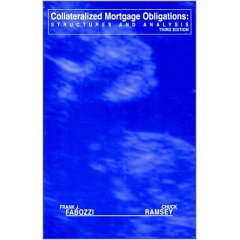
A good intro book is Collateralized Mortgage Obligations
by Chuck Ramsey and Frank Fabozzi
. It goes beyond CMOs and
talks about a lot of the risk horizons and what traders of these
do and play with. Lots of former interest rate traders apparently
do well in this field.


As far as point three: you are talking 'real options' theory here,
and you have to look for a lot of asset value delta to overcome
the (identified) barriers to exit and entry and transactions costs.
I have yet to see a good book on the real options of real estate,
but the ones that come close deal with mineral rights and land
and mostly were developed for energy exploration. Not really
'commercial' or 'residential' real options.

Continue reading "Tranched mortgage pools" »

October 9, 2006

Interest rates, what moves mortgage rates?

So what moves mortgage rates ? Supply. Demand.
Competition for money. Inflation. The Economy.
Expectations. And you, of course.

September 1, 2006

Mortgage economists, who's who 1: Scott Anderson at Wells Fargo

Scott Anderson at Wells Fargo: bio.

Scott Anderson holds a doctorate in economics with an
emphasis in monetary theory and international trade
and finance from George Washington University. He is
responsible for analysis and forecasting of international,
national and regional economic trends. His areas of focus
include macroeconomic and interest rate forecasting,
financial markets, and international economics.

Mr. Anderson provides daily analyses of U.S. economic
news, and produces the Wells Fargo Economics macroeconomic
forecasts. He authors the bi-monthly Wells Fargo California
Outlook report and co-authors Wells Fargo’s weekly Financial
Market Strategies report and the monthly Economic Indicators
report. In addition, he covers the United Kingdom, China, South
Korea, Japan, Hong Kong, and Singapore as part of our
bi-monthly international report.

Mr. Anderson's research is widely read by the financial
and business community and he has appeared in
numerous media including: CNN, Bloomberg, MSNBC,
CBS MarketWatch, BBC, NPR, Wall Street Journal, New York
Times, Financial Times, Washington Post, Los Angeles
Times, Chicago Tribune, USA Today, San Francisco
Chronicle.

Mr. Anderson joined Wells Fargo as senior economist in 2001.

Citation: decade of flat home prices.

August 8, 2006

Rent to mortgage payment ratio

Rent to mortgage payment ratio.

Mortgage payments are senitive to interest rates.
Are rents less sensitive to interest rates ?

Then why would we exprect a constant
mortgage payment to rent ratio ?

August 7, 2006

TBMA Mortgage Prepayment Projection Tables

TBMA Mortgage Prepayment Projection Tables: Questions and Answers

TBMA = The Bond Market Association.

Continue reading "TBMA Mortgage Prepayment Projection Tables" »

August 6, 2006

Hedging beyond duration and convexity

Hedging beyond duration and convexity.

By considering a representation using a Fourier-like harmonic,
empirical evidence that such a series provides our hedging
strategy on a mortgage-backed security (MBS) with the first
four principal components of yield curve.

Continue reading "Hedging beyond duration and convexity" »

August 5, 2006

mortgagebankers

Mortgage Bankers have an association; news on refinancing, prepayment,
orginations, servicing, delinquency, foreclosures, MBS, ABS, securitization.

More like this: mortgage.

July 16, 2006

Two-Factor Mortgage Valuation Model: How Much Do House Prices Matter?

An Empirical Test of a Two-Factor Mortgage Valuation Model:
How Much Do House Prices Matter?

Mortgage-backed securities, with their relative structural simplicity
and their lack of recovery rate uncertainty if default occurs, are
particularly suitable for developing and testing risky debt valuation
models. A two-factor structural mortgage pricing model in which
rational mortgage-holders endogenously choose when to prepay
and default subject to
i. explicit frictions (transaction costs) payable when terminating
their mortgages,
ii. exogenous background terminations, and
iii. a credit related impact of the loan-to-value ratio (LTV) on
prepayment.

We estimate the model using pool-level mortgage termination data
for Freddie Mac Participation Certificates, and find that the effect of
the house price factor on the results is both statistically and
economically significant. Out-of-sample estimates of MBS prices
produce option adjusted spreads of between 5 and 25 basis
points, well within quoted values for these securities.

SUGGESTED CITATION:
Chris Downing, Richard Stanton, and Nancy E. Wallace,
An Empirical Test of a Two-Factor Mortgage Valuation Model:
How Much Do House Prices Matter
?
(link to 406 K, PDF file)

Chris Downing, Federal Reserve Board, Washington, DC
Richard Stanton, Haas School of Business, University of California, Berkeley
Nancy E. Wallace, Haas School of Business, University of California, Berkeley

Continue reading "Two-Factor Mortgage Valuation Model: How Much Do House Prices Matter?" »

July 12, 2006

Mortgage Valuation and Optimal Refinancing, Pliska

An equilibrium valuation of fixed-rate mortgage contracts in
discrete time -- the mortgagor’s prepayment behavior
described by intensity process and with exogenous mortgage
rates, the value of the contract is derived in an explicit form
that can be interpreted as the principal balance plus the
value of a certain swap.

A nonlinear equation for what the mortgage rate in a
competitive market, and thus mortgage rates are endogenous
and depend upon the mortgagor’s prepayment behavior.

The complementary problem, where mortgage rates are
exogenous and the mortgagor seeks the optimal refinancing
strategy, is then solved via a Markov decision chain.

Finally, the equilibrium problem, where the mortgagor
is a representative agent in the economy who seeks the
optimal refinancing strategy and where the mortgage
rates are endogenous, is developed, solved, and analysed.


Mortgage Valuation and Optimal Refinancing, Stanley R. Pliska:
shorter and longer versions.

Continue reading "Mortgage Valuation and Optimal Refinancing, Pliska" »

June 14, 2006

Landholders, Residential Land Conversion, and Market Signals

In some metropolitan real estate markets, large land dealers
considerably influence the conversion of land for residential
use. Their activities may affect the timing, direction, and type
of new development. This study uses the Cleveland, Ohio
metropolitan region to consider whether large landholders
play a major role in residential land conversion in suburban
markets and the extent to which their actions are driven by
market signals.

Continue reading "Landholders, Residential Land Conversion, and Market Signals" »

June 13, 2006

The Complexities of Mortgage Options (Prendergast)

Mortgage option prices behave quite differently than the prices of
options on underlying securities that do not exhibit significant
convexity. As a result, the intuition of many market participants
about option risk characteristics does not typically apply to
mortgage options.

The risk characteristics of these options: negative convexity of
the underlying mortgage and the positive gamma of the option
impact call option convexity in opposing directions. As a result,
call option convexity can be either positive or negative,
depending on the interest rate scenario and option specification.

On the other hand, a mortgage put option is always positively convex.
A quantitative understanding of these risk characteristics is critical
for money managers and broker/dealers who use mortgage options.

The Complexities of Mortgage Options
Prendergast, Joseph R.
THE JOURNAL OF FIXED INCOME
March 2003

June 1, 2006

Mortgage Low Down

mortgagelowdown: looks like automated private label mortgage
related content, but closer to squidoo than domain parking site. [ * ]

May 30, 2006

Best-Practices in Mortgage Default Risk Measurement and Economic Capital

Best-Practices in Mortgage Default Risk Measurement and Economic Capital

Each of the major processes used by industry participants to measure
so-called “credit risk” for first mortgage products. The study has three
sections:

Section I provides a discussion of the general concept of Economic
Capital (“EC”), how EC is measured and used by best-practice banks,
and how EC concepts used by industry practitioners differ from
regulatory definitions of capital.

Section II discusses the various types of theoretical “credit risk
models” that are used by practitioners to measure EC for mortgages.

Section III conducts several empirical experiments in which large
historical databases are used to estimate the credit risk models
described in Section II. The empirical work is aimed at helping
the practitioner and the regulator to evaluate the results of
alternative models.

David Kaskowitz, LoanPerformance
Kyle Lundstedt, LoanPerformance
Alexander Kipkalov, Washington Mutual Inc.
John Mingo, Mingo & Co.
PDF.

May 28, 2006

Mortgage handbook at Treasury

Mortgage Banking, Comptroller’s Handbook (March 1998)

Sample entry:
Price level adjusted mortgage (PLAM). A mortgage loan in
which the interest rate remains fixed, but the outstanding
balance is adjusted for inflation.

PDF

May 10, 2006

Mortgage Payment Reset: only a 1% problem

Mortgage Payment Reset: The Rumor and the Reality.

Our nation is a $10 trillion-per-year economy currently possessing
$19 trillion in household asset value and $11 trillion in homeowner’s
equity. Losses of $110 billion – spread over several years – would
come to only about one percent of the total national homeowners’
equity.

Currently the economy is growing at about 3 percent per year,
adding about $300 billion per year to our national income. Losses
of $30 billion in a year would consume only one-tenth of this
increase, the equivalent of slowing the growth rate from 3% to 2.7%.
According to the Mortgage Bankers Association of America, mortgage
lending totals from $2 trillion to $3 trillion per year. The yearly reset
losses anticipated by this paper would constitute only about one
percent of the total annual lending amount.

Christopher Cagan, director for research and analytics at
First American Real Estate Solutions. PDF
[via NYT]

May 4, 2006

Mortgage refinancing, optimized

Mortgage Valuation and Optimal Refinancing, Pliska (2006)

Landholders, Residential Land Conversion, and
Market Signals
, Margulis (2006)

Mortgage Payment Reset: The Rumor and the Reality,
Christopher Cagan (2006)

Option-Theoretic Prepayment Model for Mortgages,
Fabozzi, Kalotay and Yang. (2004)

The Complexities of Mortgage Options,
Prendergast (2003)

Optimal Recursive Refinancing and the Valuation of
Mortgage-Backed Securities
, Longstaff (2002)

Best-Practices in Mortgage Default Risk Measurement and
Economic Capital
, Kaskowitz, Lundstedt (2002)

Mortgage Banking, Comptroller’s Handbook (1998)

Subprime mortgage rate spread at origination

Residential Mortgage Termination and Severity,
De Franco. (1994)

November 9, 2005

Real estate sentiment at Miller Samuel Soapbox

Real estate sentiment and appraisal of the New York market at
Miller Samuel's Soapbox. [*]
2005 Dec: Promoted to blogroll2.

October 10, 2005

infoproc / Stephen (Steve) Hsu

Infoproc (Steve) is a physicist interested in economic inference.

Example: exporting risk, Redmond visit.

July 25, 2005

Optimal Recursive Refinancing and the Valuation of Mortgage-Backed Securities (Longstaff)

The optimal recursive refinancing problem where a borrower minimizes
his lifetime mortgage costs by repeatedly refinancing when rates
drop. Key factors affecting the optimal decision are the cost of
refinancing and the possibility that the mortgagor may have to
refinance at a premium rate because of his credit.

The optimal recursive strategy often results in prepayment being
delayed significantly relative to traditional models. Furthermore,
mortgage values can exceed par by much more than the cost of
refinancing. Applying the recursive model to an extensive sample of
mortgage-backed security prices, we find that the implied credit
spreads that match these prices closely parallel borrowers’ actual
spreads at the origination of the mortgage. These results suggest
that optimal recursive models may provide a promising alternative
to the reduced-form prepayment models widely used in practice.

Francis A. Longstaff, Anderson School of Management.

Continue reading "Optimal Recursive Refinancing and the Valuation of Mortgage-Backed Securities (Longstaff)" »

July 9, 2005

Subprime mortgage rate spread at origination

Effects largely captured by a single variable: spread at origination
(SATO). SATO measures the difference in the mortgage rate between the
specified loan and a constant-quality subprime mortgage rate. Assuming
that lenders price borrower risk efficiently, a higher SATO
implies a poorer-credit borrower.

Search for more .

June 3, 2005

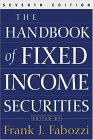
Handbook of Fixed Income Securities (Fabozzi)

The Handbook of Fixed Income Securities
Edited by Frank Fabozzi

Hardcover: 1500 pages
Publisher: McGraw-Hill; 7 edition (April 1, 2005)
ISBN: 0071440992


Part 1. Background.
1. Overview of the Types and Features of Fixed Income Securities.
2. Risks Associated with Investing in Fixed Income Securities.
3. A Review of the Time Value of Money.
4. Bond Pricing and Return Measures.
5. Measuring Interest Rate Risk.
6. The Sturcture of Interest Rates.
7. Bond Market Indexes.

Part 2. Government and Private Debt Obligations.
8. U.S. Treasury and Agency Securities.
9. Municipal Bonds.
10. Private Money Market Instruments.
11. Corporate Bonds.
12. Medium-Term Notes.
13. Inflation-Indexed Bonds (Tips).
14. Floating-Rate Securities.
15. Nonconvertible Preferred Stock.
16. International Bond Markets and Instruments.
17. Brady Bonds.
18. Stable Value Investments.

Part 3. Credit Analysis.
19. Credit Analysis for Corporate Bonds.
20. Credit Considerations in Evaluating High-yield Bonds.
21. Investing in 11 and Other Distressed Companies.
22. Guidelines in the Credit Analysis of General Obligation and Revenue Municipal Bonds.
23. High-Yield Analysis of Emerging Markets Debt.

Part 4. Mortgage-Backed and Asset-Backed Securities.
24. Mortgages and Overview of Mortgage-Backed Securities.
25. Mortgage Pass-Throughs.
26. Collateralized Mortgage Obligations.
27. Nonagency CMOs.
28. Commercial Mortgage-Backed Securities.
29. Securities Backed by Automobile Loans.
30. Securities Backed by Closed-End Home Equity Loans.
31. Securities Backed by Manufactured Housing Loans.
32. Securities Backed by Credit Card Receivables.

Part 5. Fixed Income Analytics and Modeling.
33. Characteristics of and Strategies with Callable Securities.
34. Valuation of Bonds with Embedded Options.
35. Valuation of CMOs.
36. Fixed Income Risk Modeling.
37. OAS and Effective Duration.
38. Evaluation Amortizing ABS. A Primer on Static Spread.

Part 6. Portfolio Management.
39. Bond Management. Past, Current, and Future.
40. The Active Decisions in the Selection of Passive Management and Performance Bogeys.
41. Managing Indexed and Enhanced Indexed Bond Portfolios.
42. Global Corporate Bond Portfolio Management.
43. Management of a High-Yield Bond Portfolio.
44. Bond Immunization. An Asset/Liability Optimization Strategy.
45. Dedicated Bond Portfolios.
46. Managing Market Risk Proactively at Long-Term Investment Funds.
47. Improving Insurance company Portfolio Returns.
48. International Bond Investing and Portfolio Management.
49. International Fixed Income Investing. Theory and Practice.

Part 7. Equity-Linked Securities and Their Valuation.
50. Convertible Securities and Their Investment Characterics.
51. Convertible Securities and Their Valuation.

Part 8. Derivative Instruments and Their Portfolio Management Applications.
52. Introduction to Interest-Rate Futures and Options Contracts.
53. Pricing Futures and Portfolio Applications.
54. Treasury Bond Futures Mechanics and Basis Valuation.
55. The Basics of Interest-Rate Options.
56. Controlling Interest Rate Risk and Futures and Options.
57. Interest-Rate Swaps.
58. Interest-Rate Caps and Floors and Compound Options.

June 2, 2005

Fixed Income Securities: Tools for Today's Markets (Tuckman)

Fixed Income Securities: Tools for Today's Markets,
Second Edition by Bruce Tuckman.

1. THE RELATIVE PRICING OF FIXED INCOME SECURITIES WITH FIXED CASH FLOWS.
# Bond Prices, Discount Factors, and Arbitrage.
# Bond Prices, Spot Rates, and Forward Rates.
# Yield to Maturity.
# Generalizations and Curve Fitting.

2. MEASURES OF SENSITIVITY AND HEDGING.
# One-Factor Measures of Sensitivity.
# Measures of Price Sensitivity Based on Parallel Yield Shifts.
# Key Rate and Bucket Exposures.
# Regression-Based Hedging.

3. TERM STRUCTURE THEORY AND MODELS.
# The Science of Term Structure Models.
# The Short-Rate Process and the Shape of the Term Structure.
# The Art of Term Structure Models: Drift.
# The Art of Term Structure Models: Volatility and Distribution.
# Multi-Factor Term Structure Models.
# Trading with Term Structure Models.

4. ANALYSIS OF SELECTED SECURITIES.
# Repo.
# Forward Markets.
# Eurodollar and Fed Fund Futures.
# Interest Rate Swaps.
# Fixed Income Options.
# Note and Bond Futures.
# Mortgage-Backed Securities.

May 17, 2005

Inmann

Inmann, mortgage blogger, is barkerishly spammy.

Useful listing of mortgage headlines; links are to pay-per-view versions
of what can was distributed by wire services.

May 15, 2005

Mortgage business complements auto business

  auto lending
+ real estate lending
-------
synergy

”We find the mortgage business to be very complementary with our
auto business,” said Bob Brisco, chief executive of CarsDirect.

Continue reading "Mortgage business complements auto business" »

April 26, 2005

Residential Mortgage Termination and Severity, De Franco

Modeling Residential Mortgage Termination and Severity
Using Loan Level Data

Three essays on modeling residential mortgages.

Chapter 1 presents and estimates a new model of loss given
default using a new dataset of prime and subprime mortgages. The
model combines option theory proxies with information on the loan
contract and the cash flow position of the borrower. The results
suggest that severity on subprime and adjustable rate mortgages are
similar to losses on fixed rate prime loans, but that investor owned
properties have significantly higher losses than owner occupied
houses. The results also suggest systemic overappraisals on refinanced
loans.

Chapter 2 uses option pricing methodology to value the prepayment and
default options associated with a residential mortgage, if house
prices are mean reverting.

Numerical solutions compare the results from the mean reverting house
price model to the results from a model where house prices follow a
geometric Brownian motion process.

The main contributions are:

(1) the value of the implicit rent (service flow) is derived as a
function of the house price process instead of assumed to be constant,
as in prior research;

(2) the mean reverting model has additional factors that may help
forecast mortgage termination; and

(3) the house price process is shown to have a significant effect on
the value of a mortgage over a wide range of parameter values.

Chapter 3 presents a modeling framework for residential mortgages that
has separate models for each loan payment status (Current, 30 Days
Late, 60 Days Late, 90+ Days Late, in Foreclosure, in REO, or Paid
Off). It is shown that several classes of traditional mortgage
prepayment and default models are restricted forms of this model, and
that the restrictions are rejected empirically.

Continue reading "Residential Mortgage Termination and Severity, De Franco" »

April 24, 2005

Option-Theoretic Prepayment Model for Mortgages: Fabozzi , Kalotay and Yang

A new approach for modeling the prepayments of a mortgage pool
shows how to value mortgage pools and agency mortgage-backed
securities. A notion of refinancing efficiency describes the
full spectrum of refinancing behavior.

The approach has two distinguishing features:

(1) The primary focus is on understanding the market value of a
mortgage, in contrast with standard models that strive (often
unsuccessfully) to predict future cash flows, and

(2) we use two separate yield curves, one for discounting mortgage
cash flows and the other for MBS cash flows.

An Option-Theoretic Prepayment Model for Mortgages and Mortgage-
Backed Securities

To appear in International Journal of Theoretical and Applied Finance
Dec 2004, jrg 7, nr 8, december 2004, pages 949-978.
[PDF]

April 20, 2005

Calculated Risk

Calculated Risk offers nicely illustrated economics.

There has been a significant increase in mortgage brokers. There
has been a similar increase in residential building trades, appraisers,
home inspectors and other housing related occupations. The
impact of a housing slowdown on employment will be significant.

What will the end of the refinance boom and the housing boom
do to the mortgage industry ?

Continue reading "Calculated Risk" »

April 14, 2005

thehousingbubble

thehousingbubble, not to be confused with housingbubble track
over financed, over mortgaged real estate.

April 5, 2005

Housing bubble bloggers

housingbubble, moderately frequent. not to be confused with
thehousingbubble. Both track home of those who over finance,
over mortgage their real estate.

January 9, 2005

Mortgage Blogs

The Mortgages Blog (by weblogsinc) is frequently updated with
mortgage industry news mixes some news items and more outside
links with descriptions.

Bankrate is potpourri of mortgage and consumer finance content,
more written for consumers than lenders, and syndicated onto
many consumer sites.

November 20, 2004

scholar.google.com searches refereed publications

scholar.google.com searches refereed publications.
Sample search mortgage prepayment modlleing.