Main

September 23, 2011

Optimal number and locations of fire stations, by RAND


Take the 1968 decision by New York Mayor John V. Lindsay to hire the RAND Corporation to streamline city management through computer models. It built models for the Fire Department to predict where fires were likely to break out, and to decrease response times when they did. But, as the author Joe Flood details in his book "The Fires," thanks to faulty data and flawed assumptions -- not a lack of processing power -- the models recommended replacing busy fire companies across Brooklyn, Queens and the Bronx with much smaller ones.

What RAND could not predict was that, as a result, roughly 600,000 people in the poorest sections of the city would lose their homes to fire over the next decade. Given the amount of money and faith the city had put into its models, it's no surprise that instead of admitting their flaws, city planners bent reality to fit their models -- ignoring traffic conditions, fire companies' battling multiple blazes and any outliers in their data.

The final straw was politics, the very thing the project was meant to avoid. RAND's analysts recognized that wealthy neighborhoods would never stand for a loss of service, so they were placed off limits, forcing poor ones to compete among themselves for scarce resources. What was sold as a model of efficiency and a mirror to reality was crippled by the biases of its creators, and no supercomputer could correct for that.

Continue reading "Optimal number and locations of fire stations, by RAND" »

August 13, 2011

Age of Greed ? Jeff Madrick


If the greed of Boesky or Weill is unsurprising, the lack of greed evinced by some of Madrick's characters is striking. Paul Volcker, the Fed chairman whom Madrick eccentrically berates for his determined fight against inflation, was known to be frugal; John Reed, Citigroup's boss during the 1990s, was by Madrick's own account "thoughtful and unflashy." Reagan himself was more enthusiastic about self-reliance and hard work than about material advancement, remarking that "free enterprise is not a hunting license." Early in his career, Walter Wriston, Reed's predecessor at Citi and perhaps the character whom Madrick conjures most successfully, was offered a salary of $1 million to move to Monaco and work for Aristotle Onassis. He chose to remain in a middle-income housing project in Stuyvesant Village.

Age of Greed: The Triumph of Finance and the Decline of America, 1970 to the Present


Sebastian Mallaby -- the Paul A. Volcker senior fellow at the Council on Foreign Relations, is the author of "More Money Than God: Hedge Funds and the Making of a New Elite."

BOOKS
Why We Deregulated the Banks
By SEBASTIAN MALLABY
Published: July 29, 2011
Jeff Madrick traces the regulatory and cultural changes that led to America's current financial trouble.

Continue reading "Age of Greed ? Jeff Madrick" »

July 30, 2011

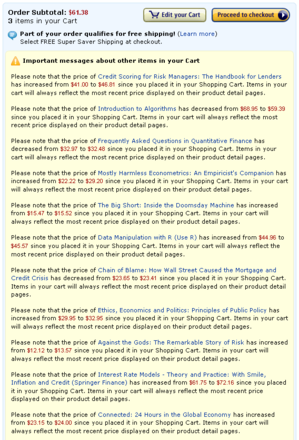
Amazon prices change


Prices at Amazon change, often.

amazon_prices_change.png

July 29, 2011

Mike Mayo's Exile on Wall Street


"Look, if you can't compete in the major leagues for over a decade, it's time to go back to the minors," said the always outspoken Mike Mayo, an analyst with CLSA. His chronicle of ruffling bank management feathers, "Exile on Wall Street" (Wiley), will be published in the fall.

JPMorgan Chase is as well managed as any gargantuan bank can be. But if you look at its businesses, it's hard to see any area where it is clearly the best, something even its own executives concede. Not in credit cards, where the premier name is American Express. Not in money management, where you might offer up T. Rowe Price. Investment banking -- Goldman Sachs (the last quarter notwithstanding). Back-office transactions, State Street.

Yet even JPMorgan is merely trading at book value. Put another way, the market regards the value that JPMorgan provides as a financial services conglomerate as zilch. How well do all of JPMorgan's divisions work together? In presentations to investors, JPMorgan executives show how much revenue they gain from existing clients. But these measures are hardly unbiased. Executives have an incentive to defend their empires. Who is to say that a certain division of JPMorgan wouldn't have won that business anyway? And nobody measures how much a bank loses through conflicts of interest.

Making a nuanced argument, John Hempton, a blogger, investor and former regulator in Australia, says that it's better for shareholders -- and societies -- to have large banks with lots of market power. That makes them more profitable and leads them to take less risk, making them safer and more enticing for investors.

July 24, 2011

Credit due in South America


South American countries -- including Chile and Brazil, two of the region's healthiest economies -- are going through growing pains as the use of credit grows. The credit-fueled spending has driven extensive economic growth. But it has also opened the door to abuses, as credit issuers have used predatory techniques to lure customers, particularly young and less affluent ones, in countries where regulation is scant, annual interest charges can top 220 percent and consumers cannot seek bankruptcy protection, economists and consumer defense groups say.

"They are learning every trick that was learned in the United States to make credit cards the most valuable part of the banking business," said Lewis Mandell, a professor emeritus at the State University of New York at Buffalo, who wrote a book on the history of the credit card industry. "And unfortunately, the problems this caused in the United States are likely to repeat themselves in Latin America."

July 6, 2011

Gingrich lead


Once again America faced a crossroads, though the word itself wasn't used. "There is virtually no middle ground," Gingrich wrote. He later concluded: "To renew or to decay. At no time in the history of our great nation has the choice been clearer." To avert disaster, Gingrich had no choice but to present many numbered lists. In addition to the Six Challenges Facing America -- similar to the challenges we faced 11 years before -- and the "five basic principles that I believe form the heart of our civilization," there were the five forces moving us toward worldwide medicine, a seven-step program to reduce drug use, the nine steps we can take immediately to advance the three revolutions in health care and more. The futurism was still there, too: "Honeymoons in space will be the vogue by 2020."

Meanwhile, his polemics had hardened. "For some psychological reason, liberals are antigun but not anti-violent criminal," was a typically dubious example. As a former professor (an unpublished one, at West Georgia College), Gingrich wrote about university leftism with all the bitterness of an ex-academic: "Most successful [alumni] get an annual letter saying, in effect, 'Please give us money so we can hire someone who despises your occupation and will teach your children to have contempt for you.' What is amazing is the overwhelming meekness of the alumni in accepting this hijacking of their alma mater."

This is sharp and funny and nearly true, but it's not a formulation designed to coax the undecided into agreement. "To Renew America" marks the moment that persuasion faded as a primary purpose of political talk and preaching to the choir took over. Having won at last, and confident that the future was safely in his pocket, Gingrich by 1995 no longer saw a reason to persuade anyone and didn't try. It's the victor's prerogative, but it doesn't give you practice in constructing arguments. And it's catching. Hence talk radio, and in a few years the blogs; hence Fox News and MSNBC.

Liberals may not have liked this new aggressive tone from conservatives, but they had it coming. At least since the Red Scare of the 1950s, mainstream institutions had viewed ideological conservatism with condescension or contempt, as either a joke or a personality disorder -- a series of "irritable mental gestures which seek to resemble ideas," in Lionel Trilling's excellent summary. Gingrich's rhetoric had the ferocity of a backlash. The liberal revulsion toward him obscured how unorthodox -- occasionally, how liberal -- his conservatism was. The books then and now are full of heresy. He showed a willingness to criticize other Republicans, even Reagan at the height of his popularity. He advocated a health tax on alcohol to discourage drinking -- social engineering, it's called -- and imagined government-issued credit cards that would allow citizens to order goods and services directly from the feds. He thought the government should run nutritional programs at grocery stores and give away some foodstuffs free. He was pushing cuts in the defense budget in 1984 and a prototype of President Obama's cash-for-clunkers program in 1995.

Continue reading "Gingrich lead " »

May 30, 2011

Risk-reward ratio that applies to everyone else


In one recent study, researchers led by Adam Galinsky of Northwestern University primed participants to feel powerful by having them write about an incident in which they had control over others and then distribute lottery tickets to themselves and another study subject. These "high-powered" people were significantly less accurate in reading emotions from facial photographs than a comparison group of participants who were not primed in the same way. This and other experiments suggest that power can blind people to the emotions of those around them and lead to "objectifying others in a self-interested way," the authors concluded.

"If the person has this sense of superiority, and they've gotten away with these kinds of things before, they begin to think that the risk-reward ratio that applies to everyone else doesn't apply to them because they're so special," said Samuel Barondes, a professor of psychiatry at the University of California, San Francisco, and author of the forthcoming, "Making Sense of People." "It's hard for people who don't think that way about themselves to believe that anyone else really does. But they do."

The exception may be the sort of man who is so consumed with advancement that certain personality traits go unexamined or unexpressed along the way. Feelings of inadequacy, a longing for paths not taken, or a sense of gratification too long delayed can prompt the taking of one small risk, one awkward advance, and then another, therapists say. It's easy to ridicule such motives, and they do not justify the harm done to others when the chairman reaches for the cookie jar, or the thigh of a Congressional page. But they are motives nonetheless -- for sexual transgressions, if only rarely sexual deviance.

Continue reading "Risk-reward ratio that applies to everyone else" »

May 1, 2011

Whited sepulchers


The influence of the King James Bible is so great that the list of idioms from it that have slipped into everyday speech, taking such deep root that we use them all the time without any awareness of their biblical origin, is practically endless: sour grapes; fatted calf; salt of the earth; drop in a bucket; skin of one's teeth; apple of one's eye; girded loins; feet of clay; whited sepulchers; filthy lucre; pearls before swine; fly in the ointment; fight the good fight; eat, drink and be merry.

Continue reading "Whited sepulchers" »

April 24, 2011

Americans do not want to be involved in politics


"Governing isn't, and shouldn't be, about party loyalty. It's about what's best for America."
Isn't this the mantra of Village thinking? Oh politics, when will you ever grow up?


Americans often complain about the operation of their government, but scholars have never developed a complete picture of people's preferred type of government. In this provocative and timely book, Hibbing and Theiss-Morse, employing an original national survey and focus groups, report the governmental procedures Americans desire. Contrary to the prevailing view that people want greater involvement in politics, most citizens do not care about most policies and therefore are content to turn over decision-making authority to someone else. People's wish for the political system is that decision makers be empathetic and, especially, non-self-interested, not that they be responsive and accountable to the people's largely nonexistent policy preferences or, even worse, that the people be obligated to participate directly in decision making.

Stealth democracy: Americans' beliefs about how government should work
John R. Hibbing, Elizabeth Theiss-Morse

Continue reading "Americans do not want to be involved in politics" »

March 25, 2011

Learning a skill so well you don't think about it

When people first learn to use a keyboard, they improve very quickly from sloppy single-finger pecking to careful two-handed typing, until eventually the fingers move effortlessly and the whole process becomes unconscious. At this point, most people's typing skills stop progressing. They reach a plateau. If you think about it, it's strange. We've always been told that practice makes perfect, and yet many people sit behind a keyboard for hours a day. So why don't they just keeping getting better and better?

In the 1960s, the psychologists Paul Fitts and Michael Posner tried to answer this question by describing the three stages of acquiring a new skill. During the first phase, known as the cognitive phase, we intellectualize the task and discover new strategies to accomplish it more proficiently. During the second, the associative phase, we concentrate less, making fewer major errors, and become more efficient. Finally we reach what Fitts and Posner called the autonomous phase, when we're as good as we need to be at the task and we basically run on autopilot. Most of the time that's a good thing. The less we have to focus on the repetitive tasks of everyday life, the more we can concentrate on the stuff that really matters. You can actually see this phase shift take place in f.M.R.I.'s of subjects as they learn new tasks: the parts of the brain involved in conscious reasoning become less active, and other parts of the brain take over. You could call it the O.K. plateau.

Continue reading "Learning a skill so well you don't think about it" »

March 16, 2011

Ability to mask disappointment


Studies of emotional cognition in preschoolers have shown that the ability to mask disappointment is highly correlated with perceived social skill level. "Display rules," that is, accepted social guidelines dictating the expression of emotions, can be seen in use by children as young as three years old--children who don't yet fully understand the difference between authentic and fabricated emotions. Writers, who understand nothing if not the difference between authentic and fabricated emotions, are often shockingly bad at hiding their own disappointments. For example: begin talking about trying the writing life, about applying to MFA programs, and the first thing anyone who has gone through a writing program will tell you is, "Don't expect to get anything out of it." You'll be told that workshop is harsh (or else stupid), that creative writing teaching jobs are a figment of Jane Smiley's imagination, that James Franco is the only person in the country allowed to publish short stories anymore. You'll be assured, essentially, that putting pen to paper is bad business.

On Expectations (And A Writer's Lack Of Same)
by S.J. Culver on March 17th, 2011

March 14, 2011

Our interest is voyeuristic -- Nick Denton


"It's helpful when someone is a hypocrite, but we should have just said that our interest is voyeuristic. 'We did this story because we thought you would like it. We thought it was funny, so we thought you'd think it was funny, too.' And there was a tidal wave of traffic and attention."

-- Nick Denton at Gawker HQ on Elizabeth Street in Lower Manhattan early this year.

Continue reading "Our interest is voyeuristic -- Nick Denton" »

February 21, 2011

Man up ?


Young men are tuning in to cable channels like Comedy Central, the Cartoon Network and Spike, whose shows reflected the adolescent male preferences of its targeted male audiences. They watched movies with overgrown boy actors like Steve Carell, Luke and Owen Wilson, Jim Carrey, Adam Sandler, Will Farrell and Seth Rogen, cheering their awesome car crashes, fart jokes, breast and crotch shots, beer pong competitions and other frat-boy pranks. Americans had always struck foreigners as youthful, even childlike, in their energy and optimism.

Pre-adulthood can be compared to adolescence, an idea invented in the mid-20th century as American teenagers were herded away from the fields and the workplace and into that new institution, the high school. For a long time, the poor and recent immigrants were not part of adolescent life; they went straight to work, since their families couldn't afford the lost labor and income. But the country had grown rich enough to carve out space and time to create a more highly educated citizenry and work force. Teenagers quickly became a marketing and cultural phenomenon. They also earned their own psychological profile. One of the most influential of the psychologists of adolescence was Erik Erikson, who described the stage as a "moratorium," a limbo between childhood and adulthood characterized by role confusion, emotional turmoil and identity conflict.

Continue reading "Man up ?" »

December 27, 2010

Intellectual capture of regulators


What one might call intellectual capture. While I would strongly argue that the FSA in my day did not favor firms unduly, it is perhaps true that we--and in this we were exactly like our American counterparts--were inclined to believe that markets were generally efficient. If willing buyers and willing sellers were trading claims happily, then, as long as they were "professional" investors, there was no legitimate reason to interfere in their markets. These people were "consenting adults in private," and the state should avert its gaze.
We now know that some of these market emperors had no clothes--and that their activities were far from benign: They could result in severe financial instability and generate serious losses for taxpayers, not to mention precipitate a global recession. That has been a grave lesson for regulators and central banks.

-- Howard Davies, former chairman of Britain's Financial Services Authority and a former deputy governor of the Bank of England, is director of the London School of Economics. His latest book is Banking on the Future: The Fall and Rise of Central Banking.

August 6, 2010

Fault Lines: How Hidden Fractures Still Threaten the World Economy


In "Fault Lines: How Hidden Fractures Still Threaten the World Economy" (Princeton University, $26.95), Raghuram G. Rajan concludes that the financial crisis erupted "because in an integrated economy and in an integrated world, what is best for the individual actor or institution is not always best for the system."

Like geological fault lines, the fissures in the world economic system are more hidden and widespread than many realize, he says. And they are potentially more destructive than other, more obvious culprits, like greedy bankers, sleepy regulators and irresponsible borrowers.

Mr. Rajan, a finance professor at the University of Chicago and former chief economist at the International Monetary Fund, argues that the actions of these players (and others) unfolded on a larger worldwide stage, that was (and is) subject to the imperatives of political economies.

He cites three fault lines: domestic political stresses; trade imbalances among countries; and the tensions produced when financial systems with very different structures interact. All three came together to damage the financial sector in 2008, he says, and could meet again to cause another crisis.

Continue reading "Fault Lines: How Hidden Fractures Still Threaten the World Economy" »

August 5, 2010

Value pricing comint to text book market ?

(Known in economics as price discrimination or price differentiation)


"We are spending $8 billion to $15 billion per year on textbooks" in the United States, Mr. McNealy says. "It seems to me we could put that all online for free."

The nonprofit Curriki fits into an ever-expanding list of organizations that seek to bring the blunt force of Internet economics to bear on the education market. Even the traditional textbook publishers agree that the days of tweaking a few pages in a book just to sell a new edition are coming to an end.

"Today, we are engaged in a very different dialogue with our customers," says Wendy Colby, a senior vice president of Houghton Mifflin Harcourt. "Our customers are asking us to look at different ways to experiment and to look at different value-based pricing models."

Continue reading "Value pricing comint to text book market ?" »

August 1, 2010

More Money Than God, Sebastian Mallaby

Since the princes are nicer and more impressive, it is easy to be seduced into the belief that they also are more trustworthy. This is false. During the last few years, for example, the princes at Citigroup, Bear Stearns, Goldman Sachs and Lehman Brothers behaved with incredible stupidity while the hedge fund loners often behaved with impressive restraint.

As Sebastian Mallaby shows in his superb book, "More Money Than God", the smooth operators at the big banks were playing with other people's money, so they borrowed up to 30 times their investors' capital. The hedge fund guys usually had their own money in their fund, so they typically borrowed only one or two times their capital.

The social butterflies at the banks got swept up in the popular enthusiasms. The contrarians at the hedge funds made money betting against them. The well-connected bankers knew they'd get bailed out if anything went wrong. The solitary hedge fund guys knew they were on their own and regarded their trades with paranoid anxiety.

Continue reading "More Money Than God, Sebastian Mallaby" »

July 25, 2010

Justice Elena Kagan: a reasonable person pursuing reasonable purposes reasonably ?


The most interesting question about the Kagan nomination remains this: Why did Barack Obama nominate someone with largely unknown legal and political views to a lifetime appointment on the Supreme Court? Under the circumstances we can do little more than guess, but I would venture that three inter-related factors were crucial. First, Obama himself, as a former president of the Harvard Law Review and University of Chicago law professor, has been immersed in cultural context -- elite legal academia -- which puts a great deal of stock in the belief that being a good Supreme Court justice is largely a matter of technical competence. Legal academia is (quite literally) invested in the idea that being a "good" judge means accepting "good" legal arguments and rejecting "bad" ones, with good and bad defined as the correct and incorrect application of legal rules. This belief is absurd - any case that reaches the Supreme Court can't be resolved merely through the application of legal rules - but its persistence signals how important it still is to American law schools, which remain committed, against all intellectual odds, to maintaining a sharp distinction between "law" and "politics."

Continue reading "Justice Elena Kagan: a reasonable person pursuing reasonable purposes reasonably ?" »

July 13, 2010

Perpetual trusts: The Rising Power of the American Dead


Tax breaks are not the only special advantages that American dynasty trusts provide. Even more troubling, they commonly include a "spendthrift clause," which provides that trust assets cannot be reached by a beneficiary's creditors. If a beneficiary causes a car accident, for example, the victim cannot be compensated with assets from the trust, even if they are the driver's only resources. So beneficiaries are free to behave as recklessly as they like, knowing that their money is forever protected for themselves and their heirs.

Surprisingly, dynasty trusts can also be bad for the beneficiaries themselves. Many wealthy people agree with Andrew Carnegie and Warren Buffett that it is not in their children's best interest for them to be given so much wealth that they don't need to work. Dynasty trusts rob future parents of the ability to decide this for their children, because the ancestor creating the trust is the one who determines how much wealth each generation of his descendants will receive.

What can be done to eliminate these trusts? A state-level solution is unlikely, since all 50 states would need to act in unison. But Congress could fix the problem by limiting the generation-skipping-transfer exemption to trusts that last no longer than two generations. After that, beneficiaries of a trust should be subject to tax, like everyone else. Then America would not have to face the uncontrollable growth of a new aristocracy.

Ray D. Madoff, a professor at Boston College Law School, is the author of "Immortality and the Law: The Rising Power of the American Dead."

Continue reading "Perpetual trusts: The Rising Power of the American Dead" »

June 11, 2010

Vocabulary vs income: Children in higher socioeconomic homes hear 2,153 words an hour; in working-class households only 1,251; on welfare, 616


Betty Hart and Todd R. Risley's landmark 1995 book, "Meaningful Differences in the Everyday Experience of Young American Children," shows that parents who supply a language-rich environment for their children help them develop a wide vocabulary, and that helps them learn to read.

The book connects language use at home with socioeconomic status. According to its findings, children in higher socioeconomic homes hear an average of 2,153 words an hour, whereas those in working-class households hear only about 1,251; children in the study whose parents were on welfare heard an average of 616 words an hour.

The question is: Will devices like smartphones change that? Smartphone users tend to have higher incomes; research from the Nielsen Company shows that they are twice as likely to make more than $100,000 a year than the average mobile subscriber. If increased use of technology encroaches on the time that well-to-do families spend communicating with their children, some could become the victims of successes originally thought to help them.

Continue reading "Vocabulary vs income: Children in higher socioeconomic homes hear 2,153 words an hour; in working-class households only 1,251; on welfare, 616 " »

March 22, 2010

Edward Chancellor: A History of Financial Speculation


If that's the case, speculators are far from being a plague on the markets. Instead, they help reduce risk by taking on the other side of popular trades, resisting the herd mentality that creates bubbles in the first place.

The speculator "loves freedom, detests cant and abhors restrictions," Edward Chancellor wrote in his 1999 book, "Devil Take the Hindmost: A History of Financial Speculation."

According to Mr. Chancellor, a financial strategist in Boston, speculators aren't motivated by greed, after all. Instead, idealism fuels their trades.

"The essence of speculation remains a utopian yearning for freedom and equality which counterbalances the drab rationalistic materialism of the modern economic system with its inevitable inequalities of wealth," he argued in his book.

Continue reading "Edward Chancellor: A History of Financial Speculation" »

March 18, 2010

Financial and business spys ?


The result is "Broker, Trader, Lawyer, Spy: The Secret World of Corporate Espionage" (Harper Business, 306 pages), Mr. Javers's account of how he doggedly tracked down rent-a-spies in United States and Europe and tried to get them to divulge their mysteries.

vs

Germany's Finance Minister Wolfgang Schaeuble told the Bundestag on March 16 that the country may have to consider ordering "intelligence agencies to set up surveillance of who is getting together with whom for which kinds of speculative processes, and where" to protect the euro

January 7, 2010

Theorists and practitioners of intelligence

Then, as now, theorists and practitioners of intelligence sought a smoothly functioning, highly efficient and seamlessly integrated organization, or cluster of organizations. But they struggled at it, largely because the purposes to which intelligence were put were complex and at times contradictory.

In his book "Cloak and Gown," published in 1987, the Yale historian Robin Winks pointed out, "The 'intelligence debate' was framed in 1949." That was the year a classic text, Sherman Kent's "Strategic Intelligence for American World Policy," came out.

To Kent, the best intelligence-gathering was the work "of devoted specialists molded into a vigorous production unit," who prized the arts of data accumulation and nonideological analysis.

Kent's book was widely adopted by intelligence services around the world. But it also had critics, among them the political scientist Willmoore Kendall, a onetime adviser to the C.I.A. He wrote that Kent's approach, influenced by the Pearl Harbor attack, betrayed "a compulsive preoccupation with prediction, with the elimination of 'surprise' from foreign affairs."

This was a worthy goal in wartime, Mr. Kendall said, but in peacetime the most useful intelligence provided the big "pictures" of the world that decision makers needed for formulating broad policy. Intelligence experts therefore should not just acquire and analyze information; they should interpret it as well.


Continue reading "Theorists and practitioners of intelligence " »

November 14, 2009

Malcolm Gladwell's Science

An eclectic essayist is necessarily a dilettante, which is not in itself a bad thing. But Gladwell frequently holds forth about statistics and psychology, and his lack of technical grounding in these subjects can be jarring. He provides misleading definitions of "homology," "saggital plane" and "power law" and quotes an expert speaking about an "igon value" (that's eigenvalue, a basic concept in linear algebra). In the spirit of Gladwell, who likes to give portentous names to his aperçus, I will call this the Igon Value Problem: when a writer's education on a topic consists in interviewing an expert, he is apt to offer generalizations that are banal, obtuse or flat wrong.


What the Dog Saw: And Other Adventures by Malcolm Gladwell

Outliers: The Story of Success by Malcolm Gladwell

The Tipping Point: How Little Things Can Make a Big Difference by Malcolm Gladwell

Blink: The Power of Thinking Without Thinking by Malcolm Gladwell

The problem with Gladwell's generalizations about prediction is that he never zeroes in on the essence of a statistical problem and instead overinterprets some of its trappings. For example, in many cases of uncertainty, a decision maker has to act on an observation that may be either a signal from a target or noise from a distractor (a blip on a screen may be a missile or static; a blob on an X-ray may be a tumor or a harmless thickening). Improving the ability of your detection technology to discriminate signals from noise is always a good thing, because it lowers the chance you'll mistake a target for a distractor or vice versa. But given the technology you have, there is an optimal threshold for a decision, which depends on the relative costs of missing a target and issuing a false alarm. By failing to identify this trade-off, Gladwell bamboozles his readers with pseudoparadoxes about the limitations of pictures and the downside of precise information.

Continue reading "Malcolm Gladwell's Science" »

October 17, 2009

Whitopian migration results from tempting pulls as much as alarming pushes

When those pop-up lists beckon you from your Web browser ("Retire in Style: Fifteen Hotspots!"), or those snappy guidebooks flirt with you from the bookstore shelves (America's 25 Best Places to Live!), ever notice how white they are?
Whitopian migration results from tempting pulls as much as alarming pushes. The places luring so many white Americans are revealing. The five towns posting the largest white growth rates between 2000 and 2004 -- St. George, Utah; Coeur d'Alene, Idaho; Bend, Oregon; Prescott, Arizona; and Greeley, Colorado -- were already overwhelmingly white. Certainly whiter than the places that new arrivals left behind and whiter than the country in general. We know why white folks are pushed from big cites and their inner-ring suburbs. The Whitopian pull includes economic opportunity, more house for your dollar, a yearning for the countryside, and a nostalgic charm.

Most whites are not drawn to a place explicitly because it teems with other white people. Rather, the place's very whiteness implies other perceived qualities. Americans associate a homogeneous white neighborhood with higher property values, friendliness, orderliness, cleanliness, safety, and comfort. These seemingly race-neutral qualities are subconsciously inseparable from race and class in many whites' minds. Race is often used as a proxy for those neighborhood traits. And, if a neighborhood is known to have those traits, many whites presume -- without giving it a thought -- that the neighborhood will be majority white.

Searching for Whitopia: An Improbable Journey to the Heart of White America (Hardcover)
by Rich Benjamin (Author)

September 14, 2009

Health and Politics in the Oval Office, Blumenthal and Morone

Blumenthal and Morone's most provocative finding is that presidents who have been most successful in moving the country toward universal health coverage have disregarded or overruled their economic advisers. Plans to expand coverage have consistently drawn cautions or condemnations from economic teams in every administration, from Harry Truman's down to George W. Bush's. An exasperated Lyndon Johnson groused to Ted Kennedy that "the fools had to go to projecting" Medicare costs "down the road five or six years." Such long-term projections meant political headaches. "The first thing, Senator Dick Russell comes running in, says, 'My God, you've got a one billion dollar [estimate] for next year on health. Therefore I'm against any of it now." Johnson rejected his advisers' estimates and intentionally lowballed the cost. "I'll spend the goddamn money." An honest economic forecast would most likely have sunk Medicare.


51piguVyh0L._SS500_.jpg

THE HEART OF POWER: Health and Politics in the Oval Office
By David Blumenthal and James A. Morone

Illustrated. 484 pp. University of California Press. $26.95


Books / Sunday Book Review
Critical Care
By ROBERT B. REICH
Published: September 6, 2009
This history of health policy and the Oval Office shows that the presidents who made the biggest steps in the direction of universal care have acted despite their economic advisers.

Continue reading "Health and Politics in the Oval Office, Blumenthal and Morone" »

August 29, 2009

Facebook, your personal life commercialized.

AN INQUIRY You're not the first to think it's creepy to have your personal life commercialized. Jürgen Habermas has been especially eloquent about this. Start with "The Theory of Communicative Action." Copies are available on AbeBooks.com. Also interesting on this score: "The Purchase of Intimacy," by Viviana Zelizer.

Continue reading "Facebook, your personal life commercialized." »

July 19, 2009

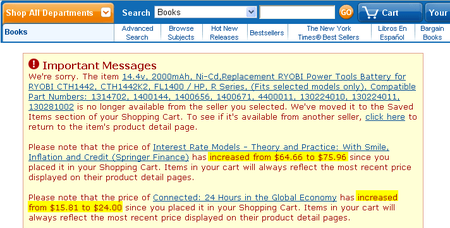
Amazon book price inflation

After placing some books in the cart, but not checking out, I return an am warned that these desired but unpurchased item are now much more expensive.

amazon_price_increase.png


See also

Amazon Prime $79 Refund class action suit

New is cheaper than used: Falkenstein's Finding Alpha and Ritholtz (Big Picture) Bailout Nation new vs used price arbitrage.

July 10, 2009

Street Fighters (Kate Kelly)

Street Fighters tells an engaging tale focused upon how a mighty firm was reduced to rubble in three days. You know the ending before you start reading, but it is no less engaging. The author has a nice sense of the characters and has done extensive research into backgrounds. We not only learn about the major players, we learn what everyone else thought about them.

Street Fighters aims to tell the story in 72 hours, not examine structural problems in finance, and succeeds.

Continue reading "Street Fighters (Kate Kelly)" »

July 6, 2009

Sales tax clampdown on internet merchant

The shots heard 'round the web: Amazon.com has closed its internet associate programs in Hawaii, North Carolina and Rhode Island after the states enacted laws requiring out-of-state internet vendors to collect sales taxes.

-- By Jeff Segal, Considered view, 01 Jul 2009

Continue reading "Sales tax clampdown on internet merchant" »

June 28, 2009

Bubble: Shiller @2005

YALE ECONOMIST ROBERT SHILLER delivers his forecast for U.S. housing with a scholarly diffidence that only slightly mutes his stark message: The market is in the throes of a bubble of unprecedented proportions that probably will end ugly.

Such unsettling talk is cheap, of course, especially from a tenured academic, and many sources, including Barron's, have wrongly predicted housing's downfall several times in the past few years. But the Ivy League professor's forecasts of coming trouble have been right before. His best seller Irrational Exuberance, predicting a bear market in U.S. stocks, hit the bookstores in March 2000, less than a week before the Nasdaq began a dizzying descent from above 5000 that would destroy 75% of its value in a little over 2½ years.

In the real-estate market, Shiller contends, a price slide could begin at any time with the crescendo of what he describes simply as "talk" -- a word that he uses to cover everything from the recent Time magazine cover story on the vertiginous rise in home prices and the popularity of cable-television shows about rehabilitating and investing in real estate to the breathless newspaper stories of Miami condos being "flipped" for profit a half-dozen times before construction even begins.

Continue reading "Bubble: Shiller @2005" »

June 24, 2009

Money in search of home owners ?

So tells Alyssa Katz' Our Lot: How Real Estate Came to Own Us in an engaging economic history.

How and when did home mortgages become Wall Street's playthings?
Who invented subprime loans - and how did they remain legal?
Who won the presidency promising to help as many Americans as possible buy a home?
What did Fannie Mae really do?
How did renters become second-class citizens?
Could your house be a target for mortgage fraud?
Why do new homes generate more greenhouse gases than all the nation's cars, trucks and buses combined?
Through stories about ordinary Americans who did their part to make the United States a nation of homeowners, Our Lot reveals how real estate turned into a fatal national obsession.

June 18, 2009

Falkenstein finds alpha

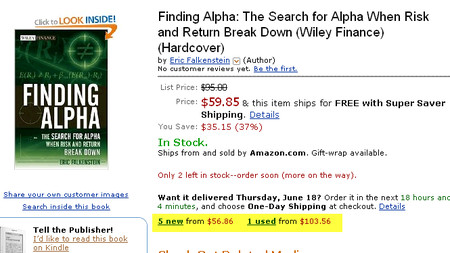
Finding Alpha: The Search for Alpha When Risk and Return Break Down (Wiley Finance) by Eric Falkenstein (Hardcover - Jun 29, 2009) is anticipated and now available.

The typical Amazon new vs used arbitrage occurs. New $56, vs used $103.

falken_alpha_book_arbit.png

See previously Big Picture Barry Bailout Nation arbitrage.


June 17, 2009

From "the Ownership Society" to "Bailout Nation"

These two new books both tell versions of that story. In "Dumb Money" (originally published as an e-book several months ago), Mr. Gross gives the lay reader a succinct, breezy and sometimes snarky account of how "the Ownership Society" so quickly devolved "into Bailout Nation," how the Alan Greenspan era of low interest rates and "Cheap Money" (from late 2001 through 2004) begat the "Era of Dumb Money" (mid-2004 through mid-2006) of growing leverage and debt, and, eventually, the "Era of Dumber Money" (late 2006 to the calamities of 2008), in which "large, old-line investment banks waded chest-deep into the subprime" mortgage swamp, processing the debt (bundling it, selling its pieces and helping others trade them) in compulsive pursuit of lucrative fees, even as the housing bubble had started to burst.

-- Michiko Kakutani

June 1, 2009

Overcomingbias: what's wrong with 'cuteonomics'

If an abstract model is supposed to be a model of the real world (and not just a mathematical construct), then we should test its assumptions and predictions against the real world. But the real world, in all its boisterous glory, is far from the serene desert landscape of an abstract model. So we must cleverly search out "natural experiments"--real-world circumstances that happen to conform to enough assumptions of a model to provide a relatively direct test of its predictions--and then apply advanced statistical techniques to isolate the effect of the variables we want to study. The result of such tests can lead to tweaks in abstract theories that improve their predictive power and utility.

Overcoming bias.


Continue reading "Overcomingbias: what's wrong with 'cuteonomics'" »

May 17, 2009

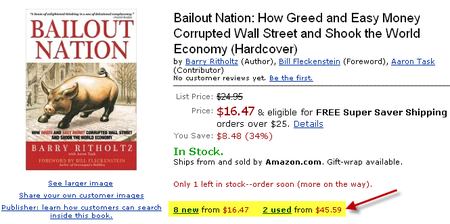
Bailout Nation, Amazon Used price

Barry's scolding Bailout Nation is out. Note the used price is three times greater than the new price.
(We blogrolled Barry Ritholtz' Big Picture years ago).


amazon_barry_bailout_new_used_.png

January 15, 2009

The less money your peer group has, the more bling you buy

The less money your peer group has, the more bling you buy, explains Virginia Postrel.

About seven years ago, University of Chicago economists Kerwin Kofi Charles and Erik Hurst were researching the "wealth gap" between black and white Americans when they noticed something striking. African Americans not only had less wealth than whites with similar incomes, they also had significantly more of their assets tied up in cars. The statistic fit a stereotype reinforced by countless bling-filled hip-hop videos: that African Americans spend a lot on cars, clothes, and jewelry--highly visible goods that tell the world the owner has money.

But do they really? And, if so, why?

The two economists, along with Nikolai Roussanov of the University of Pennsylvania, have now attacked those questions. What they found not only provides insight into the economic differences between racial groups, it challenges common assumptions about luxury. Conspicuous consumption, this research suggests, is not an unambiguous signal of personal affluence. It's a sign of belonging to a relatively poor group. Visible luxury thus serves less to establish the owner's positive status as affluent than to fend off the negative perception that the owner is poor. The richer a society or peer group, the less important visible spending becomes.

Russ Alan Prince and Lewis Schiff describe a similar pattern in their book, The Middle-Class Millionaire, which analyzes the spending habits of the 8.4million American households whose wealth is self-made and whose net worth, including their home equity, is between $1 million and $10 million. Aside from a penchant for fancy cars, these millionaires devote their luxury dollars mostly to goods and services outsiders can't see: concierge health care, home renovations, all sorts of personal coaches, and expensive family vacations. They focus less on impressing strangers and more on family- and self-improvement. Even when they invest in traditional luxuries like second homes, jets, or yachts, they prefer fractional ownership. "They're looking for ownership to be converted into a relationship rather than an asset they have to take care of," says Schiff. Their primary luxuries are time and attention.

Continue reading "The less money your peer group has, the more bling you buy" »

January 5, 2009

Status: either too early to tell or too late to change; Tufte on design consulting

Products under development "are in one of two states--either too early to tell or too late to change.''

He finished the book in 1982, after moving to Yale. No publisher would print it to his exacting standards. Tufte wanted the book to exemplify the design principles he articulated. It had to have lavish, abundant, high-resolution images and footnotes alongside the text so a reader wouldn't have to flip pages to find a reference. The book had to be printed on thick, creamy paper and sell for a reasonable price, about $30. "Publishers seemed appalled at the prospect that an author might govern design,'' he later wrote. So he took out a second mortgage at nearly 18 percent interest and produced the book himself.


---- Edward Rolf Tufte

Continue reading "Status: either too early to tell or too late to change; Tufte on design consulting" »

January 4, 2009

Falkenstein: Finding Alpha

Falkenblog (and aka Hedgefund Guy on Mahalanobis) is a frequent read, and if the book is as consistently interesting, it will be recommended.

Finding Alpha: The Search for Alpha When Risk and Return Break Down (Wiley Finance) by Eric Falkenstein (Hardcover - Jun 29, 2009)

November 14, 2008

Why Squatter Cities Are A Good Thing ?

A TED talk, The Shadow Cities Of The Future and Why Squatter Cities Are A Good Thing by Robert Neuwirth, author, Shadow Cities: A Billion Squatters, A New Urban World, gives a different take on development economics, from mud hut cluster to developed city, with or without debt and property rights.

Video after jump.

Continue reading "Why Squatter Cities Are A Good Thing ?" »

November 2, 2008

Worry about relevance, do not deviate from the consensus

The field of social psychology provides a possible answer. In his classic 1972 book, "Groupthink," Irving L. Janis, the Yale psychologist, explained how panels of experts could make colossal mistakes. People on these panels, he said, are forever worrying about their personal relevance and effectiveness, and feel that if they deviate too far from the consensus, they will not be given a serious role. They self-censor personal doubts about the emerging group consensus if they cannot express these doubts in a formal way that conforms with apparent assumptions held by the group.

Continue reading "Worry about relevance, do not deviate from the consensus" »

September 8, 2008

Option Volatility & Pricing: Advanced Trading Strategies and Techniques, Sheldon Natenberg


Option Volatility & Pricing: Advanced Trading Strategies and Techniques
, second edition (1994, Hardcover) by Sheldon Natenberg.

Natenberg not only takes great pains to explain the concept of volatility, in addition to other inputs into an option pricing model, but clearly shows that option pricing isn't the exact science many seem to believe, for the simple reason that we never know if our volatility estimate is correct.

September 6, 2008

Options as a Strategic Investment, Lawrence G. McMillan

Options as a Strategic Investment, 4th Edition (2001), by Lawrence G. McMillan .

Comprehensive and informative. Covers pretty much every conceivable option strategy in the context of both equity and futures options and imparts realistic expectations.

May 30, 2007

Interest-rate term-structure pricing models: Riccardo Rebonato

Review Paper. Interest-rate term-structure pricing models: a review
Riccardo Rebonato

Interest-rate term structure modelling from the early short-rate-based
models to the current developments; use models for pricing complex
derivatives or for relative-value option trading. Therefore, relative-pricing
models are given a greater emphasis than equilibrium models.

The current state of modelling owes a lot to how models have
historically developed in the industry, and stresses the importance
of 'technological' developments (such as faster computers or more
efficient Monte Carlo techniques) in guiding the direction of theoretical
research.

The importance of the joint practices of vega hedging and daily
model-recalibration is analysed in detail. The relevance of market
incompleteness and of the possible informational inefficiency of
derivatives markets for calibration and pricing is also discussed.

Continue reading "Interest-rate term-structure pricing models: Riccardo Rebonato" »

April 9, 2007

Way of the Turtle

Way of The Turtle, by Curtis Faith.

Relatively simple trading systems can provide a
tradable edge, but it is psychologically difficult
for traders to follow these systems and exploit
that edge.

Recommended via Traderfeed Brett and Abnornal.

March 14, 2007

Kübler-Ross model

The Kübler-Ross model describes, in five discrete stages,
the process by which people deal with grief and tragedy

Enumeration of stages (1969)

The stages are:

1. Denial - The initial stage.: "It can't be happening."
2. Anger .: "How dare you do this to me?!" (either referring to God, the deceased, or oneself)
3. Bargaining .: "Just let me live to see my son graduate."
4. Depression .: "God please don't take him away from our family"
5. Acceptance .: "I know my son will be in a better place"

March 4, 2007

Savy viewers

The Comedy Central audience is more serious than its reputation
allows. The public may still think of the “Daily Show” and “Colbert Report”
audience as a group of sardonic slackers, Gen-Y college students
who prefer YouTube to print. But publishers say it’s a much more
diverse demographic — and more important, a book-buying audience.

“It’s the television equivalent of NPR. You have a very savvy, interested
audience who are book buyers, people who do go into bookstores,
people who are actually interested in books.”

-- Martha K. Levin, of Free Press.

January 20, 2007

Atrios's bookshelf

Atrios's bookshelf.
A former economist, indeed.

db_atrios_bookshelf_pj22.jpg

January 7, 2007

Nassim Nicholas Taleb, fooled by randomness

Nassim Nicholas Taleb, Fooled By Randomness (and black swans), with
bloglike-notebook.

Black Swan discussion: MeFi, Telergraph

November 1, 2006

Economics Books, Economics Textbooks

Economics Books, Economics texts via Alex and Tyler (MR).

This list lacks empirical, practitioner guidance, such as
Econometric Analysis by William H. Greene.

October 6, 2006

Visualization and segmentation: Gelman's bag of tricks

Visualization and segmentation: Gelman's

Bag of tricks
for teaching statistics.

.

See also Gelman's Data Analysis Using Regression and Multilevel/Hierarchical Models.

May 9, 2006

Graham and Dodd breed optimism

Stephen Roach of Morgan Stanley New York revisits value analysis by Graham and Dodd.
Optimistic ?

Refs: Security Analysis by Benjamin Graham and David Dodd.

November 29, 2005

New Palgrave Dictionary: A sneak preview

New Palgrave Dictionary of Economics and the Law is previewed
(links to chapter PDFs) at the New Economist.

October 26, 2005

Dave Cross, data munger

Dave Cross, London based perl guy, has long been in my pingoshere.

Picks up on techs trends, not ASAP, but as they start crossing the
chasm. And summarizes them.
Also a fierce advocate for good customer service, with
emphasis on forthcoming non-deceitfulness over pampering.
And lefty local pantser.

Update 2006 Mar 01: Now on OnLamp.

Continue reading "Dave Cross, data munger" »

August 29, 2005

r graphics (Paul Murrell) is out

R Graphics by Paul Murrell shipped.

Previously announced.

Continue reading "r graphics (Paul Murrell) is out" »

August 20, 2005

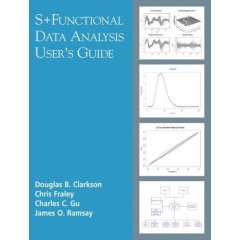
Functional data analysis (FDA)

Functional data analysis (FDA) handles longitudinal data and treats
each observation as a function of time (or other variable). The
functions are related. The goal is to analyze a sample of functions
instead of a sample of related points.

FDA differs from traditional data analytic techniques in a number of
ways. Functions can be evaluated at any point in their domain.
Derivatives and integrals, which may provide better information (e.g.
graphical) than the original data, are easily computed and used in
multivariate and other functional analytic methods.


S+Functional Data Analysis User's Guide
by Douglas B. Clarkson, Chris Fraley, Charles C. Gu, James O. Ramsay


Functional Data Analysis (Springer Series in Statistics) (Hardcover)
by J. Ramsay, B. W. Silverman

Covers topics of linear models, principal components, canonical
correlation, and principal differential analysis in function spaces.


Applied Functional Data Analysis
(Paperback)
by J.O. Ramsay, B.W. Silverman

Bernard W. Silverman's code site Applied Functional Data Analysis: Methods and Case Studies

Continue reading "Functional data analysis (FDA)" »

August 19, 2005

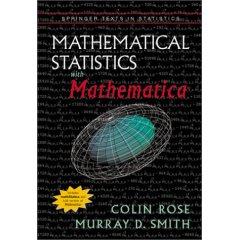
Mathematical Statistics with MATHEMATICA

Mathematical Statistics with MATHEMATICA,
Colin Rose, Murray D. Smith (Hardcover)


The mathStatica software, an add-on to Mathematica, provides a
toolset specially designed for doing mathematical statistics. It
enables students to solve difficult problems by removing the technical
calculations often associated with mathematical statistics. The
professional statistician will be able to tackle tricky multivariate
distributions, generating functions, inversion theorems, symbolic
maximum likelihood estimation, unbiased estimation, and the checking
and correcting of textbook formulas. This text would be a useful
companion for researchers and students in statistics, econometrics,
engineering, physics, psychometrics, economics, finance, biometrics,
and the social sciences.

Companion site mathStatica.com

June 3, 2005

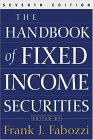
Handbook of Fixed Income Securities (Fabozzi)

The Handbook of Fixed Income Securities
Edited by Frank Fabozzi

Hardcover: 1500 pages
Publisher: McGraw-Hill; 7 edition (April 1, 2005)
ISBN: 0071440992


Part 1. Background.
1. Overview of the Types and Features of Fixed Income Securities.
2. Risks Associated with Investing in Fixed Income Securities.
3. A Review of the Time Value of Money.
4. Bond Pricing and Return Measures.
5. Measuring Interest Rate Risk.
6. The Sturcture of Interest Rates.
7. Bond Market Indexes.

Part 2. Government and Private Debt Obligations.
8. U.S. Treasury and Agency Securities.
9. Municipal Bonds.
10. Private Money Market Instruments.
11. Corporate Bonds.
12. Medium-Term Notes.
13. Inflation-Indexed Bonds (Tips).
14. Floating-Rate Securities.
15. Nonconvertible Preferred Stock.
16. International Bond Markets and Instruments.
17. Brady Bonds.
18. Stable Value Investments.

Part 3. Credit Analysis.
19. Credit Analysis for Corporate Bonds.
20. Credit Considerations in Evaluating High-yield Bonds.
21. Investing in 11 and Other Distressed Companies.
22. Guidelines in the Credit Analysis of General Obligation and Revenue Municipal Bonds.
23. High-Yield Analysis of Emerging Markets Debt.

Part 4. Mortgage-Backed and Asset-Backed Securities.
24. Mortgages and Overview of Mortgage-Backed Securities.
25. Mortgage Pass-Throughs.
26. Collateralized Mortgage Obligations.
27. Nonagency CMOs.
28. Commercial Mortgage-Backed Securities.
29. Securities Backed by Automobile Loans.
30. Securities Backed by Closed-End Home Equity Loans.
31. Securities Backed by Manufactured Housing Loans.
32. Securities Backed by Credit Card Receivables.

Part 5. Fixed Income Analytics and Modeling.
33. Characteristics of and Strategies with Callable Securities.
34. Valuation of Bonds with Embedded Options.
35. Valuation of CMOs.
36. Fixed Income Risk Modeling.
37. OAS and Effective Duration.
38. Evaluation Amortizing ABS. A Primer on Static Spread.

Part 6. Portfolio Management.
39. Bond Management. Past, Current, and Future.
40. The Active Decisions in the Selection of Passive Management and Performance Bogeys.
41. Managing Indexed and Enhanced Indexed Bond Portfolios.
42. Global Corporate Bond Portfolio Management.
43. Management of a High-Yield Bond Portfolio.
44. Bond Immunization. An Asset/Liability Optimization Strategy.
45. Dedicated Bond Portfolios.
46. Managing Market Risk Proactively at Long-Term Investment Funds.
47. Improving Insurance company Portfolio Returns.
48. International Bond Investing and Portfolio Management.
49. International Fixed Income Investing. Theory and Practice.

Part 7. Equity-Linked Securities and Their Valuation.
50. Convertible Securities and Their Investment Characterics.
51. Convertible Securities and Their Valuation.

Part 8. Derivative Instruments and Their Portfolio Management Applications.
52. Introduction to Interest-Rate Futures and Options Contracts.
53. Pricing Futures and Portfolio Applications.
54. Treasury Bond Futures Mechanics and Basis Valuation.
55. The Basics of Interest-Rate Options.
56. Controlling Interest Rate Risk and Futures and Options.
57. Interest-Rate Swaps.
58. Interest-Rate Caps and Floors and Compound Options.

June 2, 2005

Fixed Income Securities: Tools for Today's Markets (Tuckman)

Fixed Income Securities: Tools for Today's Markets,
Second Edition by Bruce Tuckman.

1. THE RELATIVE PRICING OF FIXED INCOME SECURITIES WITH FIXED CASH FLOWS.
# Bond Prices, Discount Factors, and Arbitrage.
# Bond Prices, Spot Rates, and Forward Rates.
# Yield to Maturity.
# Generalizations and Curve Fitting.

2. MEASURES OF SENSITIVITY AND HEDGING.
# One-Factor Measures of Sensitivity.
# Measures of Price Sensitivity Based on Parallel Yield Shifts.
# Key Rate and Bucket Exposures.
# Regression-Based Hedging.

3. TERM STRUCTURE THEORY AND MODELS.
# The Science of Term Structure Models.
# The Short-Rate Process and the Shape of the Term Structure.
# The Art of Term Structure Models: Drift.
# The Art of Term Structure Models: Volatility and Distribution.
# Multi-Factor Term Structure Models.
# Trading with Term Structure Models.

4. ANALYSIS OF SELECTED SECURITIES.
# Repo.
# Forward Markets.
# Eurodollar and Fed Fund Futures.
# Interest Rate Swaps.
# Fixed Income Options.
# Note and Bond Futures.
# Mortgage-Backed Securities.

May 8, 2005

Shiller speaks

Robert Shiller speaks about Real Estate and 'Irrational Exuberance' on NPR.

More and more home owners are refinancing, and a full quarter of
homes sold last year went to investors instead of live-in homeowners.
How long can this hot market last, and when it ends, are we looking at
a minor chill, or a full-blown ice age?

April 19, 2005

r graphics, Paul Murrell

R Graphics by Paul Murrell

Update 2005 Sept 03: R Graphics is shipping !

A book on the core graphics facilities of the R language and
environment for statistical computing and graphics (to be published
by Chapman & Hall/CRC in August 2005). Preview now.

March 2, 2005

Interest rate modelling, Brigo, Mercurio, Pelsser.


Interest rate modelling for practical implication: Interest Rate Models by Damiano Brigo and Fabio Mercurio. Brigo_Mercurio.jpg

For a clear and conicse treatment we also suggest you Antoon Pelsser's Efficient Methods for Valuing Interest Rate Derivatives which is extremely interesting.

Pelsser.jpg

December 28, 2004

Rick Aster / SAS programming info

Rick Aster's SAS info aka programming secrets:
Professional SAS Programming Shortcuts and Professional SAS Programming Logic.