Uniden R7 playlist
- How to update firmware on r7
- Vortex FAQ 2019 remote mute at 5:08
- Vortex set up and configure GPS-stamp your favorite traps GPS User Marks 4:22
- Vortex Uniden R7 fw 1.29
See also RD Forum
See also RD Forum
Compromising someone's digital security is time-consuming, though not for the reasons pop culture might suggest. Hacking isn't a matter of typing furiously into a cyberpunk-y computer terminal like in The Matrix (although Cooper Quintin--staff technologist at the Electronic Frontier Foundation -- did indeed spend much of our session typing into an old-fashioned command-line interface).
What he needed was time to skulk through my social-media profiles to figure out who I was, who my friends were, where I worked, who I worked with, who I was close to, who I would trust--the kind of information, thanks to social media, that's available to anyone who wants to look. This is the key difference between spearphishing and regular ol' phishing. Spearphishing involves a component of social engineering: It's the most boring kind of hacking, but also the most dangerous.
Continue reading "Spearphishing involves a component of social engineering" »
Much online advertising capitalizes on the lure of the so-called long tail of the internet -- sites that draw relatively small but attractive audiences, like blogs for new parents or forums for truck enthusiasts. Advertising on those sites costs a fraction of what it does on more prominent online destinations, which typically deal directly with advertisers.
Teenagers overseas and entrepreneurs in the United States discovered this year that they could earn thousands of dollars a month by writing wholly fictionalized or wildly exaggerated partisan political news intended to be spread on Facebook. They then reaped money from Google Ads and other networks after credulous readers in the United States clicked through to their sites.
"A lot of ad buying systems are trying to show the right ad to the right person at the right time, and you see that mantra of those three variables across the industry," said Michael Tiffany, the chief executive and a founder of White Ops, an ad fraud detection company. "Note how 'on the right site' doesn't make the list."
Continue reading "Long tail media meeds programatic ad buying" »
Today, a handful of content mills circumnavigate the need to have any humans involved at all. These aren't backstreet backlink marketeers, either: outlets as big as the Associated Press have cut some costs by employing (or deploying) robot journalists to write up quarterly earnings stories on companies like Krispy Kreme. This kind of robotic software can take a bunch of statistics such as company results--or baseball and basketball scores--and create content. A company called Automated Insights created this automated writer fleet, and the firm's robotic authors produced more than a billion pieces of content last year (likely for a fraction of the price that even the cheapest content mill can get away with paying). Compared to the shoehorned-in keywords that sometimes cause mill writers to mangle sentences in ways Shakespeare would blench at, Automated Insights' work could be in contention for a Pulitzer.
Chris Stokel-Walker is a freelance journalist, writing features for the BBC and The Sunday Times of London. He is based in the United Kingdom.
Bonus thought: could robo-journalists avoid biased reviews such as those of June Chu, Dean of Yale University's Pierson College ?
The baffler on Citizen Zuckerberg.
The media is getting played, too
"The American press has focused a disproportionate amount of attention on Russian hacking and cyberattacks, and the reporting itself has only muddied the truth for most in the audience:
-- says Clint Watts, a former FBI special agent and Executive Officer of the Combating Terrorism Center at West Point, in an interview with CJR. Watts is now a senior fellow at the Center for Cyber and Homeland Security at George Washington University, where he analyzes social bots, trolls, and websites that intelligence agencies say are the foot soldiers of Russia's information war.
"The hacking generates information, which promotes Russia's influence campaign, but the end objective is to convince people to choose a candidate based on Russia's preference. This is getting confused, because people hear 'hack' and they think their votes are being changed."
It's a classic page from the Cold War playbook, says Watts, adding that Putin has brought new meaning to the Soviet-Era doctrine of using "the force of politics" rather than "the politics of force."
"The main success of this campaign is not that it took place, but the panic we are in now," Meister adds. "We've lost our self-confidence in our system, in our democracy, in our elections and in our media. That's the biggest success of the Russian campaign."
Continue reading "Hacking the news is social engineering: Clint Watts" »
Did Mr. Nadella, who has been at Microsoft since 1992, learn nothing from the Clippy disaster? Clippy, the animated anthropomorphic paper clip introduced in 1996, popped up unbidden in Microsoft Office programs to offer advice. "Are you writing a letter?" it would ask annoyingly. Clippy became famous for the ire it provoked and, in 2010, Time magazine included Clippy in a roundup of the 50 worst inventions of all time, along with asbestos, leaded gasoline and pay toilets.
Matthew G. Kirschenbaum, an associate professor of English at the University of Maryland and author of "Track Changes: A Literary History of Word Processing," said the move reflected a failure to understand what writers need. "Most of the most innovative writing tools now on the market position themselves precisely as distraction-free platforms," he said.
"The hope is that, in not too many years, human brains and computing machines will be coupled," wrote Joseph Carl Robnett Licklider, who was known as "Lick" and is the man widely remembered as the internet's Johnny Appleseed. Mr. Licklider joined the Pentagon in 1962, and his ideas later formed the basis for the military's primordial internet work.
Even a big-vision idealist like Mr. Licklider could never have imagined that more than 50 years later, we would be telling the internet our deepest secrets and our whereabouts, and plugging in our smartphones, refrigerators, cars, oil pipelines, power grid and uranium centrifuges.
And even the early internet pioneers at the Pentagon could not have foreseen that half a century later, the billions of mistakes made along the way to creating the internet of today and all the things attached to it would be strung together to form the stage for modern warfare.
It is rare to find a computer today that is not linked to another, that is not baked with circuitry, applications and operating systems and that has not -- at one point or another -- been probed by a hacker, digital criminal or nation looking for weaknesses to exploit for profit, espionage or destruction.
wordtoyourmother compiled by Nick Weaver.
LendingClub's problems this week, musings of Matt Levine:
LendingClub got in trouble for being too much like a FintTech -- a "financial technology" company -- and too little like a bank, focusing on algorithms and speed and coolness rather than the plodding legalistic work that is the actual business of finance.
LendingClub got in trouble for being too much like a bank and too little like a FinTech, with mission creep, conflicts of interest and "a complicated network of middlemen" instead of a pure technology-driven neutral platform.
In the future, Mr. Zuckerberg imagines that "a physical thing, like a TV, will just be a $1 app" inside virtual reality on Facebook, he recently told a conference of software developers building apps for Facebook. But that may be 10 years off, by Mr. Zuckerberg's own admission. People who do not work at Facebook might say it is a fantasy.
Facebook even appears willing to turn the price-crushing model on itself. To get virtual reality to every place in the world, Facebook's Oculus VR headsets, currently $600, may have to cost $5, said Mike Schroepfer, the company's chief technology officer.
Is that another fantasy? For Facebook, getting those costs down could mean controlling the next big communications platform, since Mr. Zuckerberg believes virtual reality may eventually supplant smartphones as a primary connection to the online world.
"The world is making enough phones. It's better for the world if there are fewer devices," Mr. Schroepfer said. "It's not totally obvious how all this shakes out -- whether we'll have lots of consumer products, or it all disappears into a couple of VR headsets."
Jan Koum, WhatsApp's founder, who was born in Ukraine, has talked about his family members' fears that the government was eavesdropping on their phone calls. In the company's early years, WhatsApp had the ability to read messages as they passed through its servers. That meant it could comply with government wiretap orders.
But in late 2014, the company said that it would begin adding sophisticated encoding, known as end-to-end encryption, to its systems. Only the intended recipients would be able to read the messages.
"WhatsApp cannot provide information we do not have," the company said this month when Brazilian police arrested a Facebook executive after the company failed to turn over information about a customer who was the subject of a drug trafficking investigation.
For more than a half-century, the Justice Department has relied on wiretaps as a fundamental crime-fighting tool. To some in law enforcement, if companies like WhatsApp, Signal and Telegram can design unbreakable encryption, then the future of wiretapping is in doubt.
"You're getting useless data," said Joseph DeMarco, a former federal prosecutor who now represents law enforcement agencies that filed briefs supporting the Justice Department in its fight with Apple. "The only way to make this not gibberish is if the company helps."
Fintech insurgents are moving and growing quickly, they must overcome big challenges of their own before reshaping the industry. They are still relatively small and niche players in the sprawling retail banking business. They are not deposit-taking institutions, where consumer savings are insured by the government.
They also lack the legal and regulatory apparatus that traditional banks have built over many decades. Already, some of the new services are facing regulatory scrutiny. In November, Apple, Google, Amazon, PayPal and Intuit formed a Washington-based advocacy group, Financial Innovation Now, to promote policies to "foster greater innovation in financial services."
Known in Chinese as Weixin (微信) -- "micro letter" -- WeChat is first and foremost a messaging app for sending text, voice, and photos to friends and family. It was launched just 4 years ago by Chinese investment holding company Tencent, one of the largest internet companies in the world. As of earlier this year, WeChat had 549 million monthly active users (MAUs) among over one billion registered users, almost all of them in Asia. To put that in context: That's only 150M MAUs fewer than Facebook Messenger, almost 3x the MAUs of Japan's Line, and 10x the MAUs of Korea's Kakao.
Mobile dating went mainstream about five years ago; by 2012 it was overtaking online dating. In February, one study reported there were nearly 100 million people--perhaps 50 million on Tinder alone--using their phones as a sort of all-day, every-day, handheld singles club, where they might find a sex partner as easily as they'd find a cheap flight to Florida. "It's like ordering Seamless," says Dan, the investment banker, referring to the online food-delivery service. "But you're ordering a person."
The comparison to online shopping seems an apt one. Dating apps are the free-market economy come to sex. The innovation of Tinder was the swipe--the flick of a finger on a picture, no more elaborate profiles necessary and no more fear of rejection; users only know whether they've been approved, never when they've been discarded. OkCupid soon adopted the function. Hinge, which allows for more information about a match's circle of friends through Facebook, and Happn, which enables G.P.S. tracking to show whether matches have recently "crossed paths," use it too. It's telling that swiping has been jocularly incorporated into advertisements for various products, a nod to the notion that, online, the act of choosing consumer brands and sex partners has become interchangeable.
Andreessen Horowitz is a talent agency as much as a tech investor. Marc Andreessen, the web pioneer who was a founder of Netscape and other companies before trying his hand at venture capital, has made this point explicitly a in 2010 interview of Michael Ovitz, the onetime Hollywood superagent who started Creative Artists Agency.
Radar.oreilly on interface languages and feature discovery.
In 1999 a dotcom with no revenue could burn $100 million in one year, with $2 million of that going to a Super Bowl ad. Its namesake website could offer a terrible user experience, and still the company could go public. Investors would chase the rising stock price, which would drive up the price further, which in turn drew more investors, feeding a textbook 'speculative bubble' that burst the moment everyone realised there wasn't any there there.
This kind of stuff isn't happening any more. It's not that the internet has become less important, or investors less 'irrationally exuberant' -- it's that start-ups have gotten cheaper. A web start-up today has almost no fixed capital costs. There's no need to invest in broadband infrastructure, since it's already there. There's no need to buy TV ads to get market share, when you can grow organically via search (Google) and social networks (Facebook). 'Cloud' web servers, like nearly all other services a virtual company might need -- such as credit-card processing, automated telephone support, mass email delivery -- can be paid for on demand, at prices pegged to Moore's Law.
The
state of big data in 2014, in a chart.
Via Matt Turck, 2014/05/11.
In April, AT&T said it would introduce a gigabit-speed TV and Internet service, U-verse with GigaPower, in 21 metropolitan areas in the United States. Three cities in Texas already have it: Dallas, Fort Worth and Austin.
Google won't say how many people have signed up for Fiber, which costs $70 for Internet or $120 a month for Internet and cable TV. There is also an option that offers much slower broadband for a $300 installation fee. A door-to-door study commissioned by Bernstein Research and performed by Haynes & Company found that about a third of lower-income households in Fiber areas had signed up for some version of the service, along with three-quarters of the households in areas with incomes of $100,000 or more.
Kevin Lo, the general manager of Google Fiber, said the Internet giant had plenty of patience to see what percolated in the cities with its high-speed network. "We need to encourage developers who have great ideas, but we also need to build a critical mass of people who can use those applications. You need both for the breakthroughs to happen," he wrote in an email.
Computer science wasn't always dominated by men. "In the beginning, the word 'computers' meant 'women,' " says Ruth Oldenziel, a professor at Eindhoven University of Technology in the Netherlands who studies history, gender and technology. Six women programmed one of the most famous computers in history -- the 30-ton Eniac -- for the United States Army during World War II.
But as with many professions, Dr. Oldenziel said, once programming gained prestige, women were pushed out. Over the decades, the share of women in computing has continued to decline. In 2012, just 18 percent of computer-science college graduates were women, down from 37 percent in 1985, according to the National Center for Women & Information Technology.
This lack of women has become of greater concern in the industry for a number of reasons. For one, the products that the tech industry creates are shaping the future for everyone. "Women are increasingly consumers; they're not going to like products that don't work for them," said Londa Schiebinger, a Stanford professor who runs the Gendered Innovations project, which encourages engineers and scientists to consider gender when developing new products.
In U.S. Google searches, the most common word to follow the phrase "Is my husband . . ." is "gay." It is ten times more common than "depressed." It won't be long before Google will be able to provide the answer. Right now, just from your pattern of likes on Facebook (and without relying on status updates or comments), an algorithm can determine with eighty-eight-per-cent accuracy whether you are straight or gay.
Sixty per cent of the time, it can tell whether your parents were divorced before you turned twenty-one. Rudder calls this trove of data "an irresistible sociological opportunity." He writes, "You know the science is headed to undiscovered country when someone can hear your parents fighting in the click-click-click of a mouse."
Silicon Valley needs a de facto "mayor", the person who represents its broad interests, and not those of a particular company, industry or advocacy groups. The Valley began with such individuals--Stanford's Fred Terman, Dave Packard and then Intel founder Robert Noyce. But that ended with Noyce's premature death in 1990. Now, poised to reinvent itself one more time and lead the global economy again, Silicon Valley needs another leader to address the great changes to come.
Now come socialbots. These automated charlatans are programmed to tweet and retweet. They have quirks, life histories and the gift of gab. Many of them have built-in databases of current events, so they can piece together phrases that seem relevant to their target audience. They have sleep-wake cycles so their fakery is more convincing, making them less prone to repetitive patterns that flag them as mere programs. Some have even been souped up by so-called persona management software, which makes them seem more real by adding matching Facebook, Reddit or Foursquare accounts, giving them an online footprint over time as they amass friends and like-minded followers.
Researchers say this new breed of bots is being designed not just with greater sophistication but also with grander goals: to sway elections, to influence the stock market, to attack governments, even to flirt with people and one another.
Why Do Programmers Use Courier Typeface?
Courier is just one of many monospace fonts. They are also called fixed-width fonts. Consolas is the default font in Visual Studio, and there are even better fonts for programmers.
We like fonts where:
0 cannot be confused with O
Punctuation characters like "," are bigger because they are far more important in programming than in daily use
Brackets are distinct
"1," "I," "l," and "|" cannot be confused (that is 1, i, L, and the pipe sign)
This leads to fewer bugs. Mistyping "," as "." will often break your code and at least lead to unexpected behavior. The same is true for ":" versus ";" and so on.
Slate explainer rides on Quora.
Congress passed the Telecommunications Act of 1996, the largest change in communications law since the 1930s. The law maintained the basic/enhanced dichotomy, but it renamed its two parts. Basic services became telecommunications services; enhanced services became information services.
Now, into which of these two categories does the Internet fall? The FCC regards the World Wide Web--the entire apparatus of browsers and HTML files, the layers upon layers of computation and presentation--as an information service (i.e., an enhanced service). It would make sense, then, that the wires through which this information service traveled were regarded as a telecommunications service (i.e., a basic service). Indeed, when most people accessed the web through phone wires with a dial-up modem, the agency did categorize phone lines as a telecommunications service--because it regarded all phone lines that way.
San Francisco is much more of a company town. Go into any bar in San Francisco and you will hear people talking about their start-up, or a battle they recently had with a line of code. Stop by a coffee shop in some neighborhoods here and you will be surrounded by venture capitalists being pitched a new idea for a new app. All of these people rarely, if ever, interact with people outside the tech world.
Unfair? Sure, but we are talking about glossy magazine stereotypes here.
In New York, if you meet someone who works in tech you feel like you've met a long-lost relative. Bars, coffee shops and restaurants are a mishmash of people from vastly different industries.
The lack of diversity between social groups in San Francisco isn't going to change anytime soon, as the number of tech employees in the Bay Area is only going to continue to rise. Ted Egan, chief economist for San Francisco's Controller's Office, recently said that in the early-90s, tech workers made up less than 1 percent of city workers in San Francisco. In 2000, tech employees had risen to 3 percent of the workforce. By 2013, that number had passed 6 percent.
Evan Fitzmaurice, an Austin-based lawyer and longtime friend who until recently was the Texas Film Commissioner, has attended many a SXSW. He tells me one night over dinner that while he's wired to the hilt ("I've gotta connect to the Matrix"), he sees the downside of perpetual connectedness. "You're truncating natural thought.
Things don't gestate anymore. It's instantaneous, without the benefit of reflection. And everything's said at volume 10. Nothing's graduated anymore. It's a clamor." Though not religious himself, he says what I witness at SXSW would be recognized by any religious person. "They're trying to supplant deliverance and redemption through religion with civil religion and technological redemption--the promise of a sublime life on a higher plane."
Like many professions today, software development is developing new rules for education and status identification. At one point, a degree from MIT or Stanford was the key ticket to a major Silicon Valley company, and from there, a start-up or a management role.
The new culture around hackathons and open source projects is going to upend this forced march. Students increasingly are engaging with startups earlier in their careers, and they are building products rather than writing code samples. With a continued focus on education, there is an opportunity here to solve the engineer crunch, and perhaps even expand the range of people who are involved in engineering the next great startups.
Downloading a two-hour high-definition movie takes, on average, 35 minutes.
Suneet Tuli, CEO of Datawind, maker of the Aakash 2 tablet uses the slide below to explain how cheap tablets will disrupt the market for more expensive tablets, and potentially other types of personal computing devices, like laptops. "I think [Intel's move] is the classical example of bridging the performance gap between low- and high-end products, where the increasing performance at the low-end of the market starts putting pressure on the higher end of the market," says Tuli, referring to Clayton Christensen's Innovator's Dilemma.
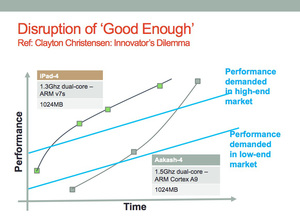
http://qz.com/124393/intel-100-tablet-by-christmas/
Microsoft just couldn't compete with the strong stuff: iPhones, iPads, Google, Facebook. With Windows 8 they mixed two weak strains together: the Windows desktop and Metro's touchscreen UI. They put a touchscreen interface on machines without touchscreens. It was the opposite of synergy--it was a speedball.
Know thy complexities ( Read this cheat sheet. ) Then make certain you understand how they work. Then implement common computational algorithms such as Dijkstra's, Floyd-Warshall, Traveling Salesman, A*, bloom filter, breadth-first iterative search, binary search, k-way merge, bubble/selection/insertion sort, in-place quick sort, bucket/radix sort, closest pair and so on. Again, ABC.
Having found its golden meme, Solid Gold Bomb wrote a computer script to churn out hundreds of T-shirt designs riffing on the phrase -- "Keep Calm and Dream On" to "Keep Calm and Dance Off." In theory, Solid Gold Bomb could be selling billions of them, for they only become "real" once an order is made. It's the infinite monkey theorem, applied to products: with time, the algorithms would produce a T-shirt someone wants.
Amazon does not vet such items, and Solid Gold Bomb is too solid to care. The advent of 3D printing will create an explosion in such phantom products.
Books got there first: Amazon brims with algorithmically produced "literature." Philip M. Parker, a marketing professor, must be the most productive, erudite writer in history: Amazon lists him as author of more than 100,000 books. His secret? An algorithm to generate page-turners like "Webster's Estonian to English Crossword Puzzles" and "The 2007-2012 Outlook for Premoistened Towelettes and Baby Wipes in Greater China" ("The moist towelette is an essential part of the lunchbox, and with the new global economy, this volume is essential," reads its only review). Some of these books might be useful, but much of algorithmic literature exists for one reason: to swindle unsuspecting customers.
When the former Wired editor Chris Anderson wrote of "the long tail" -- the idea that, thanks to the Internet, companies can look beyond blockbusters and make money on obscure products -- he never warned us it would be so long and so ugly. Somehow, well-crafted niche products have surrendered to algorithmic schlock.
-- Evgeny Morozov
Continue reading "Automated search and automated commerce begat algorithmic schlock ?" »
Google Reader lived on borrowed time: creator Chris Wetherell reflects
My translation: Google never really believed in the project. Google Reader started in 2005 at what was really the golden age of RSS, blogging systems and a new content ecosystem. The big kahuna at that time was Bloglines (acquired by Ask.com) and Google Reader was an upstart.
And it entered the market with big ideas, a clear, clean slate and captured the imagination of early adopters despite some glitches. The Google Reader team, which included Chris (who was the Senior Software Engineer), worked hard to keep pushing the product forward. Among the folks who worked on the project included backend guru Ben Darnell, Mihai Parparita and Jason Shellen.
I wonder, did the company (Google) and the ecosystem at large misread the tea leaves? Did the world at large see an RSS/reader market when in reality the actual market opportunity was in data and sentiment analysis? Wetherell agreed. "The reader market never went past the experimental phase and none was iterating on the business model," he said. "Monetization abilities were never tried."
"There was so much data we had and so much information about the affinity readers had with certain content that we always felt there was monetization opportunity," he said. Dick Costolo (currently CEO of Twitter), who worked for Google at the time (having sold Google his company, Feedburner), came up with many monetization ideas but they fell on deaf ears. Costolo, of course is working hard to mine those affinity-and-context connections for Twitter, and is succeeding. What Costolo understood, Google and its mandarins totally missed, as noted in this November 2011 blog post by Chris who wrote.
In the call with analysts, Mr. Lynch was pressed on whether Barnes & Noble's digital content was really proprietary. Mr. Lynch acknowledged that what the bookseller possessed was the ability to sell publishers' content, but he insisted that it was "a strategic asset that is hard to replicate."
Wall Street seemed heartened by the company's acknowledgment that it needed to recalibrate its device business, perhaps anticipating that it would accelerate a breakup of the device and retail units. Shares of Barnes & Noble rose 3.35 percent, to close at $15.74.
Continue reading "Barnes & Noble did it all for the Nookie" »
The doctor knelt at the bedside to perform the time-honored tradition of percussing the heart. "Do it like this," he said, placing his left hand over the man's heart, and tapping its middle finger with the middle finger of his right.
One by one, each trainee took a turn. An X-ray or echocardiogram would do the job more accurately. But Dr. Heineken wanted the students to experience discovering an enlarged heart in a physical exam.
Dr. Heineken fills his teaching days with similar lessons, which can mean struggling upstream against a current of technology. Through his career, he has seen the advent of CT scans, ultrasounds, M.R.I.'s and countless new lab tests. He has watched peers turn their backs on patients while struggling with a new computer system, or rush patients through their appointments while forgetting the most fundamental tools -- their eyes and ears.
For these reasons, he makes a point of requiring something old-fashioned of his trainees.
"I tell them that their first reflex should be to look at the patient, not the computer," Dr. Heineken said. And he tells the team to return to each patient's bedside at day's end. "I say, 'Don't go to a computer; go back to the room, sit down and listen to them. And don't look like you're in a hurry.' "
One reason for this, Dr. Heineken said, is to adjust treatment recommendations based on the patient's own priorities. "Any difficult clinical decision is made easier after discussing it with the patient," he said.
Complexity analysis is also a tool that allows us to explain how an algorithm behaves as the input grows larger. If we feed it a different input, how will the algorithm behave? If our algorithm takes 1 second to run for an input of size 1000, how will it behave if I double the input size? Will it run just as fast, half as fast, or four times slower? In practical programming, this is important as it allows us to predict how our algorithm will behave when the input data becomes larger. discrete.gr/complexity/.
New features abound, of course, but they're the sort that university teachers and other white-collar workers know all too well: ways of doing more with less, by making workers (or customers) handle the routine chores that used to be done for them. Nowadays you can tag a given "product" for Amazon so that it knows what you think of a book; if you want, you can even study a tag cloud that lists and ranks the most popular customer tags, so that you'll do a better job of tagging for the company. You can enter a customer discussion or post a review.
And, of course, whenever you buy a book, you help Amazon not only gauge the book's popularity, but also identify the other books that you have bought as well. It's an efficient, thoroughly commercial counterpart to the old information system. The simple, elegant Web page that once showered discriminating customers with information now invites the consumer to provide information of every sort for Amazon to digest and profit from.
The story of Microsoft's lost decade could serve as a business-school case study on the pitfalls of success. For what began as a lean competition machine led by young visionaries of unparalleled talent has mutated into something bloated and bureaucracy-laden, with an internal culture that unintentionally rewards managers who strangle innovative ideas that might threaten the established order of things.
"I was stunned when Bill announced that he was stepping aside to become 'chief software architect' in January 2000, with Steve Ballmer succeeding him as C.E.O.," recalled Paul Allen. "While Steve had long served as Bill's top lieutenant, you got the sense through the nineties that he wasn't necessarily being groomed for Microsoft's top spot. I'd say that Bill viewed him as a very smart executive with less affinity for technology than for the business side--that Steve just wasn't a 'product guy.' "A businessman with a background in deal-making, finance, and product marketing had replaced a software-and-technological genius.
By the dawn of the millennium, the hallways at Microsoft were no longer home to barefoot programmers in Hawaiian shirts working through nights and weekends toward a common goal of excellence; instead, life behind the thick corporate walls had become staid and brutish. Fiefdoms had taken root, and a mastery of internal politics emerged as key to career success.
In those years Microsoft had stepped up its efforts to cripple competitors, but--because of a series of astonishingly foolish management decisions--the competitors being crippled were often co-workers at Microsoft, instead of other companies. Staffers were rewarded not just for doing well but for making sure that their colleagues failed. As a result, the company was consumed by an endless series of internal knife fights. Potential market-busting businesses--such as e-book and smartphone technology--were killed, derailed, or delayed amid bickering and power plays.
That is the portrait of Microsoft depicted in interviews with dozens of current and former executives, as well as in thousands of pages of internal documents and legal records.
"They used to point their finger at IBM and laugh," said Bill Hill, a former Microsoft manager. "Now they've become the thing they despised."
Consumer Internet companies of the newer generation are doing even more. In many cases, the tools they are providing businesses resemble specialized versions of so-called customer relationship management services from companies like Salesforce.com, which help businesses increase sales and keep track of communications with clients.
By moving in this direction, consumer Internet companies hope to tap potentially rich new sources of revenue, which could make them more attractive to investors. A company that gets business clients to depend on a broad set of its services can make it tougher for competitors to swipe its customers.
"You can't just sell advertising without being exposed to someone else undercutting you on price," said Spencer Rascoff, chief executive of Zillow. "If you sell ads plus services, you're in a more defensible position."
Bill Gurley, a Zillow board member and venture capitalist, has seen enough hybrid Internet companies that serve both businesses and consumers that he coined a term to describe them: B2B2C. "We're moving from a day and age where you're just a Web site to one where we're automating the connections between businesses and consumers," he said.
Mr. Gurley's firm, Benchmark Capital, has invested in several other companies he puts in that camp, including Uber, which offers a mobile app that lets consumers hail a town car and gives drivers a "heat map" highlighting the areas where they are most likely to find customers.
GrubHub, another one of his investments, lets consumers order takeout and delivery food from more than 15,000 restaurants online and through mobile apps. In many cases, the service uses a clunky system in which customer orders are sent to restaurants by fax and confirmed by phone.
Recently, though, GrubHub introduced a product called OrderHub that could allow it to become more entwined in restaurants' operations. OrderHub is a tablet computer running Google's Android operating system that lets restaurants receive orders electronically, confirm them with a couple of taps and improve the accuracy of delivery time estimates.
Mr. Chandna of Greylock said the bulk of security start-ups that solicit his firm fall into one of four categories: mobile security, authentication, intrusion detection and "big data" security companies.
Several recently secured millions in financing. Lookout, a firm that blocks malware and spyware on consumers' mobile devices, raised $78 million from top-tier firms like Accel Partners and Andreessen Horowitz. A range of new start-ups market a similar service to businesses that now must deal with the headache of employees' bringing their iPhones and iPads to work and carting confidential intellectual property around with them.
Zenprise, a start-up that brings business-level security to consumer phones, recently raised $65 million. Appthority, a one-year-old start-up that tracks suspicious behavior by mobile apps, raised $6.5 million from Venrock, U.S. Venture Partners and others last May. Solera Networks, a security start-up that tracks intrusions in real time, has raised over $50 million from Intel Capital and others, and many say it is ripe for a nine-figure acquisition.
Since going public just over seven months ago at a price of $10 per share, shares of Zynga (ZNGA) have lost nearly 70% of their value, including today's decline of 40% following a disastrous earnings report. As if Wall Street didn't have enough of an image problem, stories like this only add fuel to the fire. Looking at the firms who underwrote the ZNGA offering shows a who's who of the most high profile firms on the street, including Morgan Stanley, Bank of America/Merrill Lynch (BAML), Barclays, Goldman Sachs, and JP Morgan. When the so-called most respected companies on Wall Street underwrite garbage like ZNGA, can you fault individual investors for becoming disillusioned with the stock market? In the eyes of investors, these firms are no different from a sleazy used car salesperson, or a guy on the street selling fake handbags or Rolex watches.
Right now the company has cash on hand worth almost half of its market cap. At one point an analyst asked outright, "Why should people buy your stock at $3 a share?"
Pincus' answer was long but simple. Paraphrased, he said: If you believe in social gaming, we're the biggest and best. There's no denying social gaming is big, and that Zynga dominates the category. Whether anyone believes it's a big business is Zynga's challenge.
It was a somewhat contentious conference call. One analyst, Richard Greenfield of BTIG, brought up to Mark Pincus, Zynga's chief executive, that he had sold stock at $12 a share shortly after the public offering. Mr. Pincus did not directly respond beyond saying "we believe in the opportunity for social gaming and play to be a mass-market activity, as it is already becoming."
After the call, Mr. Greenfield downgraded Zynga's stock to neutral from buy in a report titled, "We are sorry and embarrassed by our mistake."
In an interview, Mr. Greenfield said: "Right now, everything is going wrong for Zynga. In a rapidly changing Internet landscape that is moving to mobile, it's very hard to have confidence these issues are temporary."
Most Zynga games are free. The company makes money from a small core of dedicated users who buy virtual goods like tractors in FarmVille. Over the last year, the average daily amount of money Zynga took in from these core users dropped 10 percent even as the overall number of users expanded.
Zynga and Facebook are tied at the hip. Until recently, Zynga games could be played only on the Facebook platform, and for every dollar that users spent on buying virtual goods, Facebook pocketed 30 cents, its principal moneymaking channel other than advertising.
That partnership has continued. Zynga has seven of the top 10 games on Facebook.
Hope it has a good fast compound wildcard search: from ather about sujbec search
Microsoft admits that it's going after Gmail members with Outlook.com. Its sales pitch has three big pillars. First: unlimited mail storage. Not seven gigabytes or whatever -- unlimited.
Second, the design is far less cluttered than Gmail.
Third, no ads based on e-mail content. On Gmail, next to a message to you about a Disney World trip, you might see ads for Orlando hotels. No human reads the messages, but even a software algorithm analyzing your mail is enough to give some people the willies.
They won't have that discomfort with Outlook.com. Microsoft says that the ads are never based on your messages' contents. In fact, Microsoft lets you tailor the ads to your interests. The initial Ad Settings screen is still crude, but already you can specify categories that you are and are not interested in: yes to home electronics, no to adult diapers. It should be hard for either the advertisers or the public to argue with that basic premise: as long as you're earning this free service by seeing ads, at least they're ads you'll find interesting.
Anand Shimpi, 30, of Raleigh, NC's AnandTech.com, is not alone in the benchmark review business; sites including The Tech Report and Tom's Hardware have a similar obsession with performance data, though smaller followings.
But many chip executives, Wall Street investors and technically minded consumers see Shimpi's meticulously collected test results as the most authoritative and highly trustable.
In today's world, we have delegated many of our daily decisions to computers. On the drive to work, a GPS device suggests the best route; at your desk, Microsoft Word guesses at your misspellings, and Facebook recommends new friends. In the past few years, the suggestion has been made that when computers make such choices they are "speaking," and enjoy the protections of the First Amendment.
The argument that machines speak was first made in the context of Internet search. In 2003, in a civil suit brought by a firm dissatisfied with the ranking of Google's search results, Google asserted that its search results were constitutionally protected speech. (In an unpublished opinion, the court ruled in Google's favor.) And this year, facing increasing federal scrutiny, Google commissioned Eugene Volokh, a law professor at the University of California, Los Angeles, to draft a much broader and more elaborate version of the same argument. As Professor Volokh declares in his paper: "Google, Microsoft's Bing, Yahoo! Search, and other search engines are speakers."
-- Tim Wu, a law professor at Columbia, is the author of "The Master Switch: The Rise and Fall of Information Empires."
At least some of the early adopters of the Kinect were not content just to play games with it. "Kinect hackers" were drawn to the fact that the object affordably synthesizes an arsenal of sophisticated components -- notably, a fancy video camera, a "depth sensor" to capture visual data in three dimensions and a multiarray microphone capable of a similar trick with audio.
Combined with a powerful microchip and software, these capabilities could be put to uses unrelated to the Xbox. Like: enabling a small drone to "see" its surroundings and avoid obstacles; rigging up a 3-D scanner to create small reproductions of most any object (or person); directing the music of a computerized orchestra with conductorlike gestures; remotely controlling a robot to brush a cat's fur. It has been used to make animation, to add striking visual effects to videos, to create an "interactive theme park" in South Korea and to control a P.C. by the movement of your hands (or, in a variation developed by some Japanese researchers, your tongue).
The primacy of Interaction Design
The new digital landscape in which entrepreneurs operate is no longer dominated by sales-driven cultures, or by the need to deploy and maintain infrastructure. Instead, amazing products, products that are often bought rather than sold, dominate this new landscape.
Designers of these products are increasingly in direct touch with their users. We have spoken of this product-driven versus sales-driven change, and it impacts every sector we invest in. Design moves to the center. We believe designers are choosing urban life in the city over suburban life elsewhere.
-- Benchmark
Spitzer forced an industry-wide settlement in which the involvement of research analysts in IPOs was pared back and the "Chinese Wall" between research and banking was strengthened.
This industry reform had several consequences, some of which were positive and some of which were negative.
On the positive side, the reforms removed some stress for analysts. Once analysts were no longer evaluated in part on banking business, they focused more on serving institutional investor clients and researching already public companies. And that's unequivocally a good thing.
On the negative side, it became harder for companies to go public...because it turned out that having analysts involved in the screening, positioning, and marketing of deals and then providing follow-on research coverage of small companies made the whole IPO process work better. So that, arguably, was a bad thing.
Read more: Henry Blodget / businessinsider
Continue reading "Facebook IPO, why it's different from the dotcom ere $FB -- Blodget" »
If you do not want the content of your e-mail messages examined or analyzed at all, you may want to consider lesser-known free services like HushMail, RiseUp and Zoho, which promote no-snooping policies. Or register your own domain with an associated e-mail address through services like Hover or BlueHost, which cost $55 to $85 a year.
Another shrouding tactic is to use the search engine DuckDuckGo, which distinguishes itself with a "We do not track or bubble you!" policy. Bubbling is the filtering of search results based on your search history. (Bubbling also means you are less likely to see opposing points of view or be exposed to something fresh and new.)
Regardless of which search engine you use, security experts recommend that you turn on your browser's "private mode," usually found under Preferences, Tools or Settings. When this mode is activated, tracking cookies are deleted once you close your browser, which "essentially wipes clean your history," said Jeremiah Grossman, chief technology officer with WhiteHat Security, an online security consulting firm in Santa Clara, Calif.
Most cybercrime estimates are based on surveys of consumers and companies. They borrow credibility from election polls, which we have learned to trust. However, when extrapolating from a surveyed group to the overall population, there is an enormous difference between preference questions (which are used in election polls) and numerical questions (as in cybercrime surveys).
For one thing, in numeric surveys, errors are almost always upward: since the amounts of estimated losses must be positive, there's no limit on the upside, but zero is a hard limit on the downside. As a consequence, respondent errors -- or outright lies -- cannot be canceled out. Even worse, errors get amplified when researchers scale between the survey group and the overall population.
Suppose we asked 5,000 people to report their cybercrime losses, which we will then extrapolate over a population of 200 million. Every dollar claimed gets multiplied by 40,000. A single individual who falsely claims $25,000 in losses adds a spurious $1 billion to the estimate. And since no one can claim negative losses, the error can't be canceled.
THE cybercrime surveys we have examined exhibit exactly this pattern of enormous, unverified outliers dominating the data. In some, 90 percent of the estimate appears to come from the answers of one or two individuals. In a 2006 survey of identity theft by the Federal Trade Commission, two respondents gave answers that would have added $37 billion to the estimate, dwarfing that of all other respondents combined.
This is not simply a failure to achieve perfection or a matter of a few percentage points; it is the rule, rather than the exception. Among dozens of surveys, from security vendors, industry analysts and government agencies, we have not found one that appears free of this upward bias. As a result, we have very little idea of the size of cybercrime losses.
-- Dinei Florêncio is a researcher and Cormac Herley, Microsoft Research.
Continue reading "Cybercrime: overcounted, and as tradegy of the commons" »
Mary Landesman, a security researcher who now works at Cisco, has tracked cybercrime from its early days, when virus writers showed off their wares on message boards and hackers defaced porn sites for fun. In December 2000, Ms. Landesman saw a lament: A virus writer wondered on a message board where her fellow virus writers had gone. Ms. Landesman took it as a harbinger of the danger ahead: The virus writers had begun to work for people who could pay them, and they kept quiet.
Anonymous rewrote the hacktivist playbook. It began to challenge a far broader political and economic order. "This really is cyberwar, and I don't use that term in a sensational way," said Richard Power, who chronicled the cybercrime of the 1990s in his book "Tangled Web." "You're looking at not just one particular cause. You're attacking the whole power structure. It involves some core critique."
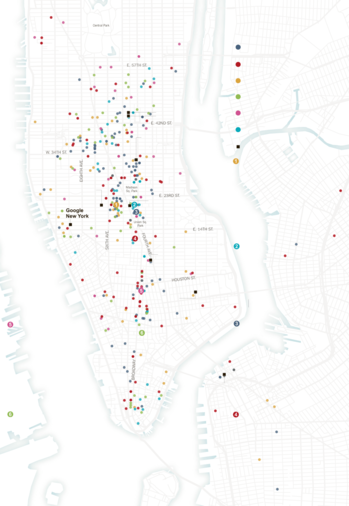
Startups cluster from Broadway to rand Central in midtown, down to SoHo.
Mr. Girouard said that Google Apps would introduce even more features with Google+ over the next few months. "We're headed to a place where all productivity is inherently social," he said. "Questions like 'What do we do next?' and 'Who needs to make a decision today?' are handled inefficiently now. It's why there are so many meetings in companies." Social networks in business, he said, could be faster, less formal and more efficient.
Social networking "is the next phase of what we're going to do in business," said Mr. Girouard.
-- David Girouard, who runs Google Apps for Business.
Beats have redefined the lowly headphone, as well as how much people are willing to pay for a pair of them. A typical pair of Beats sell for about $300 -- nearly 10 times the price of ear buds that come with iPods. And, despite these lean economic times, they are selling surprisingly fast.
Whether Beats are worth the money is open to debate. Reviews are mixed, but many people love them. The headphones are sleekly Apple-esque, which is no surprise, since they were created by a former designer at Apple. Beats also offer a celebrity vibe and a lot of boom-a-chick-a-boom bass.
So much bass, in fact, that some audio experts say that Beats distort the sound of the music.
"In terms of sound performance, they are among the worst you can buy," says Tyll Hertsens, editor in chief of InnerFidelity.com, a site for audiophiles. "They are absolutely, extraordinarily bad."
Time was, manufacturers marketed high-priced audio equipment by emphasizing technical merits like frequency response, optimum impedance, ambient noise attenuation and so on. The audience was mostly a small cadre of audiophiles tuned to the finer points of sound quality.
But, three years ago, Beats by Dr. Dre set out to change all that by appealing to more primal desires: good looks, celebrity and bone-rattling bass. Annual sales are approaching $500 million, and Beats have transformed headphones into a fashion accessory.
Continue reading "Beats: Dr Dre's fashion accessory for dofus" »
The Steve Jobs who founded Apple as an anarchic company promoting the message of freedom, whose first projects with Stephen Wozniak were pirate boxes and computers with open schematics, would be taken aback by the future that Apple is forging. Today there is no tech company that looks more like the Big Brother from Apple's iconic 1984 commercial than Apple itself, a testament to how quickly power can corrupt.
Apple's rise to power in our time directly paralleled the transformation of global manufacturing. As recently as 10 years ago Apple's computers were assembled in the United States, but today they are built in southern China under appalling labor conditions. Apple, like the vast majority of the electronics industry, skirts labor laws by subcontracting all its manufacturing to companies like Foxconn, a firm made infamous for suicides at its plants, a worker dying after working a 34-hour shift, widespread beatings, and a willingness to do whatever it takes to meet high quotas set by tech companies like Apple.
I have traveled to southern China and interviewed workers employed in the production of electronics. I spoke with a man whose right hand was permanently curled into a claw from being smashed in a metal press at Foxconn, where he worked assembling Apple laptops and iPads. I showed him my iPad, and he gasped because he'd never seen one turned on. He stroked the screen and marveled at the icons sliding back and forth, the Apple attention to detail in every pixel. He told my translator, "It's a kind of magic."
Mr. Jobs's magic has its costs. We can admire the design perfection and business acumen while acknowledging the truth: with Apple's immense resources at his command he could have revolutionized the industry to make devices more humanely and more openly, and chose not to. If we view him unsparingly, without nostalgia, we would see a great man whose genius in design, showmanship and stewardship of the tech world will not be seen again in our lifetime. We would also see a man who in the end failed to "think different," in the deepest way, about the human needs of both his users and his workers.
It's a high bar, but Mr. Jobs always believed passionately in brutal honesty, and the truth is rarely kind. With his death, the serious work to do the things he has failed to do will fall to all of us: the rebels, the misfits, the crazy ones who think they can change the world.
Mike Daisey is an author and performer. His latest monologue, "The Agony and the Ecstasy of Steve Jobs," is scheduled to open at the Public Theater on Tuesday
Gina Trapani, founder of the influential blog Lifehacker, said the business card is already close to extinct in places like tech conventions. "I see people exchange Twitter handles, I see people scan each other's badges," and send one another quick e-mails from their phones, she said. "But I definitely don't see people handing out cards anymore."
An app for the business networking site LinkedIn.com makes it easier to share contacts in person using Bluetooth. Newer sites like Hashable.com, Contxts.com and About.me allow users to create and share virtual business cards.
Continue reading "business card is already close to extinct in places like tech conventions" »
Hany Farid, a renowned expert in forensic photographic image analysis. (Farid was consulted by the Associated Press in debunking the fake Bin Laden death photos, and has also teamed up with Microsoft to develop anti-child-pornography software.) Using compression data and metadata from millions of photos, Farid and his colleagues at Dartmouth have developed a database that matches photos to the digital cameras that took them.
I. 1991-1999: The HTML Age.
The HTML Age was about documents, true to Tim Berners-Lee's original vision of a "big, virtual documentation system in the sky." The web was dominated by static, hand-coded files, which web clients crudely formatted (with defaults that offend even the mildest of typographiles). Static documents were served to static clients.
II. 2000-2009: The LAMP Age.
The LAMP Age was about databases. Rather than documents, the dominant web stacks were LAMP or LAMP-like. Whether CGI, PHP, Ruby on Rails, or Django, the dominant pattern was populating an HTML template with database values. Content was dynamic server-side, but still static client-side.
III. 2010-??: The Javascript Age.
The Javascript age is about event streams. Modern web pages are not pages, they are event-driven applications through which information moves. The core content vessel of the web -- the document object model -- still exists, but not as HTML markup. The DOM is an in-memory, efficiently-encoded data structure generated by Javascript.
LAMP architectures are dead because few web applications want to ship full payloads of markup to the client in response to a small event; they want to update just a fragment of the DOM, using Javascript. AJAX achieved this, but when your server-side LAMP templates are 10% HTML and 90% Javascript, it's clear that you're doing it wrong.
The reporters had begun preliminary work on the Afghanistan field reports, using a large Excel spreadsheet to organize the material, then plugging in search terms and combing the documents for newsworthy content. They had run into a puzzling incongruity: Assange said the data included dispatches from the beginning of 2004 through the end of 2009, but the material on the spreadsheet ended abruptly in April 2009. A considerable amount of material was missing. Assange, slipping naturally into the role of office geek, explained that they had hit the limits of Excel. Open a second spreadsheet, he instructed. They did, and the rest of the data materialized -- a total of 92,000 reports from the battlefields of Afghanistan.
The reporters came to think of Assange as smart and well educated, extremely adept technologically but arrogant, thin-skinned, conspiratorial and oddly credulous. At lunch one day in The Guardian's cafeteria, Assange recounted with an air of great conviction a story about the archive in Germany that contains the files of the former Communist secret police, the Stasi. This office, Assange asserted, was thoroughly infiltrated by former Stasi agents who were quietly destroying the documents they were entrusted with protecting. The Der Spiegel reporter in the group, John Goetz, who has reported extensively on the Stasi, listened in amazement. That's utter nonsense, he said. Some former Stasi personnel were hired as security guards in the office, but the records were well protected.
Continue reading "Smart and well educated, extremely adept technologically" »
Dan Duncan advocated the "don't get mad, get even" strategy for Yves' Naked Capitalism:
While you sort it out, always include several internal internal links to other posts. As long as you have internal links to your other work, then at least the scraped content will get you deep links to your back pages.
Other technological considerations: Instead of a simple HTAccess denial--ie simply denying access from the offending IP address-- do an HTAccess "re-write". By doing this, you don't block access...rather, you send the asshole "false" content of your choice. It could be a HUGE file of jibberish like "hy^&GBHBDFNLG#$&H%" ...or even better send them "The Best of DownSouth"! ["Please Yves of Naked Cap, we won't ever scrape your site again. Please, just-make-it-stop! We're begging you!"] [Of course, you are more than welcome to send them my commentary as well.]
Or, you could send the scraper into an infinite loop with something like this in HTAccess:
RewriteCond %{REMOTE_ADDR} ^123.123.123
RewriteRule ^(.*)$ http://domain.tld/feed
Replace the IP address with that of the scraper and replace the feed URL with the feed from the scraper's site. That would actually be amusing. If you do this, please let us know what happens.
Here are some other good blacklist options from a helpful site:
perishablepress.com/press/2009/02/03/eight-ways-to-blacklist-with-apaches-mod_rewrite/
Also, beyond the Cease and Desist, you need to file DMCA Reports with the Search Engines.
www.mcanerin.com/EN/articles/copyright-03.asp
And finally, since they are scraping to game Google go to Google:
googlewebmastercentral.blogspot.com/2008/06/duplicate-content-due-to-scrapers.html
Droopy: A Tiny Web Server That Makes Receiving Files a Snap
By SIMON MACKIE of GigaOm
Droopy is a mini web server that's designed to make it easy for you to receive files on your computer -- and is especially useful for those times when a less-than-tech-savvy client wants to send you a large file. Instead of them trying to send the file over IM or FTP, or using a service like Dropbox, just give them your Droopy address and they can upload the file using their browser; it will be saved directly onto your machine.
Droopy runs on Unix (Linux and Mac) and Windows machines. It's a Python script, but don't let that worry you. Although you will need to have Python installed and will have to use the command line,
California spends more than $40 a day per inmate for health care, including expenses for guards who accompany them on visits to outside doctors. NuPhysicia says that this cost is more than four times the rate in Texas and Georgia, and almost triple that of New Jersey, where telemedicine is used for mental health care and some medical specialties.
"Telemedicine makes total sense in prisons," says Christopher Kosseff, a senior vice president and head of correctional health care at the University of Medicine and Dentistry of New Jersey. "It's a wonderful way of providing ready access to specialty health care while maintaining public safety."
Georgia state prisons save an average of $500 in transportation costs and officers' pay each time a prisoner can be treated by telemedicine, says Dr. Edward Bailey, medical director of Georgia correctional health care.
![Reblog this post [with Zemanta]](http://img.zemanta.com/reblog_e.png?x-id=d6a83086-c84f-4c11-a3c2-cd43f5662bcf)
Computer scientists and policy experts say that such seemingly innocuous bits of self-revelation can increasingly be collected and reassembled by computers to help create a picture of a person's identity, sometimes down to the Social Security number.
"Technology has rendered the conventional definition of personally identifiable information obsolete," said Maneesha Mithal, associate director of the Federal Trade Commission's privacy division. "You can find out who an individual is without it."
Carter Jernigan and Behram Mistree analyzed more than 4,000 Facebook profiles of students, including links to friends who said they were gay. The pair was able to predict, with 78 percent accuracy, whether a profile belonged to a gay male.
On Friday, Netflix said that it was shelving plans for a second contest -- bowing to privacy concerns raised by the F.T.C. and a private litigant. In 2008, a pair of researchers at the University of Texas showed that the customer data released for that first contest, despite being stripped of names and other direct identifying information, could often be "de-anonymized" by statistically analyzing an individual's distinctive pattern of movie ratings and recommendations.
pair of researchers that cracked Netflix's anonymous database: Vitaly Shmatikov, an associate professor of computer science at the University of Texas, and Arvind Narayanan, now a researcher at Stanford University.
By examining correlations between various online accounts, the scientists showed that they could identify more than 30 percent of the users of both Twitter, the microblogging service, and Flickr, an online photo-sharing service, even though the accounts had been stripped of identifying information like account names and e-mail addresses.
The blueprint reflects the government's view that broadband Internet is becoming the common medium of the United States, gradually displacing the telephone and broadcast television industries. It also signals a shift at the F.C.C., which under the administration of President George W. Bush gained more attention for policing indecency on the television airwaves than for promoting Internet access.
In a move that could affect policy decisions years from now, the F.C.C. will begin assessing the speeds and costs of consumer broadband service. Until then, consumers can take matters into their own hands with a new suite of online and mobile phone applications released by the F.C.C. that will allow them to test the speed of their home Internet and see if they're paying for data speeds as advertised.
"Once again, the F.C.C. is putting service providers on the spot," said Julien Blin, a telecommunications consultant at JBB Research.
Continue reading "New FCC Puts Performance Before Prudishness" »
CAMERAS TACKLE LOW LIGHT From the beginning of digital-camera time, the rule was: if you want to take no-flash photos in low light, you'd better buy yourself one of those big, black, heavy S.L.R. cameras. Too often, the pocket cameras that make up 90 percent of camera sales produce blurry or grainy shots in low light.
This year, the camera companies finally abandoned their decade-long obsession with megapixels. Instead, several of them began working on things that really count -- like bigger sensors for better pictures.
Panasonic and Olympus teamed up to create the Micro Four Thirds format: coat-pocketable cameras that take near-S.L.R.-quality photos. Fujifilm and Sony released new shirt-pocket models whose redesigned sensors do exceptionally well in low light. And Canon's PowerShot S90 combines an unusually large sensor (for a little camera) and a remarkable lens to produce amazing low-light shots.
Still, even these cameras may someday seem laughably crude; already, high-end cameras like the Canon EOS 5D MKII actually "see" better in low light than you do. Trickle-down theory, do your thing.
Continue reading "Coat pockets vs shirt pockets as benchmarks" »
The Dell Latitude Z's real magic lies elsewhere.
For example, most laptops require brute force and crunching noises before making their way into docking stations. But not the Latitude Z.
It glides onto a shiny, thin platform that fuels the laptop via an inductive charging mechanism much like you would find with a fancy toothbrush that recharges on a stand. The platform then uses wireless communications to link with a small, rectangular docking station that handles a connection to the office network and monitor.
So, the executive looking to impress can buy a wireless mouse and wireless keyboard and then plop the Latitude Z onto the platform, revealing a one-cord (power) wonder. `
But the most impressive feature on the Latitude Z may be the ability to check e-mail, calendar and contact information and to browse the Web via an instant-on software package.
The software fires up the moment you open the laptop and connects right to a wireless network without Windows.
(Under the hood, it's Linux running on top of an ARM chip on a mini-motherboard that provides this quick access feature. You're basically talking about most of the components needed to run an iPhone being hitched to a large battery. So, the computer can run in instant-on mode for days.)
Consumers now buy more PCs than businesses do, and their wants and desires for better-looking devices have invaded the cubicle. The current breed of consumer has shown an ability to turn something like the Apple iPhone into an overnight sensation, then demand that companies embrace it. Google, meanwhile, uses its influential Web search and YouTube properties to introduce people to its e-mail, document and Web browser software, and Facebook now provides inspiration to business software makers.
For Google, winning over consumers is crucial to its strategy of infiltrating corporations and deflating Microsoft's core businesses. "We are the next generation," says Dave Girouard, the president of Google's business products division. "The big difference in technology here is the pace of innovation."
htmlplayground is an interactive demonstration of Hyper Text Markup Language (HTML), the basic technology of web pages.
Seesmic (a start-up led by Loïc Le Meur) is hardly alone. TweetDeck, a budding business of the London engineer Iain Dodsworth, has more than a million users and also blends together Facebook and Twitter feeds. The software sits on the desktop, endlessly churning out both banal and urgent dispatches from everyday life.
SocialScope, a program from Amit Kumar, a former Bear Stearns investment banking analyst, is tailored for BlackBerry phones and lets users check multiple social networks. Though it is only in beta mode, it is already a more full-featured window into the social network than Facebook's own software for the BlackBerry.
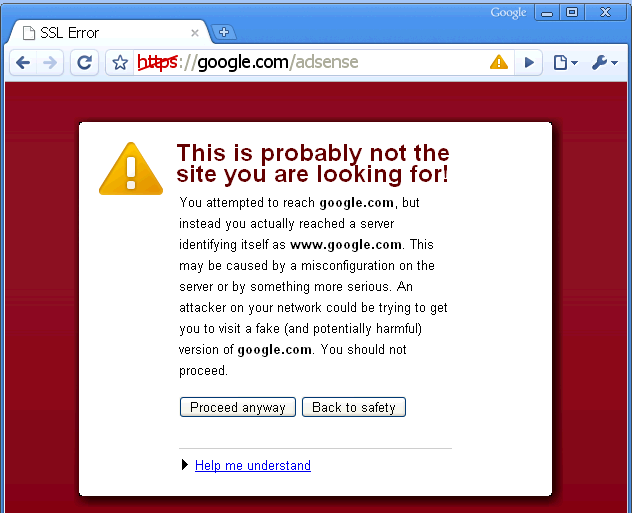
Google.com and www.google.com do not share certificates.
Digital Money Forum keeps on top of electronic payments.
Example: ATM anniversary.
dabble is a uTube for databases.
Example Colbert.
more examples, more
Andy Kessler telcom investing.
Skype (SkypeOut), Vonage E.g.s, Philly WiFi battles Verizon
and Silicon Valley history.
Also in the NYT.
Spreadsheets put on the web by NumSum.
Like Flickr for accountants.
Satelite Radio: Sirius and XM discussion at satelliteguys.us.
Digital radio and Sirius at droxy.
Kimberly 'KC' Claffy measures internet traffic.
Evan Williams, blogging and podcast (Odeo) pioneer.
Rely on RSS, not new tags to find new content: undeniably geeky.
mathforge mathematical computing.
Examples: .
U.S. hostility towards science -- Topic: General Science
By: aklemm (Fri, 28 Oct 05 at 09:23:35 PST)
Causality where none exists -- Topic: Economics
By: aklemm (Mon, 24 Oct 05 at 16:13:26 PST)
Takes up the FBR meme.
Dave Cross, London based perl guy, has long been in my pingoshere.
Picks up on techs trends, not ASAP, but as they start crossing the
chasm. And summarizes them.
Also a fierce advocate for good customer service, with
emphasis on forthcoming non-deceitfulness over pampering.
And lefty local pantser.
Update 2006 Mar 01: Now on OnLamp.
Infoproc (Steve) is a physicist interested in economic inference.
Example: exporting risk, Redmond visit.
An Experiment in A New Kind of Music: WolframTones.
Program and diagram your own ringtones, and more, systematically.
ex-Hip, ex Active Perl guy Dick Hartd now chases marrying privacy
and convenience in a single sign on.
And he appreciates fine cars, travel, and wine.
An excellent presentation at O'Reilly's Open Source 2005.
techdirt is the thinking man's Slashdot. Better editing, thoughtful
exposition, all in the lead paragraph.
Previously: Alterslash is literally a better Slashdot.
The HeyMath platform includes an online repository of questions,
indexed by concept and grade, so teachers can save time in devising
homework and tests. Because HeyMath material is accompanied by
animated lessons that students can do on their own online, it
provides for a lot of self-learning. Indeed, HeyMath, which has been
adopted by 35 of Singapore's 165 schools, also provides an online
tutor, based in India, to answer questions from students stuck on
homework.
Formerly one of the MSM popular press's better technology writers,
bayosphere's Dan Gillmor didn't stay solo for long.
43folders for power users and alpha geeks.
Today's tactical equivalent to Seven habits of highly effective people.

To COMPACTLY store and SPEEDILY manipulate the large
N-dimensional data sets which are the bread and butter
of scientific computing. e.g. $a=$b+$c can add two
2048x2048 images in only a fraction of a second.
Perl Data Language (PDL), PDL::Impatient - PDL for the impatient
A PDL scalar variable (an instance of a particular class of
perl object, i.e. blessed thingie) is a piddle.
Search for stylized facts or for Coruscation at Mozbot, France's prettier Google.
Verification: testing against specifications.
Validation: testing against operating goals.
Mexoryl SX is one of the few sure and stable UVA sun filters. It
provides long-lasting, effective protection due to the virtually
impervious nature of the molecule to the action of solar energy. In the
key field of sun-protection research, Mexoryl SX has been patented by
L'Oréal, and has been used in the Group's sunscreen formulations in
Europe since 1993. Research activities are underway to develop products
that can be introduced to the US market.
When they prescribe sunscreens to patients, dermatologists should
be aware both of the SPF and UVA protection ... that is the main
issue. Americans are probably the worst who are not protected
from the sun and particularly from UVA radiations.
-- André Rougier, Ph.D., Dermatology Times.
Clay Shirky on tagsonomy: tags are cheap reader (not author/editor)
supplied metadata, having (at least) these characteristics:
1. It’s made by someone else
2. Its creation requires very few learned rules
3. It’s produced out of self-interest (Corrolary: it is guilt-free)
4. Its value grows with aggregation
5. It does not break when there is incomplete or degenerate data
And this is what’s special about tagging. Lots of people tag links on
del.icio.us.
Radar O'Reilly buzzes social and open source software, with a
smattering of user empathy.

Another group blog.
Humor columnist Verity Stob, of the former EXE magazine, has brought
her witty, merciless view of software development to Dr. Dobb's Online.
Dan Bricklin: a graybeard of personal computing annotates
conferences and ponders Open Source.

Ask Bjoern Hansen and his notes.
Perl coverage and recent detailed reviews of Mac OS Tiger qualifies
him for my alpha geek blogroll.
Google Blog-o-scoped reviews Google's new search history retention
and recall.
Ben Hammersley, web-centric technology coverage, presentented with
excellent minimalist page layout.
Jon Udell offers pragmatic computer technology reviews with
can-do examples. A favourite writer since Byte magazine.
At O'Reilly, InforWorld index.
Example recorded actual product demos like this Oxygen XML
editor kill vapourware angst of Dan Bricklin's slideshows.
alterslash is the thinking man's Slashdot dump.